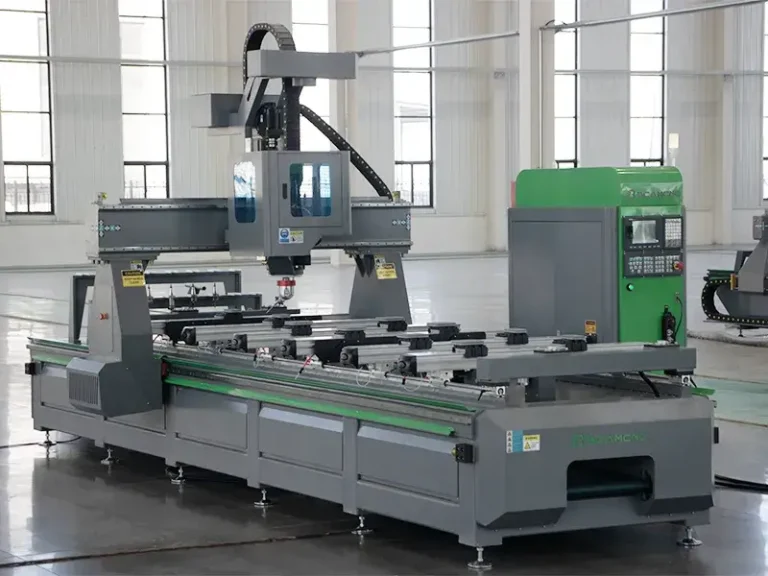

In 15 years of CNC application and field-testing, I have seen countless large-format 5-axis gantries that look impressive on paper but “drift” as soon as they travel across a 3-meter X-axis. After reviewing the latest calibration data for the BCAMCNC BCM2030D—tested with a Renishaw XL-80 Laser Interferometer—the results are clear: X/Y at 0.03mm and Y at 0.03mm, with Z at 0.01mm. For a large-scale gantry, these aren’t just numbers; they are the baseline for industrial-grade reliability.
Technical Depth: From Linear Compensation to RTCP Stability
On a machine of this scale, mechanical perfection is a myth. Pitch error in the ball screws or rack-and-pinion systems accumulates as the travel distance increases. This is where Pitch Error Compensation becomes the “Software Spine” of the hardware. The Renishaw system doesn’t just measure a single point; it builds a comprehensive compensation table that corrects every millimeter of deviation directly within the control system. For production managers, this means that the “invisible seams” in large-scale molds or aerospace composites stay invisible. Without this calibration, you would inevitably see “steps” or witness marks where tool paths overlap, leading to hours of manual sanding and increased labor costs.
The Z-axis reaching 0.01mm is the real “Secret Sauce” for 5-axis simultaneous machining. In RTCP (Rotation Tool Center Point) mode, any Z-axis deviation is amplified by the tilt of the A/C head. A 0.01mm Z-axis precision ensures that the tool tip follows complex 3D contours with absolute depth consistency. This prevents “gouging” during the final pass and ensures a surface finish that often requires zero post-processing. Simply put, this level of Z-axis stability is what allows a machine to transition from a “pattern-maker” to a “mold-maker.”
As an engineer, I must be candid: laser compensation is not a magic wand. While the BCM2030D shows exceptional calibration results, long-term accuracy depends on the machine’s “bones.” The stability seen in these tests relies heavily on the Aging Treatment of the cast-iron base. If the frame hasn’t been properly stress-relieved, even the best Renishaw compensation table will become obsolete within months as the metal settles. Furthermore, in non-climate-controlled shops, operators must account for thermal expansion. BCAMCNC’s ability to hit these numbers in a standard factory environment suggests a robust structural rigidity that can withstand the daily temperature swings of a working production floor.
The era of buying a CNC machine based solely on spindle RPM or motor wattage is over. The BCM2030D’s performance after Renishaw compensation signals a shift toward Metrology-Driven Manufacturing. For factory owners and technical buyers, this data confirms that BCAMCNC is prioritizing the geometric accuracy required for high-stakes contracts. Whether you are trimming carbon fiber or carving precision aluminum molds, having a machine that has been “internally mapped” by a laser interferometer provides a level of peace of mind that standard assembly simply cannot match.