
A cabinet factory can survive with one CNC router. It cannot scale with one.
Most production bottlenecks in cabinet manufacturing are not caused by spindle power, feed speed, or software features. They come from process interruption between machines: boards waiting for drilling, operators re-checking labels, edge banding queues, membrane door rework, or unstable material flow after nesting.
That is why more European furniture manufacturers are no longer purchasing single woodworking machines. They are buying coordinated production lines.
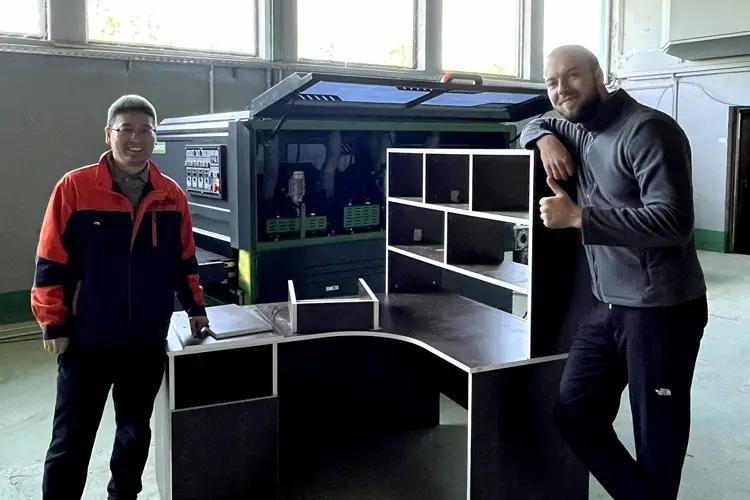
One recent project delivered by BCAMCNC for a European cabinet manufacturer included:
- CNC nesting router BCM2140E
- Automatic loading system
- BCF450DJ edge banding machine
- Six-sided drilling machine
- Curved edge banding machine BCF N700-3
- Double-head hinge boring machine
- Vacuum membrane press
- Wrapping machine
- Polishing machine
- Slitting machine
- Two belt conveyor systems
The customer was not building a “machine collection.”
They were solving three factory-level problems:
- Labor instability
- Production rhythm mismatch between processes
- Margin loss caused by rework and handling time
That distinction matters.
What Actually Breaks a Cabinet Factory Production Flow
Nesting Is Usually Not the Problem
Most factories initially focus on the CNC router because it is visible, expensive, and easy to benchmark.
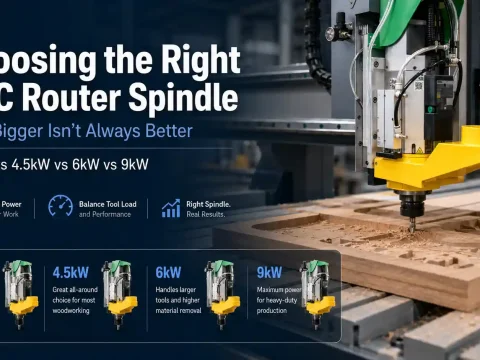
8kW spindle or 12kW?
Italian drill bank or Chinese drill bank?
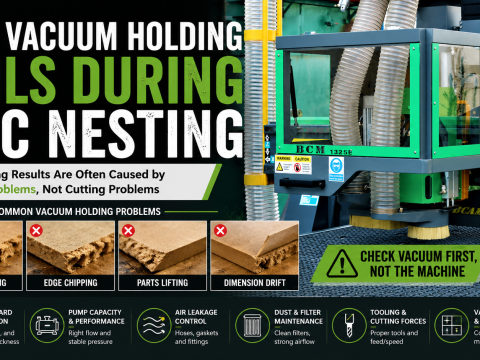
Vacuum table zoning?
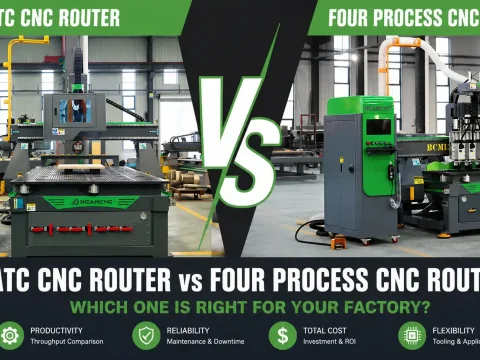
Linear ATC or carousel?
These matter, but after installation, the router rarely becomes the long-term bottleneck.
The real instability usually appears downstream.
A factory may cut 120 sheets during one shift, then suddenly discover:
- edge banding cannot keep pace
- drilling queues are stacking
- operators start manually sorting parts
- membrane doors are delayed waiting for polishing
- curved components require separate handling logic
- small batches destroy process rhythm
At that point, the CNC router is idle half the time anyway.
Factories often underestimate how much production efficiency is lost between machines rather than inside machines.
Edge Banding Decides Whether Your Production Is Stable
Straight edge banding is predictable. Curved edge banding is where many factories quietly lose money.
The BCF450DJ in this project handles standard cabinet panels efficiently:
- PVC edge tape
- ABS edging
- 0.4–3 mm edge thickness
- EVA or PUR adhesive systems
For normal cabinet bodies, that is enough.
But once the factory starts producing:
- curved doors
- radius corners
- custom islands
- irregular decorative panels
manual edge processing starts appearing everywhere.
That changes labor dependency immediately.
The addition of the BCF N700-3 curved edge banding machine suggests this factory was preparing for higher-margin custom work, not only standard modular cabinets.
Factories entering premium cabinet markets usually discover the same thing:
Flat panels are easy to automate.
Special-shaped components are where production planning becomes painful.
Six-Sided Drilling Changes Operator Behavior More Than Most Buyers Expect
Many buyers evaluate six-sided drilling machines by drilling speed alone.
That is incomplete.
The real operational advantage is process consistency.
When factories move from manual positioning or point-to-point drilling into six-sided processing, three things typically happen.
Label dependency increases
Operators stop checking geometry manually and start trusting barcode logic completely.
If label management is weak, production chaos increases instead of decreasing.
Rework becomes more expensive
Incorrect drilling on a cabinet side panel is not only material waste.
It also affects:
- edge banding sequence
- assembly scheduling
- packaging batches
- installation timelines
One drilling mistake can delay an entire kitchen shipment.
Dust extraction quality suddenly matters much more
Poor extraction inside six-sided drilling causes hidden reliability problems:
- sensor contamination
- clamp positioning errors
- hole deviation
- pneumatic instability
Many factories ignore this during purchasing discussions because it is not visually impressive.
Then six months later, maintenance teams spend every weekend cleaning sensors.
The Hidden Cost Nobody Talks About: Material Handling
Most machinery brochures focus on machining.
Factories suffer more from moving boards than cutting them.
This project included:
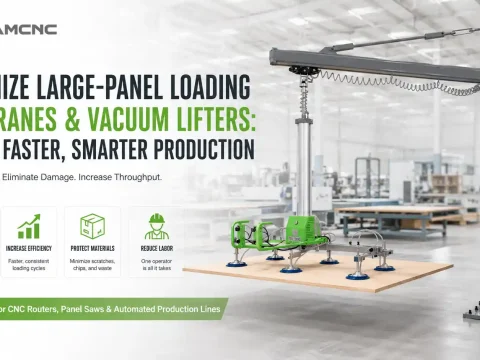
- automatic loading system
- dual belt conveyor systems
That detail is more important than many buyers realize.
A factory running 18 mm MDF, plywood, PET laminated board, and high-gloss panels simultaneously cannot rely on manual handling forever.
Different materials behave differently during transport:
| Material Type | Common Production Issue | Hidden Cost |
|---|---|---|
| High-gloss PET board | Surface scratching during transfer | Rework and customer complaints |
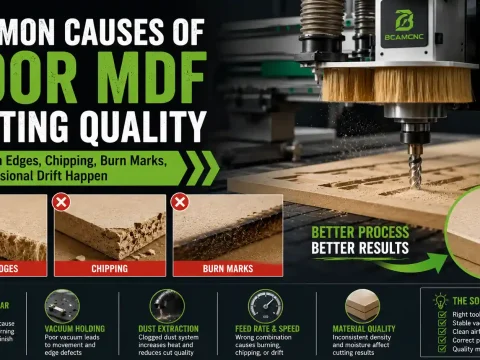
| MDF for membrane doors | Dust contamination before pressing | Lamination defects |
| Plywood | Edge inconsistency | Unstable edge banding quality |
| Thin decorative panels | Conveyor vibration deformation | Positioning errors |
| Curved components | Manual stacking dependency | Labor bottlenecks |
Factories often spend months optimizing cutting parameters while ignoring transport logic entirely.
Then operators start placing foam pads everywhere to protect surfaces.
That is usually the first visible sign the production flow was not designed correctly.
Real Factory Case: Why One European Workshop Reorganized Its Entire Cabinet Line
Challenge
One mid-sized European cabinet manufacturer originally operated with:
- one nesting CNC
- manual loading
- standalone edge bander
- traditional hinge boring workflow
Production volume was acceptable during low season.
Problems started when custom kitchen orders increased.
Not because machine capacity was insufficient.
Because batch fragmentation destroyed workflow rhythm.
Operators constantly switched between:
- white melamine
- wood grain texture panels
- PET gloss boards
- membrane door orders
The factory discovered something uncomfortable:
Their highest-margin products caused the lowest production efficiency.
Attempt
The factory initially tried increasing labor.
That created new problems instead:
- inconsistent drilling accuracy between shifts
- edge banding queues during peak orders
- membrane door rework caused by rushed sanding
- overtime dependency during installation season
Meanwhile, curved cabinet orders interrupted straight-line edge banding continuously.
The factory later realized they were not suffering from insufficient machine speed.
They were suffering from unstable process coordination.
Solution
The eventual solution was not “buying faster machines.”
It was restructuring the production flow around coordinated automation.
That included:
- automatic loading
- process-linked conveyors
- six-sided drilling
- separated curved edge workflow
- dedicated membrane door process
Their production manager later mentioned something many equipment suppliers avoid discussing:
“Cycle time was not our biggest issue. Material confusion was.”
That is extremely common in custom furniture manufacturing.
Membrane Pressing Looks Simple Until Real Production Starts
Vacuum membrane processing looks stable during equipment demonstrations.
Real production behaves differently.
PVC foil response changes depending on:
- ambient temperature
- glue curing consistency
- MDF density variation
- routing depth
- sanding quality
- foil thickness
Experienced factories know that stable negative pressure is non-negotiable.
Most membrane door production lines operate around:
- vacuum pressure ≥ -0.09 MPa
- heating temperature approximately 130°C–150°C depending on PVC foil thickness
- MDF moisture content typically below 8%
If these parameters drift, defects start appearing very quickly:
- corner whitening
- edge lifting
- trapped air
- uneven gloss reflection
- foil rebound after cooling
Factories often blame the membrane press first.
In reality, unstable substrate preparation is usually the root cause.
Poor sanding consistency before pressing can ruin an entire production batch even when the press itself is functioning normally.
Why ROI Calculations Often Fail in Cabinet Equipment Purchasing
Buyers Usually Underestimate Downtime Between Processes
A machine brochure may claim:
- 25 m/min edge banding
- 40 m/min rapid travel
- 18-tool automatic changer
But actual factory throughput depends on:
- queue management
- operator movement
- batch switching
- cleaning frequency
- adhesive changeover
- barcode discipline
- maintenance response time
Production lines fail more often from organizational mismatch than machine weakness.
Cheap Automation Can Increase Maintenance Labor
Some factories buy automation systems purely to reduce headcount.
Then they discover:
- pneumatic systems require stable compressed air
- vacuum pumps need regular filter cleaning
- conveyor sensors become dust-sensitive
- servo synchronization drifts over time
An unstable automation line is worse than semi-manual production because operators stop trusting the system.
In woodworking factories, trust in process stability matters more than theoretical speed.
Membrane Door Production Is Frequently Underestimated
Factories new to PVC membrane doors usually underestimate curing discipline.
For example:
- insufficient adhesive flash-off time can create trapped vapor
- inconsistent routing depth affects foil stretching
- unstable workshop temperature changes membrane behavior
- over-sanding weakens corner adhesion
Factories running multiple foil suppliers also encounter variation in:
- foil elasticity
- heat response
- surface gloss stability
That is why experienced manufacturers standardize material sourcing aggressively once production stabilizes.
What Industrial Buyers Should Evaluate Before Purchasing a Cabinet Production Line
Process Compatibility Matters More Than Brand Mixing
A factory can technically combine machines from five suppliers.
The real question is:
Who takes responsibility when production rhythm breaks?
Most integration problems appear in:
- labeling logic
- conveyor timing
- drilling data compatibility
- maintenance coordination
- software communication
The machine itself is often not the hardest part.
Synchronization is.
Ask About Maintenance Access Before Asking About Speed
Engineers inside factories care about questions salespeople rarely mention:
- How long does glue cleaning take?
- Can operators access pneumatic valves quickly?
- How often must sensors be recalibrated?
- Is local spare-part inventory available?
- What happens if one conveyor motor fails?
These questions determine uptime far more than catalog specifications.
Standardization Reduces Long-Term Operating Cost
Factories producing highly customized cabinets still need standardized internal logic.
That includes:
- panel naming conventions
- barcode rules
- drilling logic
- material routing
- edge tape management
Without process standardization, automation simply moves confusion faster.
FAQ
Is a full cabinet production line suitable for small factories?
Not always.
Factories with unstable order flow or highly inconsistent product types may not benefit immediately from full automation. In some cases, a flexible semi-automatic setup produces better ROI during early growth stages.
Why add a curved edge banding machine separately?
Straight edge banders struggle with irregular geometry and radius components. Manual processing creates inconsistent finish quality and high labor dependency, especially in premium cabinet production.
Does six-sided drilling significantly reduce labor?
Usually yes, but only when barcode management and upstream data preparation are stable. Otherwise, drilling automation can amplify production errors instead of reducing them.
What is often ignored during production line planning?
Material handling.
Factories typically focus on machining specifications while underestimating transfer logic, stacking, sorting, and surface protection during movement between processes.
Is membrane door production difficult to stabilize?
It can be.
Temperature, MDF quality, adhesive behavior, sanding consistency, and foil tension all influence final appearance. Factories without disciplined substrate preparation often experience unstable quality.
A Production Line Should Match the Factory, Not the Catalog
The best cabinet production line is not the one with the longest specification sheet.
It is the one operators can run consistently during peak season without process collapse.
That usually means evaluating:
- production rhythm
- order structure
- labor stability
- maintenance capability
- material mix
- downstream workflow
before evaluating machine speed.
At BCAMCNC, most long-term projects start with production-flow discussion first, machine configuration second.
Because in real factories, machining is only one part of manufacturing.