
Poor MDF cutting quality is one of the most common complaints in cabinet manufacturing, furniture production, and panel processing workshops.
The first reaction is usually the same.
“The machine has lost accuracy.”
In many cases, that assumption is wrong.
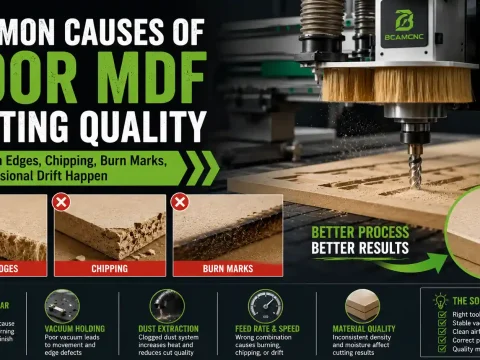
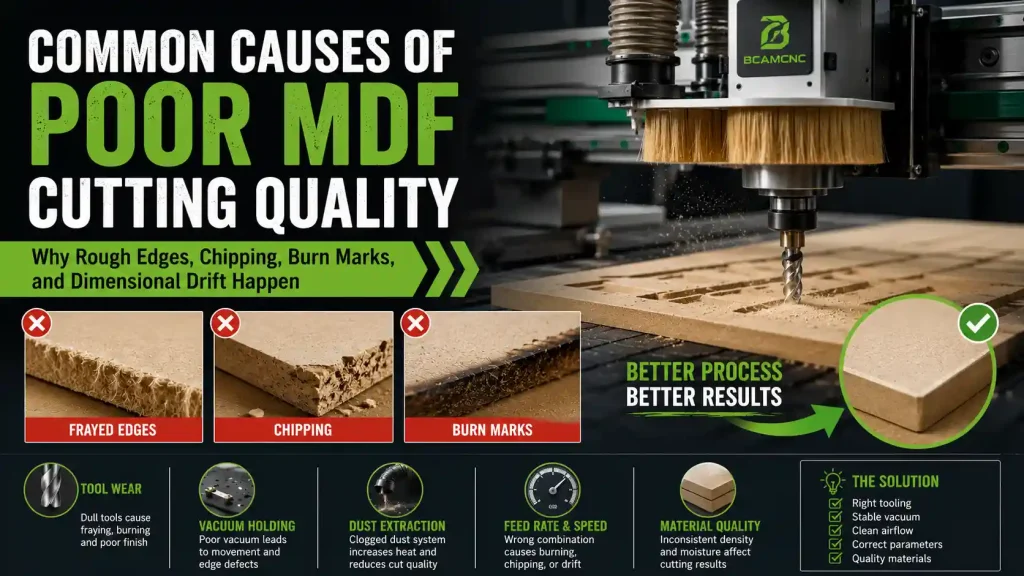
After visiting woodworking factories and troubleshooting production issues for years, I’ve found that rough edges, edge chipping, burn marks, dimensional drift, and poor surface finish are rarely caused by a CNC router suddenly becoming inaccurate. More often, they result from small process failures that gradually accumulate until cutting quality becomes impossible to ignore.
The frustrating part is that many different problems create similar symptoms. A worn cutter, poor vacuum holding, inconsistent MDF density, clogged dust extraction, or improper feed rates can all produce edges that look equally bad.
Replacing the machine is often the most expensive solution to a problem that started somewhere else.
MDF Is Not as Consistent as Most People Think
Many operators treat MDF as a standardized material.
It isn’t.
Even boards with the same thickness can behave differently during machining.
Differences in:
- Density
- Resin content
- Moisture content
- Fiber structure
- Manufacturing quality
all affect cutting performance.
One batch of MDF may produce clean edges throughout an entire shift.
The next batch may begin chipping despite using the same machine, cutter, and program.
In lower-quality boards, internal density variations can cause sections of the sheet to cut differently. Operators often blame machine accuracy when the actual problem exists inside the material itself.
Before changing machine settings, always verify whether the board quality has changed.
Tool Wear Creates More Problems Than Most Operators Realize
A cutter does not need to look damaged to be worn out.
This is one of the most expensive misconceptions in woodworking production.
MDF is highly abrasive because of its resin content and fine fibers.
As the cutting edge gradually wears:
- Heat generation increases
- Surface finish deteriorates
- Tool deflection increases
- Dust production rises
The symptoms usually appear as:
- Fuzzy edges
- Rough sidewalls
- Increased chipping
- Burn marks
- Poor dimensional consistency
Many factories continue using tools beyond their effective cutting life because the tool still appears visually acceptable.
The machine is blamed.
The cutter is the actual problem.
Tool Geometry Matters More Than Many Shops Realize
Different cutters solve different problems.
Using the wrong geometry often creates defects that no amount of parameter adjustment can fix.
Up-Cut Bits
Best suited for:
- Deep pocketing
- Efficient chip evacuation
Potential issue:
- Top edge fraying
Down-Cut Bits
Best suited for:
- Clean top surfaces
- Laminated boards
Potential issue:
- Poor chip evacuation
- Increased heat
Compression Bits
Best suited for:
- Through-cutting MDF
- Double-sided edge quality
Potential issue:
- Witness lines when cutting depth is improperly set
One common mistake occurs when the depth of cut is positioned exactly at the compression transition point of the cutter.
The result is a visible line in the center of the MDF edge.
Many operators assume the spindle is vibrating.
The actual issue is tool geometry interacting with cutting depth.
Vacuum Holding Problems Often Look Like Cutting Problems
Some of the worst edge quality issues have nothing to do with cutting.
They come from movement.
When a sheet moves slightly during machining, symptoms may include:
- Chipped edges
- Rough surfaces
- Dimensional variation
- Poor slot quality
The movement may be invisible to the operator.
The defects are not.
Common causes include:
- Spoilboard leakage
- Dirty vacuum filters
- Damaged gaskets
- Insufficient vacuum capacity
- Excessively worn spoilboards
For MDF nesting applications, vacuum systems commonly operate between approximately:
-0.75 bar and -0.95 bar
depending on machine design, material coverage, and spoilboard condition.
A panel only needs to move a fraction of a millimeter to affect edge quality.
Dust Extraction Is Part of the Cutting Process
Many factories view dust collection as a housekeeping system.
That mindset causes problems.
Dust extraction directly influences cutting quality.
When MDF dust accumulates around the cutter:
- Heat increases
- Chips are recut repeatedly
- Tool life decreases
- Edge quality deteriorates
I’ve walked into shops where the CNC router looked nearly new but produced terrible edge quality.
The root cause was a partially blocked extraction line.
The cutter was repeatedly cutting the same dust and chips.
Operators replaced tools.
Production slowed.
The actual problem was airflow.
Good dust extraction is not optional.
It is part of the machining process.
Feed Rate and Spindle Speed Must Work Together
One of the most common mistakes in MDF processing is attempting to improve quality by increasing spindle speed.
This often makes things worse.
When spindle speed is too high relative to feed rate, the cutter begins rubbing rather than cutting.
The result is friction.
Friction creates heat.
Heat destroys edge quality.
Common symptoms include:
- Burn marks
- Dark edges
- Resin buildup
- Shorter tool life
Many MDF applications operate within spindle speed ranges between approximately:
15,000 and 24,000 RPM
but the correct setting depends on:
- Tool diameter
- Cutter geometry
- Number of flutes
- Feed rate
- Material density
The objective is proper chip formation, not maximum spindle speed.
Collets and Tool Holders Are Often Ignored
A worn collet can create problems that resemble machine vibration.
Many shops replace cutters regularly but ignore the collet.
Over time:
- Clamping force decreases
- Runout increases
- Surface finish deteriorates
Even small amounts of runout can create:
- Chatter marks
- Poor edge finish
- Shortened tool life
Because the defect appears at the cutting edge, operators frequently blame the spindle.
The issue may be sitting inside the tool holder.
The Ghost Tolerance Problem: A Real Factory Example
Several years ago, a cabinet manufacturer contacted us regarding a recurring dimensional issue.
Cabinet side panels were drifting by approximately 0.5 mm.
Management believed the machine had developed a mechanical problem.
The engineering team suspected the rack-and-pinion system.
The maintenance department inspected the machine.
Everything appeared normal.
After further investigation, the issue was traced to MDF storage conditions.
The sheets had been stored near a concrete floor where moisture levels fluctuated significantly.
As the material absorbed moisture, internal stresses changed.
The boards behaved differently during machining.
The machine was accurate.
The material was unstable.
After improving storage conditions and rotating inventory more carefully, the dimensional issue disappeared without replacing any machine components.
The lesson was simple:
Not every tolerance problem originates from the machine.
Common MDF Cutting Defects and Their Likely Causes
| Symptom | Probable Cause | Immediate Action |
|---|---|---|
| Top Edge Fraying | Dull cutter or incorrect geometry | Inspect tool wear, consider down-cut or compression bit |
| Bottom Edge Chipping | Vibration or poor hold-down | Check vacuum system and spoilboard condition |
| Burn Marks | Excessive heat generation | Reduce RPM or increase feed rate |
| Fuzzy Edges | Tool wear or poor chip evacuation | Replace cutter and inspect dust extraction |
| Rough Surface Finish | Vibration or runout | Check collets and tool holders |
| Dimensional Drift | Material movement or unstable MDF | Inspect vacuum system and material storage |
| Witness Line on Edge | Incorrect compression bit setup | Adjust cutting depth |
FAQ
Why does MDF chip during CNC cutting?
The most common causes are worn cutters, improper cutter geometry, vacuum holding problems, or inconsistent board density.
Why are my MDF edges fuzzy?
Fuzzy edges are typically caused by tool wear, poor chip evacuation, or incorrect cutting parameters.
What spindle speed is best for MDF?
There is no universal setting. Many applications operate between 15,000 and 24,000 RPM, but the correct speed depends on tooling and feed rate.
Why does MDF burn during cutting?
Burning is usually caused by excessive heat from an improper feed-to-speed relationship or a worn cutter.
Does MDF quality really affect machining results?
Absolutely. Density, moisture content, resin content, and manufacturing consistency all influence cutting performance.
How often should collets be replaced?
Replacement intervals vary based on usage and operating conditions. Regular inspection for wear and runout is more important than relying on appearance alone.
Before You Blame the CNC Router
When MDF cutting quality starts to decline, the CNC router is often the first thing people suspect.
Most of the time, it should be the last thing investigated.
Before considering a machine upgrade, check:
- Tool condition
- Vacuum performance
- Dust extraction airflow
- Feed rates
- Spindle speed
- Collet condition
- Material storage practices
- MDF consistency
In many factories, the most expensive solution is replacing a machine to solve a problem caused by a dull cutter, a clogged filter, or unstable material.
Good MDF cutting quality is rarely the result of a single high-end machine.
It is usually the result of dozens of small process details working together consistently every day.