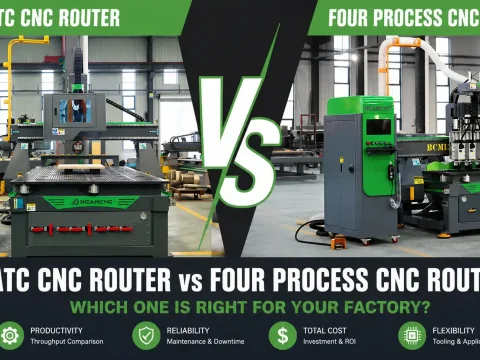

If you’re choosing between an ATC CNC Router and a Four Process CNC Router, machine price is usually not the deciding factor. The real question is how your production floor operates every day.
For factories producing standard cabinet components, wardrobes, and repetitive panel furniture, a Four Process CNC Router often delivers a faster return on investment because it eliminates many of the systems that can create downtime. For shops producing custom furniture, architectural millwork, decorative panels, solid wood components, and mixed-order production, an ATC CNC Router can significantly improve workflow by reducing operator intervention and program limitations.
The mistake many buyers make is comparing spindle power, travel speed, or tool capacity while ignoring where production time is actually lost. In most woodworking factories, the bottleneck is not cutting speed. It is tool management, setup interruptions, and production consistency across an entire shift.
The Real Decision Is Not Speed—It Is Production Stability
After spending years around cabinet factories, furniture workshops, and panel processing lines, I’ve noticed that machine utilization reports rarely tell the whole story.
A machine may show eight hours of operation per day.
That does not mean eight hours of productive cutting.
Operators stop programs.
Tools wear unexpectedly.
Vacuum holding becomes unstable.
Production schedules change.
Tool paths are modified.
Jobs require additional drilling or grooving operations that were not planned originally.
The difference between an ATC CNC Router and a Four Process CNC Router becomes obvious when these everyday production realities start accumulating.
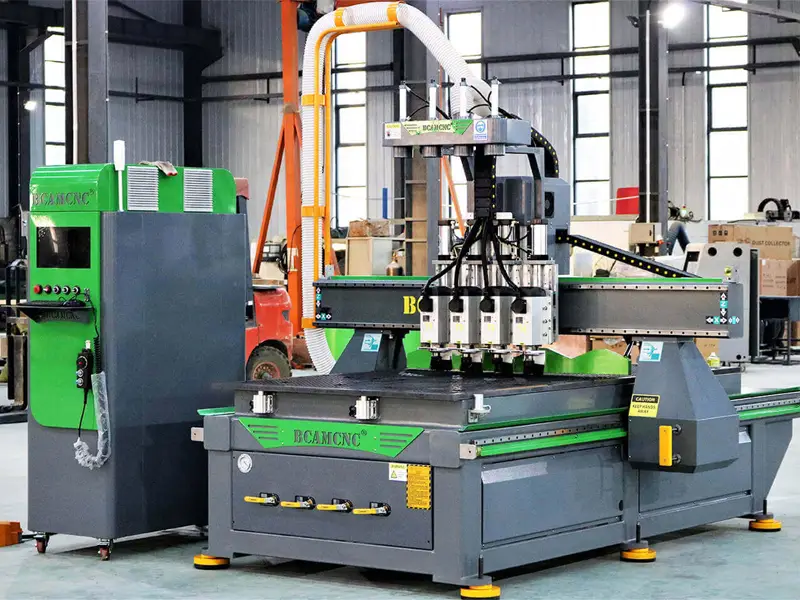
What Is a Four Process CNC Router?
A Four Process CNC Router uses four independent spindles mounted on the machine. Each spindle is assigned a specific tool and operation.
A typical configuration may include:
- Compression cutter for nesting
- Drill bit for vertical holes
- Grooving cutter
- Finishing or trimming cutter
Instead of changing tools automatically, the machine switches between dedicated spindles.
The concept is simple.
There is no tool magazine.
There is no automatic tool changer arm.
There are fewer pneumatic components.
There are fewer sensors.
There are fewer moving parts that require calibration.
For cabinet manufacturers producing the same type of products every day, this simplicity is often an advantage rather than a limitation.
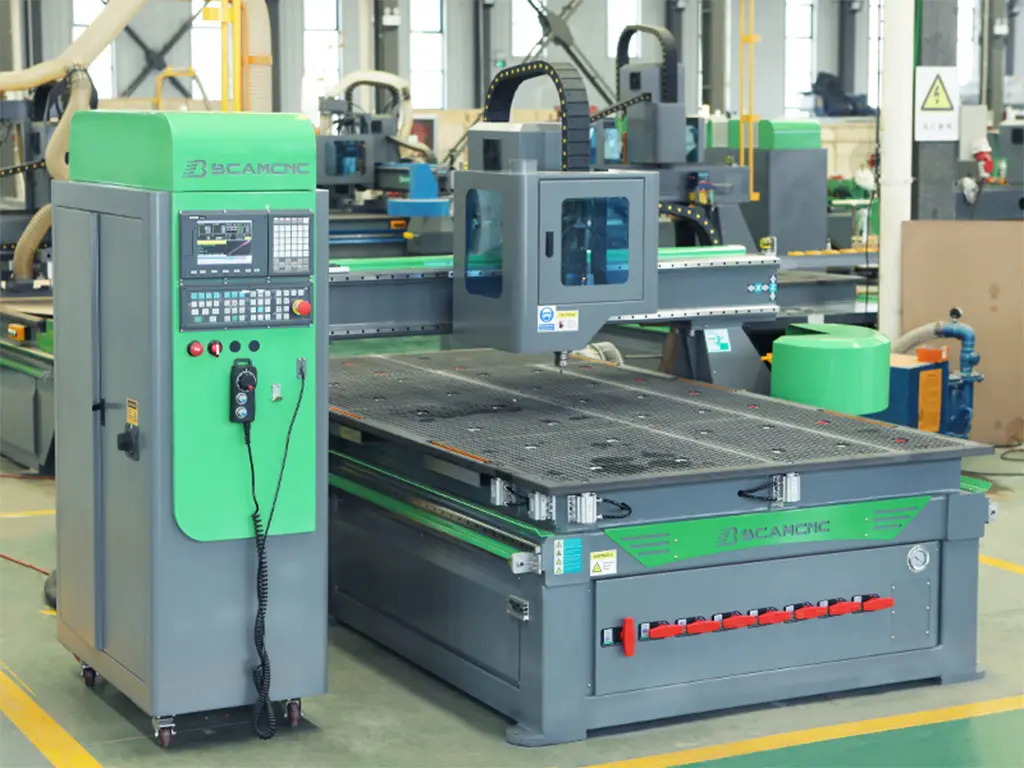
What Is an ATC CNC Router?
An ATC CNC Router uses a single spindle combined with an Automatic Tool Changer system.
Common tool magazine capacities include:
- 8 tools
- 10 tools
- 12 tools
- 16 tools
- 20 tools or more
The machine automatically selects and changes tools according to the machining program.
A typical program may involve:
- Nesting
- Drilling
- Pocketing
- Engraving
- Grooving
- Profiling
without any operator intervention.
For high-mix production environments, this flexibility becomes valuable very quickly.
The benefit is not necessarily faster cutting.
The benefit is uninterrupted workflow.
Comparative Reality Check
| Item | ATC CNC Router | Four Process CNC Router |
|---|---|---|
| Initial Investment | Higher | Lower |
| Tool Capacity | 8–20+ Tools | Fixed 4 Tools |
| Tool Change Method | Automatic | Dedicated Spindles |
| Typical Tool Change Time | 8–15 Seconds | Less Than 2 Seconds |
| Mechanical Complexity | High | Low |
| Maintenance Requirement | Moderate to High | Low |
| Pneumatic Dependency | High | Minimal |
| Production Flexibility | Excellent | Moderate |
| Suitable Daily Output | 30–150 Sheets* | 20–100 Sheets* |
| Best For | Custom Production | Standardized Production |
*Actual output depends on material type, nesting efficiency, part complexity, operator skill, and downstream processes.
The Hidden Costs Most Buyers Never Calculate
When buyers compare quotations, they usually focus on machine price.
The long-term costs are often elsewhere.
An ATC CNC Router requires:
- Tool holders (ISO30 or HSK)
- Pneumatic systems
- Tool sensors
- Tool release cylinders
- Tool magazine maintenance
- Air treatment systems
The tool change process typically requires stable compressed air between 0.6 MPa and 0.8 MPa.
This sounds straightforward.
Until moisture enters the air system.
I’ve seen factories spend days troubleshooting spindle alarms that were ultimately caused by water contamination damaging a pneumatic tool release cylinder.
The spindle was fine.
The air system was not.
An ATC machine is extremely reliable when maintained correctly.
But it expects the supporting systems around it to be equally reliable.
A Four Process CNC Router avoids most of these concerns because the tool-changing mechanism simply does not exist.
Less complexity usually means fewer failure points.
Tool Holders, Runout, and the Cost of Small Mistakes
This is one issue many first-time ATC buyers underestimate.
Tool holders require care.
Dust inside an ISO30 taper.
A damaged retention knob.
Improper tightening.
Even 0.05 mm of runout can create problems:
- Shorter tool life
- Poor edge quality
- Chatter marks
- Increased spindle load
- Inconsistent groove dimensions
The edge-banding department often discovers these problems before the CNC operator does.
A rough edge created during nesting can later cause visible imperfections after edge banding.
The problem started at the CNC router, but the cost appears further down the production line.
That is how hidden manufacturing costs are created.
Where Each Machine Performs Best
ATC CNC Router Applications
An ATC CNC Router typically performs best in:
- Custom furniture manufacturing
- Architectural millwork
- Decorative wall panels
- Stair components
- Solid wood furniture
- Door manufacturing
- Mixed-order production
These applications frequently require multiple tool types and frequent program changes.
Four Process CNC Router Applications
A Four Process CNC Router is often the better choice for:
- MDF cabinet production
- Wardrobe manufacturing
- Closet systems
- Flat-pack furniture
- Repetitive nesting operations
- Batch panel processing
If most jobs use the same four tools every day, the additional flexibility of an ATC system may never generate enough value to justify its complexity.
A Real Factory Example
Several years ago, I worked with a cabinet manufacturer producing custom wardrobes and storage systems.
Their workshop operated two Four Process CNC Routers.
Initially, the machines performed well.
Most products followed standard dimensions.
Most jobs used the same tooling.
Production volume increased.
Customer requests became more complicated.
Soon the engineering department was creating programs that required additional drilling patterns, decorative grooves, special edge profiles, and custom panel machining.
The machines could still complete the work.
The problem was workflow.
Operators were constantly modifying programs and manually adjusting production sequences to fit within the limitations of the four available tools.
Management believed production capacity was the issue.
After reviewing machine utilization data, we discovered something different.
The machines were not spending excessive time cutting.
They were spending excessive time waiting for production decisions.
One Four Process CNC Router was replaced with a 12-tool ATC CNC Router.
Cutting speed barely changed.
Machine uptime improved only slightly.
The biggest improvement came from production planning.
Jobs flowed through the factory with fewer interruptions.
Programming became simpler.
Operators spent less time making decisions at the machine.
Delivery schedules became more predictable.
That predictability ultimately created more value than the additional tool capacity itself.
Common Misunderstandings
“ATC CNC Routers Are Always Faster”
Not necessarily.
For simple cabinet nesting operations, a Four Process CNC Router can often achieve similar or even better cycle times because spindle switching is nearly instantaneous.
The advantage of ATC appears when product complexity increases.
“Four Process CNC Routers Are Only for Small Factories”
Not true.
Many highly profitable furniture manufacturers process large production volumes using Four Process CNC Routers every day.
Their success comes from standardized products and stable workflows.
“ATC Improves Accuracy”
No.
Accuracy comes from machine structure, servo systems, guide rails, rack-and-pinion quality, ball screws, spindle condition, and machine calibration.
ATC improves flexibility and process consistency.
It does not automatically improve tolerance.
FAQ
Will an ATC CNC Router produce more accurate parts?
No. Accuracy is primarily determined by machine rigidity, transmission systems, spindle quality, and calibration procedures. The ATC system only automates tool changes.
What air pressure is required for an ATC CNC Router?
Most systems operate between 0.6 MPa and 0.8 MPa. Stable, clean, dry compressed air is essential for reliable tool changes.
Is a Four Process CNC Router easier to maintain?
Generally, yes. With fewer pneumatic and mechanical systems, maintenance requirements are typically lower.
What vacuum level is recommended for MDF nesting?
Most vacuum pumps operate between -0.75 bar and -0.95 bar, depending on spoilboard condition, sheet size, leakage rate, and material type.
Which machine offers the better ROI?
That depends on production complexity.
Factories producing standardized cabinet components often achieve excellent ROI with a Four Process CNC Router.
Factories handling frequent design changes, custom furniture, and mixed-order production usually benefit more from an ATC CNC Router.
The Decision Most Factories Should Make
Before comparing machine quotations, answer three questions:
- How many different tool types do you use in a typical day?
- How many sheets do you process per shift?
- What percentage of your orders are custom products?
These numbers usually reveal the correct machine long before you start comparing spindle power or machine price.
If your production depends on flexibility, frequent design changes, and multiple tooling operations, an ATC CNC Router will likely remove bottlenecks that a Four Process CNC Router cannot.
If your factory produces the same cabinet components day after day, simplicity often wins.
The machine that generates the highest profit is rarely the machine with the most features.
It is usually the machine that creates the fewest interruptions between raw material and finished product.