
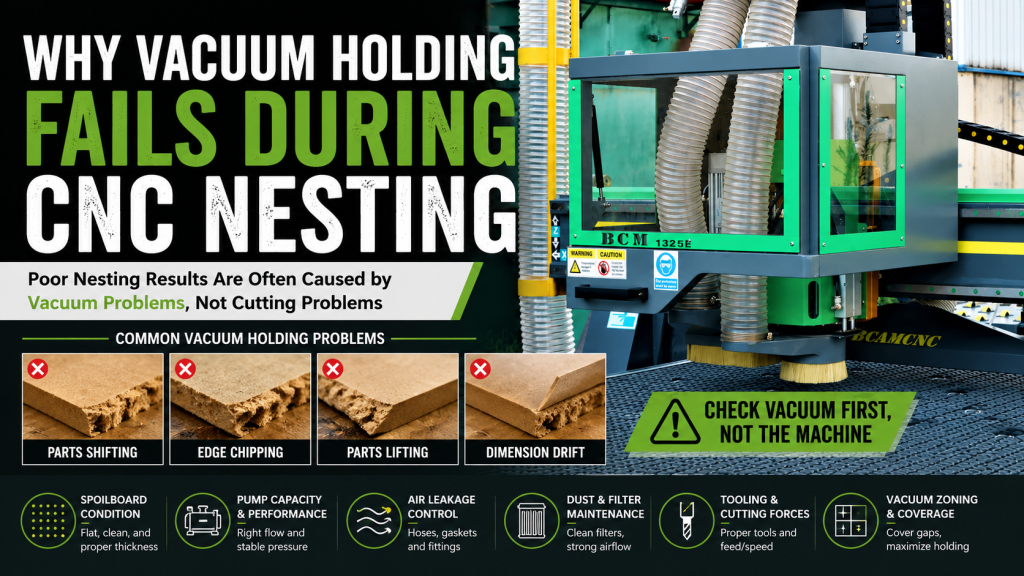
When cabinet parts start moving during a nesting cycle, operators usually blame the cutter.
When dimensions begin drifting, they blame machine accuracy.
When small parts break loose or get pulled into the cutter, they blame programming.
In many factories, all three assumptions are wrong.
The actual problem is often vacuum holding.
After visiting furniture factories and troubleshooting nesting production lines, I have found that vacuum-related issues are among the most misunderstood causes of poor production performance. Vacuum failures rarely stop production immediately. Instead, they gradually increase scrap rates, reduce cutting quality, shorten tool life, and create inconsistencies that operators struggle to explain.
The most frustrating part is that vacuum problems often look exactly like cutting problems.
By the time edge quality begins to deteriorate or dimensions start drifting, the vacuum issue may have existed for weeks.
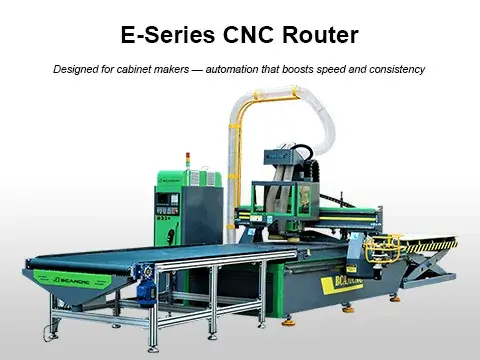
Why Vacuum Holding Matters More Than Many Shops Realize
A nesting CNC router can only cut accurately if the material remains completely stationary.
That sounds obvious.
In practice, the vacuum system is constantly fighting against:
- Cutting forces
- Air leakage
- Material stress
- Spoilboard wear
- Dust contamination
Even extremely small movement can affect production quality.
A panel does not need to visibly slide across the table.
Movement that is barely measurable can still cause:
- Edge chipping
- Rough surfaces
- Poor slot quality
- Dimensional variation
- Assembly fit issues
Many factories focus heavily on spindle power, machine speed, and tooling while overlooking the system responsible for holding every sheet in place.
The Physics Most Operators Never Think About
Vacuum holding is not about suction. It is about maintaining sufficient pressure differential to resist cutting forces.
Every time a cutter enters the material, lateral forces attempt to move the workpiece.
The vacuum system must generate enough holding force to overcome those forces.
When cutting conditions change, the balance changes.
Factors that influence holding performance include:
- Available vacuum pressure
- Effective contact area
- Material permeability
- Spoilboard condition
- Tool geometry
- Feed rate
Many operators respond to movement by increasing vacuum pump capacity.
Sometimes that helps.
Often it does not.
A larger pump cannot permanently compensate for excessive leakage.
The Porosity Trap
MDF is one of the most common sources of vacuum loss.
This surprises many operators.
MDF is widely used because it machines consistently and provides a suitable spoilboard material.
However, MDF is porous.
Air can move through it.
When processing thin panels or lower-density materials, the vacuum system may lose efficiency because air is continuously passing through the sheet itself.
The vacuum pump is not only holding the panel.
It is constantly compensating for air leakage.
This becomes especially noticeable when machining:
- Thin MDF
- Low-density MDF
- Particle board
- Perforated panels
The material itself becomes part of the vacuum equation.
The Spoilboard Is Often the Real Problem
A worn spoilboard can destroy vacuum performance long before operators notice it.
Many shops continue resurfacing spoilboards repeatedly without evaluating their overall condition.
Over time spoilboards become:
- Excessively porous
- Uneven
- Contaminated
- Mechanically weakened
As air leakage increases, vacuum efficiency decreases.
The pump continues running.
Production continues.
Cutting quality gradually declines.
Common symptoms include:
- Small parts moving
- Parts lifting slightly
- Edge chipping
- Reduced dimensional consistency
The spoilboard is often blamed last when it should be checked first.
Vacuum Pumps Do Not Solve Air Leaks
One of the most common misconceptions in nesting production is:
“More pump equals more holding.”
Not necessarily.
If significant leakage exists, a larger pump may simply compensate for losses rather than improve holding force.
Common leakage sources include:
- Damaged vacuum hoses
- Worn gaskets
- Open vacuum zones
- Cracked fittings
- Poor spoilboard condition
Before investing in a larger pump, it is usually worth identifying where vacuum loss is occurring.
Many factories spend thousands upgrading pumps when the actual problem is a few dollars’ worth of maintenance.
Small Parts Create Large Problems
Vacuum holding becomes weaker as nesting progresses.
At the start of a cycle, most of the sheet remains intact.
Vacuum holding is usually strong.
As machining continues, more material is removed.
Cutouts allow additional air to enter the system.
Holding force decreases.
This is why many factories experience problems only near the end of the program.
Typical examples include:
- Cabinet connectors
- Shelf supports
- Drawer components
- Narrow strips
Operators often reduce feed rates to compensate.
Output drops.
Production slows.
The actual issue is frequently vacuum performance rather than cutting speed.
Tool Geometry Directly Affects Holding Stability
Not all cutters generate the same cutting forces.
Tool selection influences vacuum performance more than many operators realize.
Up-cut cutters tend to pull material upward.
This force works directly against the vacuum table.
Down-cut cutters push material downward.
Compression cutters generate more balanced forces when properly applied.
When machining smaller components, tool geometry can determine whether a part remains stable or shifts during cutting.
The machine may be functioning perfectly.
The vacuum system may be functioning perfectly.
The cutter may still create instability.
Dust Is Quietly Reducing Vacuum Performance
Most operators understand that dust affects cutting quality.
Fewer realize that dust also affects vacuum holding.
Fine MDF dust can:
- Restrict airflow
- Contaminate filters
- Block vacuum channels
- Reduce pump efficiency
The problem develops gradually.
Performance slowly decreases.
No alarms appear.
Then one day parts begin moving.
The vacuum system did not suddenly fail.
It has likely been losing efficiency for months.
A Real Factory Example: The Phantom Shift Problem
A cabinet manufacturer contacted us because small parts were moving unpredictably during nesting.
Management initially suspected programming errors.
Operators blamed tooling.
Maintenance personnel inspected the machine and found no mechanical problems.
After testing the vacuum system, the source became clear.
The spoilboard had been resurfaced repeatedly over a long period and had become excessively porous.
Vacuum leakage increased significantly.
At the same time, smaller components were being machined with tooling that generated relatively high lateral forces.
The pump was operating normally.
The machine was operating normally.
The spoilboard had become the bottleneck.
After replacing the spoilboard and adjusting tooling strategy for smaller parts, movement problems disappeared.
No machine upgrade was required.
No programming changes were required.
Production stability improved immediately.
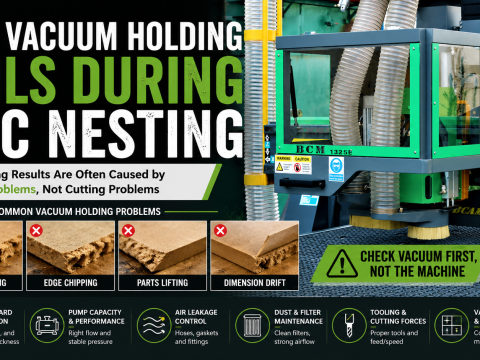
Common Vacuum Holding Problems and Their Likely Causes
| Symptom | Probable Cause | Recommended Action |
|---|---|---|
| Small parts moving | Insufficient holding force | Inspect spoilboard and vacuum zones |
| Edge chipping | Material movement | Check vacuum leakage |
| Inconsistent dimensions | Panel shifting | Verify vacuum pressure |
| Parts lifting during cutting | Poor material contact | Check board flatness |
| Reduced vacuum performance | Filter contamination | Clean or replace filters |
| Poor holding near cycle end | Excessive air entry through cutouts | Consider tabs or onion-skin cutting |
| Pump running continuously | System leakage | Inspect hoses and fittings |
| Excessive scrap rate | Multiple vacuum losses | Perform full vacuum system audit |
Maintenance That Actually Matters
Many shops focus on the vacuum pump and ignore the rest of the system.
The air path matters.
Areas that deserve regular inspection include:
- Spoilboard condition
- Vacuum filters
- Vacuum hoses
- Manifolds
- Vacuum zones
- Gasket integrity
A perfectly functioning pump cannot compensate for poor airflow management.
Good vacuum performance is usually the result of many small maintenance activities performed consistently.
FAQ
Why do small parts move during nesting?
As more material is removed, additional air enters the vacuum system through cutouts. Holding force decreases while cutting forces remain unchanged.
Can a larger vacuum pump solve holding problems?
Sometimes, but not always. Excessive leakage may limit the benefit of a larger pump.
How often should a spoilboard be resurfaced?
The interval depends on production volume, material type, and spoilboard condition. Maintaining a flat and consistent sealing surface is the objective.
Does MDF affect vacuum performance?
Yes. Different MDF products may have different density and permeability characteristics, which can influence vacuum effectiveness.
Does cutter geometry affect vacuum holding?
Yes. Different cutter designs generate different cutting forces that may influence part stability during machining.
Why do parts only move near the end of a program?
As more material is removed, air entry increases and vacuum effectiveness may decrease.
Before You Blame the Machine
When nesting quality begins to decline, many factories immediately investigate:
- Machine accuracy
- Servo systems
- Tooling
- Programming
Those areas deserve attention.
But vacuum holding should often be checked first.
A nesting CNC router can only cut accurately if the material remains stationary.
In many factories, poor nesting results are not caused by machine defects.
They are caused by a vacuum system that has gradually lost the ability to do its job.
Before investing in a larger machine, a more powerful spindle, or new software, inspect the system responsible for holding every sheet on the table.
The solution may be much simpler—and much less expensive—than you expect.