
Why This Machine Exists
Most CNC workshops begin with a standard router built primarily for wood processing. That setup works well until production demands expand. A shop that once cut MDF panels may later need to machine acrylic signage, plastic parts, or even aluminum components for fixtures and brackets.
This shift exposes the limitations of entry-level CNC routers. Manual tool changes interrupt production. Machine frames built for wood begin to struggle with the lateral forces generated during aluminum machining. Surface finish becomes inconsistent when switching between soft materials and non-ferrous metals.
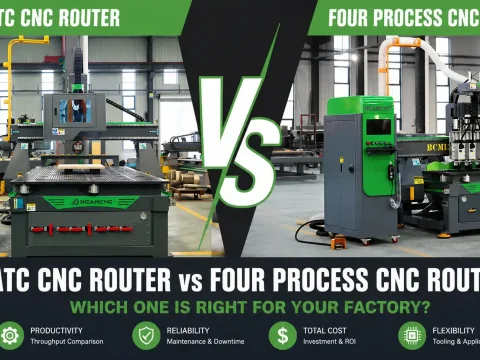
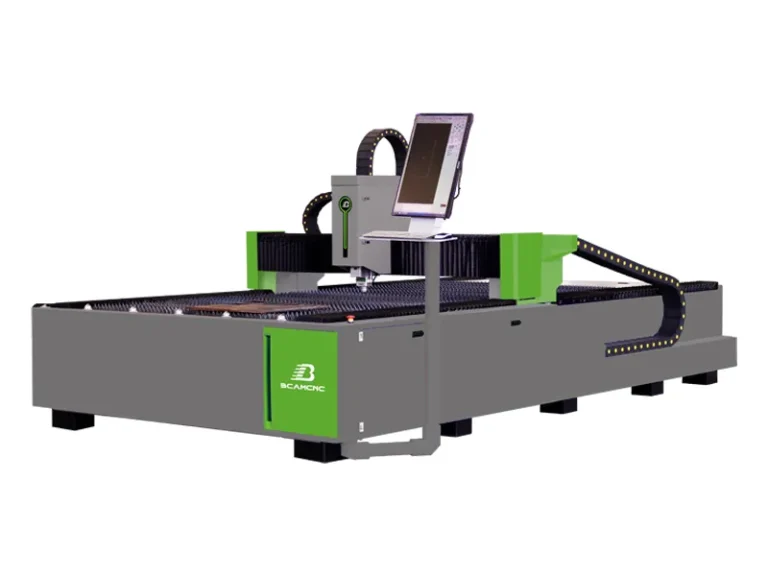
The BCAMCNC C-Series Carousel ATC CNC Router is designed to solve these problems. It is built for manufacturers that require a reliable platform capable of cutting wood, plastics, and aluminum in the same production environment.
At the center of the system is a Carousel Tool Changer that allows automatic switching between multiple cutting tools. Combined with a rigid machine structure, the C-Series functions as a practical ATC CNC Wood Router while maintaining the stability required for controlled CNC Aluminum Cutting.
Technical Breakdown
Carousel Tool Changer: Removing the Tool Change Bottleneck
In real production environments, machining time is rarely the main source of inefficiency. Tool changes are often the larger problem.
A single machining program may require several tools, including roughing end mills, finishing cutters, engraving tools, and aluminum-specific carbide tools. On a manual machine, every tool change forces the operator to pause the program, replace the cutter, reset offsets, and restart the job.
These interruptions reduce machine utilization and increase the risk of operator error.
The Carousel Tool Changer on the C-Series eliminates this bottleneck. Multiple tools are stored in a rotating tool magazine positioned near the spindle. When the program calls for a different tool, the system automatically exchanges the cutter and continues the operation.
This system provides several practical advantages:
Automatic tool switching without operator intervention
Consistent tool length measurement and repeatability
Reduced downtime between machining operations
Continuous multi-step machining within a single program
For shops producing cabinet parts, signage, or mixed-material components, a true ATC CNC Wood Router significantly improves production efficiency.
Structural Rigidity and Frame Stability
Wood routing and aluminum machining place very different mechanical loads on a CNC machine.
Wood cutting typically involves high spindle speeds with relatively low cutting resistance. Aluminum machining introduces stronger lateral cutting forces, particularly during slotting or pocketing operations.
If the machine frame lacks rigidity, these forces create vibration, tool deflection, and inconsistent surface finishes.
The C-Series is built with a heavy-duty structural frame designed to resist torsional flex and lateral stress. This rigidity allows the gantry to remain stable during demanding machining operations.
In practice, this structural stability leads to several improvements:
More consistent cutting accuracy
Reduced vibration during aluminum machining
Improved surface finish on metal parts
Longer cutting tool life
This is particularly important when machining thin aluminum plates where vibration can easily affect the workpiece.
Managing Vibration When Switching Materials
Many workshops underestimate the challenges of switching between materials on the same machine.
A cutting strategy that works well for MDF may produce chatter when applied to aluminum. Acrylic machining may introduce heat buildup if chip evacuation is not properly controlled.
The C-Series addresses these issues through machine rigidity and automated tool management. The Carousel Tool Changer allows the machine to switch instantly between material-specific cutting tools.
Typical tooling combinations include compression bits for MDF, single-flute cutters for acrylic and plastics, and carbide end mills optimized for CNC Aluminum Cutting.
Using the correct cutter for each material significantly reduces vibration and improves overall machining stability.
Material Processing Performance
MDF and Engineered Wood Panels
Furniture manufacturers and cabinet producers often require high-speed panel processing. MDF machining involves long toolpaths and continuous cutting loads.
The rigid frame of the C-Series maintains stability across large sheet processing tasks. The machine supports efficient pocketing, slotting, and contour cutting while maintaining consistent edge quality.
Acrylic and Plastic Machining
Acrylic requires a different approach compared to wood. Excessive heat can cause melting or edge deformation.
The C-Series allows precise control over spindle speed and feed rate, enabling clean chip evacuation and smooth edge finishing. With the appropriate cutting tools, acrylic panels can be processed with minimal post-processing.
Aluminum Machining Capability
Although routers are traditionally associated with wood, many manufacturers require occasional aluminum machining.
The structural stability of the C-Series allows reliable CNC Aluminum Cutting for applications such as brackets, mounting plates, fixture components, and industrial panels.
The Carousel Tool Changer makes it possible to perform both roughing and finishing operations in a single program without manual intervention.
Operational Efficiency in Mixed-Material Production
One of the practical advantages of the Carousel Tool Changer is improved workflow management.
Operators can preload multiple tools into the magazine and run different machining programs without stopping the machine for manual tool replacement.
This allows shops to process different materials throughout the day while maintaining consistent production flow.
For mixed-material workshops, this flexibility reduces idle time and simplifies job scheduling.
Return on Investment Considerations
From a business perspective, the value of the C-Series is not limited to machining speed. Its main benefit is the reduction of operational bottlenecks.
Automatic tool changes reduce downtime and improve machine utilization. The rigid machine structure ensures consistent part quality when machining both wood and aluminum.
More importantly, the machine expands the range of work a shop can accept. Manufacturers that previously limited their routers to wood processing can begin producing aluminum components without investing in a dedicated metal machining center.
Conclusion
The BCAMCNC C-Series Carousel ATC CNC Router is designed for workshops that require stability, flexibility, and consistent machining performance across multiple materials.
With its heavy-duty frame, automated Carousel Tool Changer, and ability to process wood, plastics, and aluminum, the machine provides a reliable solution for mixed-material production environments.
Rather than focusing on marketing claims, the real strength of the C-Series lies in predictable performance. For manufacturers operating in real production conditions, that reliability is often the most valuable feature a machine can provide.