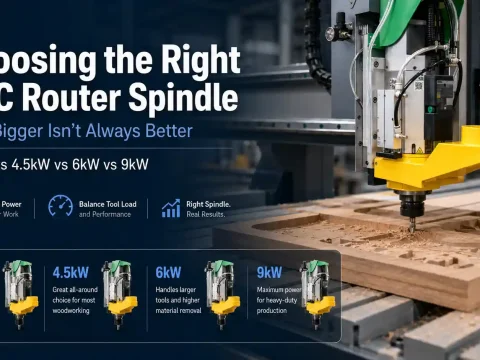

If you are buying a CNC router spindle only because it has the highest kW rating, you may be paying for extra weight, extra heat, higher power consumption, and more maintenance without getting better daily output. In many woodworking and panel processing shops, the real problem is not a weak spindle. It is a mismatch between spindle power, tool diameter, feed rate, material thickness, vacuum holding, gantry rigidity, dust extraction, and the way operators actually run the machine every day.
A bigger spindle can help when the machine is built for it and the cutting load requires it. But if the rest of the CNC router system cannot use that power, the result may be vibration, poor edge finish, faster tool wear, heavier Z-axis load, unstable cutting, and more rework at sanding, edge banding, painting, or assembly.
For most buyers, 3.2kW, 4.5kW, 6kW, and 9kW should not be seen as “small to large” only. They should be seen as different production choices.

Why spindle power is often misunderstood
A CNC router spindle does not work alone. It is part of a cutting system.
The spindle rotates the tool. The tool removes material. The gantry carries the cutting load. The Z-axis handles vertical movement and tool pressure. The vacuum table or fixture holds the part. The dust collector removes chips. The operator decides RPM, feed rate, cutting depth, tool life, and when to stop pushing a dull cutter.
If one link is weak, a larger spindle will not fix the process.
A 9kW spindle with poor workholding can still move small parts during the final pass. A 6kW spindle with weak dust extraction can still recut chips inside the groove. A 4.5kW spindle with a worn collet can still leave visible marks on the edge. A 3.2kW spindle with sharp tools, stable vacuum, and correct parameters may produce cleaner parts than a poorly maintained high-power machine.
This is why experienced production people do not ask only, “How many kilowatts is the spindle?”
They ask:
What material do you cut most often?
What thickness is your daily work?
What cutter diameter do you use?
How many hours per shift will the machine run?
Is the next process sanding, edge banding, painting, assembly, or mold finishing?
Does your operator understand feed rate, RPM, chip load, and tool wear?
Can your vacuum table hold the part under the cutting force you want to use?
The spindle decision affects more than the CNC router. It affects the next process and the real cost of each finished part.
3.2kW spindle: efficient for lighter and moderate work
A 3.2kW spindle is not a weak choice when the application is correct.
It can be practical for sign making, acrylic cutting, PVC board, light MDF engraving, plywood cutting, decorative panels, small furniture parts, and workshops that do not run aggressive cutting all day. It is lighter on the Z-axis, easier to manage, and usually more economical to maintain than larger spindle options.
For light to moderate 18 mm board processing, a 3.2kW spindle can be enough if the tool, vacuum holding, feed rate, and cutting depth are well matched. But it should not be described as the automatic best choice for high-volume cabinet nesting. If a factory cuts 18 mm MDF or particle board continuously for long shifts, 4.5kW or 6kW may give more stable production margin.
Where 3.2kW works well
3.2kW is suitable when the shop mainly cuts light boards, acrylic, PVC, plywood, MDF panels, advertising materials, or small-batch woodworking parts. It is also a reasonable choice when the cutting depth is moderate and the buyer values lower operating cost and simpler maintenance.
Where 3.2kW becomes risky
The risk appears when the shop expects fast, deep, continuous cutting in dense MDF, hardwood, thick plywood, or large production batches. The spindle may still cut, but the operator may need to reduce feed speed or cutting depth. That protects the tool, but it increases cycle time. If feed becomes too slow while RPM remains high, wood edges may burn and plastic chips may melt.
In that situation, the machine is not really saving money. It is moving cost into longer production time, shorter tool life, and extra finishing work.
4.5kW spindle: the practical middle ground for many workshops
For many cabinet shops, furniture factories, door panel producers, and sign-making workshops, 4.5kW is often the most balanced spindle choice.
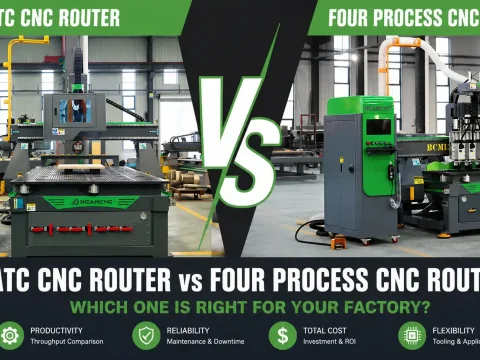
It has enough power for common CNC router work such as MDF cabinet parts, plywood panels, particle board, acrylic, PVC, MDF door carving, light solid wood components, and mixed woodworking jobs. It also fits many ATC CNC router configurations because it gives a useful balance between power, spindle weight, tool flexibility, maintenance cost, and machine responsiveness.
A 4.5kW spindle is not just a compromise. In many factories, it is the correct production choice.
Why 4.5kW is often selected
This spindle size can usually handle common woodworking tools and medium-duty cutting without making the machine unnecessarily heavy. It gives more cutting margin than 3.2kW, especially when the shop moves from light engraving into profiling, cabinet parts, door designs, or regular panel processing.
It is also easier for operators to manage than an oversized spindle. The machine remains more responsive during frequent Z-axis movement, tool changes, drilling, profiling, and detailed cutting.
Where 4.5kW may not be enough
If the factory regularly cuts thick hardwood, uses large-diameter tools, runs deep 3D relief work, processes heavy foam molds, or wants more aggressive material removal, 4.5kW may become limiting. The operator may need more passes or lower feed speed to keep the cut stable.
That is not a failure. It simply means the production demand has moved into a heavier spindle range.
6kW spindle: useful power when the cutting load is real
A 6kW spindle starts to make sense when the job requires stronger cutting capacity and longer duty cycles.
It is suitable for heavier MDF processing, thicker plywood, solid wood parts, deep relief carving, larger cutters, foam molds, tooling board, and some light aluminum work when the CNC router is designed for that application. It gives more margin under load and allows the machine to stay more stable when cutting resistance increases.
But 6kW also exposes weak points faster.
If the spoilboard leaks, the vacuum zones are not closed correctly, the tool is dull, the collet is worn, or the dust collector cannot clear chips, a stronger spindle will not solve the problem. It may make the problem more expensive.
What must support a 6kW spindle
A 6kW spindle should be matched with a rigid frame, stable gantry, strong Z-axis structure, suitable inverter, proper tool holders, good collets, reliable vacuum holding or fixtures, and strong dust extraction.
The operator also needs to understand the relationship between feed rate, spindle speed, cutting depth, tool diameter, and material behavior. Without that, the extra power becomes easy to misuse.
Typical 6kW production logic
A factory should consider 6kW when daily production really requires more cutting margin. For example, thicker boards, harder wood, deeper passes, larger tools, mold materials, or longer shifts can justify the upgrade.
It should not be selected only because it looks safer on paper.
9kW spindle: heavy-duty power for the right machine
A 9kW spindle is not wrong. It is just often selected for the wrong reason.
It can be useful for heavy-duty CNC router applications, large tools, thick solid wood, heavy nesting, large foam molds, tooling board roughing, composite machining, and certain non-ferrous metal applications when the machine structure is built for that load.
But a 9kW spindle asks more from the whole machine.
It is heavier. It creates more inertia. It places more demand on the gantry, Z-axis, spindle mount, inverter, electrical system, cooling, tool holder, vacuum table, and operator. On a standard-duty CNC router, a heavy spindle may reduce dynamic response. In detailed cutting, frequent lifting, drilling cycles, corner machining, or small tool work, the machine may need to slow down to maintain stability.
That means a larger spindle does not always reduce cycle time.
When 9kW makes sense
A 9kW spindle should be considered when the factory has real heavy-duty cutting demand, enough machine rigidity, suitable workholding, proper electrical supply, and operators who can manage cutting parameters safely.
It may be suitable for heavy solid wood, large mold work, large-diameter tools, long production shifts, and specific industrial applications where the cutting load truly requires it.
When 9kW becomes a burden
If the factory mainly cuts 18 mm particle board, MDF cabinet panels, acrylic, PVC, or standard sheet materials, 9kW may add cost without improving daily output. The buyer may pay for higher power capacity, more weight, more heat, and stricter maintenance while the real bottleneck remains toolpath efficiency, vacuum holding, sanding, edge banding, or operator habits.
Do not buy 9kW for a “maybe one day” job if your daily production does not need it. 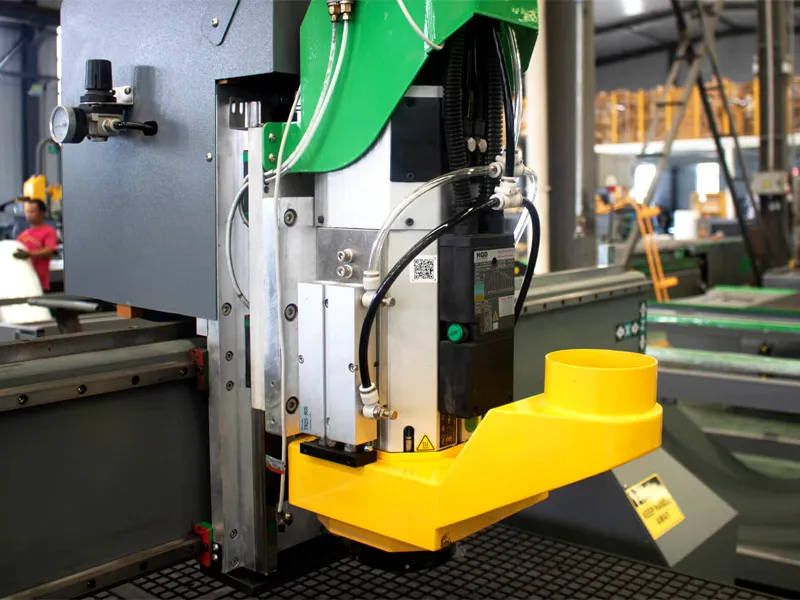
Spindle power comparison for CNC router buyers
| Spindle Power | Best-Fit Work | Typical Materials | Production Advantage | Hidden Cost or Risk | Practical Advice |
|---|---|---|---|---|---|
| 3.2kW | Light to moderate cutting, engraving, sign making, small-batch woodworking | MDF, plywood, acrylic, PVC, light plastics | Lower cost, lighter Z-axis load, easier daily management | Slower cycle time if forced into heavy cutting; heat problems if feed is reduced too much | Choose it for light-duty and moderate work, not heavy continuous nesting |
| 4.5kW | General woodworking, cabinet parts, MDF doors, mixed workshop jobs | MDF, plywood, particle board, acrylic, PVC, some hardwood | Balanced power, weight, cost, flexibility, and maintenance | May be limited for large tools, thick hardwood, or aggressive roughing | Often the safest choice for mixed woodworking and cabinet shops |
| 6kW | Heavier woodworking, thicker boards, deep carving, foam molds, tooling board | MDF, hardwood, solid wood, foam, tooling board, light aluminum with proper setup | Better stability under load and more cutting margin | Requires stronger machine structure, vacuum, dust extraction, and tool management | Choose it when the daily cutting load justifies the extra power |
| 9kW | Heavy-duty cutting, large tools, large-format machining, demanding production | Thick solid wood, large foam molds, composites, non-ferrous materials depending on machine design | High removal potential on a properly built machine | More weight, heat, power demand, crash risk, and maintenance discipline | Use it only when production demand and machine rigidity support it |
The real production limits are often outside the spindle
Many customers blame the spindle when the real problem is somewhere else.
Vacuum holding
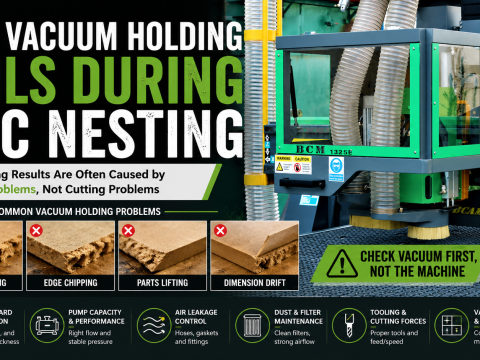
A stronger spindle creates more cutting force. If the vacuum table cannot hold the part firmly, the workpiece may shift during the final pass. This is common in small cabinet parts, nested MDF sheets, thin plywood, and jobs where unused vacuum zones are left open.
A new spoilboard may hold well. After weeks of cutting, dust, grooves, uneven resurfacing, and poor sealing reduce vacuum performance. If the operator does not maintain the spoilboard or close unused zones, more spindle power will not improve production. It may only create scrap faster.
Tool condition
A dull cutter makes any spindle look underpowered. MDF and particle board are abrasive. Plywood has glue lines and density changes. Solid wood changes with grain and moisture. If the shop has no tool replacement rule, operators often keep using cutters until the edge quality becomes unacceptable.
By then, the CNC router has already created extra sanding and finishing work.
Collet and tool holder condition
Poor collet condition can damage edge quality and reduce tool life. Excessive runout makes the tool cut unevenly. One flute may work harder than the other. Small-diameter carbide tools become more vulnerable. Surface finish becomes less stable.
Collets should be treated as consumable precision parts, not permanent accessories.
VFD and electrical cabinet heat
The spindle and inverter should be matched as a system. A higher-power spindle needs a suitable VFD and proper electrical cabinet ventilation. If the cabinet is hot, dusty, or poorly ventilated, thermal alarms may stop the machine during long jobs.
This kind of fault often appears after several hours of operation, not immediately after startup. That is why it can be hard for a new buyer to diagnose.
Compressed air for ATC systems
For ATC CNC routers, compressed air quality is critical. Many automatic tool change systems require clean and dry air, often around 0.6–0.8 MPa depending on the spindle and machine design. The exact value should follow the machine manual.
Low pressure can cause tool-change faults. Moisture can shorten pneumatic component life. Dirty air creates small problems that become repeated downtime.
This is related to ATC and pneumatic systems, not to air-cooled spindle cooling itself.
Dust extraction
More material removal creates more chips and dust. If chips stay inside the groove, the cutter recuts them. Heat rises. Edge quality drops. Fine MDF dust also contaminates machine parts, sensors, tool holders, and linear motion components.
For MDF, plywood, and particle board, dust extraction is not a small accessory. It is part of the cutting process.
Material behavior changes the spindle decision
The same spindle power behaves differently on different materials.
MDF and particle board
MDF is predictable, but abrasive. It wears tools faster than many new buyers expect. Particle board can also create unstable edge quality if the tool is dull or the feed rate is wrong.
For light MDF work, 3.2kW can be enough. For regular cabinet production, MDF doors, and continuous sheet processing, 4.5kW or 6kW is usually more practical. The final decision depends on board thickness, tool diameter, cutting depth, daily production hours, and required edge finish.
Plywood
Plywood is less consistent than MDF. Glue layers, internal voids, and density differences affect cutting load. The spindle may sound stable for most of the sheet, then suddenly change tone when it reaches a hard glue layer.
For general plywood furniture parts, 4.5kW is often a reasonable choice. For thicker plywood, faster production, or larger tools, 6kW gives more margin.
Solid wood
Solid wood is not one material. Oak, beech, pine, rubberwood, walnut, teak, and other woods behave differently. Moisture content also changes cutting resistance. A board stored in a humid workshop does not cut the same as a dry board.
For moderate solid wood carving and furniture parts, 4.5kW can work. For heavier cutting, larger tools, or longer shifts, 6kW is usually more comfortable. A 9kW spindle should only be considered when machine structure, fixture strength, and production volume justify it.
Acrylic and PVC
Plastic processing is more about heat control than spindle power. If RPM is too high or feed is too slow, chips may melt or smear. A larger spindle does not solve that.
For acrylic, PVC, and advertising materials, 3.2kW or 4.5kW is often enough. Tool geometry, chip evacuation, and correct feed rate matter more.
Foam and tooling board
Foam does not require high cutting force, but large molds may need long tools, smooth motion, large working size, and long running time. Tooling board may require more stable cutting depending on density and toolpath.
For foam molds and tooling board, 4.5kW or 6kW is common. Larger spindle options should be based on tool diameter, material density, cutting depth, and duty cycle.
Aluminum and non-ferrous materials
Aluminum cutting on a CNC router requires caution. Power alone does not make a router suitable for aluminum. Machine rigidity, chip evacuation, tool coating, feed rate, spindle speed, cooling method, and fixture strength decide the result.
A 6kW spindle can be suitable for light aluminum work on a properly designed CNC router. A 9kW spindle may be used for heavier non-ferrous applications, but only when the entire machine is built for that load.
A router should not be treated like a vertical machining center unless the structure, spindle, drive system, and process design support that type of work.
Spindle power and downstream cost
Cutting success should not be judged only at the CNC table.
A part that leaves the router with rough edges may slow down sanding. A cabinet panel with chipped edges may create problems at the edge banding machine. An MDF door with torn fibers may show defects after painting. A plastic part with melted chips may need rework. A part that moves during cutting may fit poorly during assembly.
The spindle choice affects all of these downstream processes.
If a 6kW spindle allows faster cutting but creates more vibration, the shop may lose time later in finishing. If a 3.2kW spindle keeps purchase cost low but forces slow production, delivery risk increases. If a 9kW spindle increases maintenance load without improving daily sheet output, the extra investment is not working.
The right question is not, “Which spindle is strongest?”
The right question is, “Which spindle gives stable parts to the next process at the lowest total cost?”
Accuracy, tolerance, and ISO thinking in the real workshop
Machine accuracy is often discussed using standards such as the ISO 230 series, which is commonly referenced for machine tool testing and evaluation. That kind of testing is useful, but factory production is affected by more than a test report.
In real CNC router work, tolerance depends on machine structure, tool runout, collet condition, material movement, vacuum holding, thermal change, tool deflection, spoilboard flatness, and operator setup.
A stronger spindle does not automatically improve accuracy. If the spindle is too heavy for the machine structure, dynamic performance may become worse. If the cutting force is too high for the fixture, the part may move. If the tool is too long, it may deflect. If the collet is worn, the cut will not be stable.
For woodworking and panel processing, practical repeatability matters more than an impressive number in isolation. The machine must produce stable parts every day, not only during acceptance testing.
If a project has a tight tolerance requirement, such as detailed plastic parts, aluminum components, mold work, or precise assembly parts, spindle power should be discussed together with machine rigidity, tool length, fixture design, tool holder accuracy, and inspection method.
Case study: the furniture shop that bought too much spindle
A furniture factory selected a 9kW spindle for a new CNC router because the owner wanted room for possible future solid wood work. On paper, the decision looked safe.
In daily production, however, most jobs were 18 mm particle board and MDF cabinet panels. The machine spent most of its time cutting sheets, drilling holes, profiling panels, and preparing parts for edge banding. Heavy solid wood work was rare.
After some time in production, the factory noticed that the large spindle did not bring the expected advantage for normal sheet processing. The heavier spindle system required more attention from operators and maintenance staff. The machine was not always as responsive during jobs with frequent Z-axis movement, small details, and repeated drilling cycles. The real bottlenecks were not spindle power. They were toolpath efficiency, spoilboard maintenance, vacuum zoning, cutter replacement timing, and edge quality before edge banding.
The factory later reviewed the process and moved toward a more suitable spindle configuration for its main sheet-processing work. The change was not about using the smallest spindle possible. It was about matching the machine to the work that actually paid the bills every day.
The lesson is simple: do not let rare future jobs decide the configuration for daily production.
How to choose the right spindle power before ordering
Before selecting 3.2kW, 4.5kW, 6kW, or 9kW, review the production situation in a practical way.
Start with the work that pays the bills
Do not choose spindle power based on a material you may cut a few times a year. Look at the main orders, the most common material, and the parts that fill the machine schedule every week.
Check material and thickness
18 mm MDF, 25 mm hardwood, 6 mm acrylic, 50 mm foam, and aluminum plate are not the same cutting problem. Thickness, density, chip behavior, and required edge finish all change the spindle decision.
Confirm tool diameter
Small tools do not benefit much from oversized spindle power. Large tools require stronger torque, better clamping, more rigid structure, and safer programming.
Check the machine structure
The gantry, Z-axis, spindle mount, servo system, and frame must support the spindle. A heavy spindle on a standard-duty gantry may reduce dynamic performance instead of improving productivity.
Check workholding
Vacuum table, spoilboard condition, sealing, clamps, pods, and fixtures decide whether cutting force can be used safely. If the workpiece cannot stay fixed, more power only creates scrap faster.
Check dust extraction
Higher removal rates produce more chips and dust. If extraction is weak, edge quality, tool life, and machine maintenance will suffer.
Check operator skill
A high-power spindle requires proper parameter control. Wrong feed rate, wrong RPM, excessive cutting depth, dull tools, or poor tool clamping can damage parts quickly.
Check service and replacement availability
For production factories, downtime is part of cost. Spindle brand, bearing service, inverter matching, spare parts, and technical support should be included in the purchase decision.
FAQ
Will a bigger spindle make my CNC router cut faster?
Only if the current spindle is the real bottleneck. If feed rate is limited by tool strength, workholding, machine rigidity, chip evacuation, or edge quality, a bigger spindle will not automatically reduce cycle time.
Is 3.2kW enough for 18 mm MDF?
It can be enough for some 18 mm MDF work, especially with correct tools, stable vacuum, proper feed rate, and moderate cutting depth. For continuous cabinet production or faster nesting, 4.5kW or 6kW is often more practical.
Is 4.5kW the best choice for cabinet making?
For many cabinet shops, 4.5kW is a practical choice because it balances power, weight, cost, and maintenance. It is not always the strongest option, but it often fits real cabinet and furniture production well.
When should I choose 6kW?
Choose 6kW when the factory regularly cuts thicker boards, hardwood, deep relief work, foam molds, tooling board, or runs longer production shifts that need more cutting stability.
Do I need 9kW for a standard CNC router?
Usually not for standard sheet processing. A 9kW spindle should be selected for heavy-duty applications and only when the machine structure, workholding, electrical system, and production load support it.
Can a CNC router cut aluminum with a 6kW or 9kW spindle?
Yes, in some cases, but aluminum cutting depends on machine rigidity, fixture strength, toolpath, chip evacuation, spindle speed, feed rate, tool coating, and cooling method. Power alone is not enough.
What air pressure is needed for an ATC spindle?
Many ATC spindle systems require clean, dry compressed air around 0.6–0.8 MPa, depending on the spindle model and machine design. The exact requirement should follow the machine manual.
Which is better, air-cooled or water-cooled spindle?
Both can work well. Air-cooled spindles are simpler in some environments, but they need clean airflow and good dust management. Water-cooled spindles are often quieter and thermally stable, but the cooling system must be maintained properly.
Does higher spindle power improve edge finish?
Not by itself. Edge finish depends on tool sharpness, tool geometry, runout, feed rate, RPM, material quality, chip evacuation, and machine stability. A larger spindle can still produce a poor edge if the process is wrong.
Practical advice before choosing a CNC router spindle
Do not buy a spindle for a “maybe one day” job and let your daily production pay the cost.
If your main work is signage, acrylic, PVC, and light panels, 3.2kW may be enough. If you run cabinet parts, MDF doors, plywood, and mixed woodworking jobs, 4.5kW is often the practical middle choice. If your factory cuts thicker boards, hardwood, foam molds, tooling board, or runs longer shifts, 6kW deserves serious consideration. If you need heavy-duty cutting with large tools, 9kW can be the right answer, but only when the whole CNC router system is built for it.
Before ordering a CNC router, send BCAMCNC your main materials, thickness range, tool diameter, working size, daily production target, sample drawings, and required edge quality. Our engineering team can help match spindle power with the machine frame, vacuum table, tool system, inverter, dust extraction, and production process.
The goal is not to sell the largest spindle. The goal is to build a CNC router that cuts steadily, protects tools, reduces rework, and keeps the next production step moving.