
Many factories invest heavily in CNC routers, panel saws, nesting cells, and automated production software while continuing to load materials manually. On paper, the machining process looks efficient. On the workshop floor, two operators are struggling to position a 2800 mm panel onto a vacuum table, waiting for each other to align corners, avoid collisions, and prevent damage.
That gap between material storage and machine loading is where a surprising amount of profit disappears.
A chipped edge on a premium laminated board, a scratched acrylic panel, a dropped aluminum composite sheet, or a CNC router waiting three minutes for every loading cycle may seem like small issues individually. Over hundreds of sheets per week, they become measurable production losses.
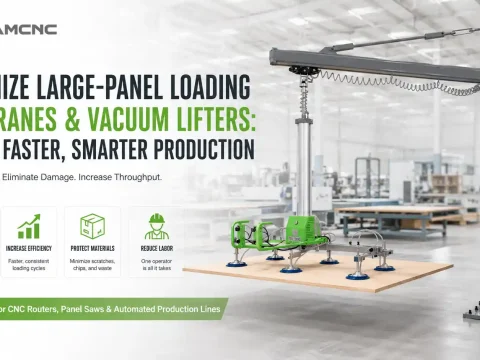
For many woodworking, furniture, composite, and panel processing facilities, integrating a jib crane with a vacuum lifting system is not about adding another piece of equipment. It is about removing a bottleneck that directly affects throughput, product quality, labor utilization, and workplace safety.

The Real Challenge Is Not Weight—It Is Control
Many managers evaluate lifting systems based on weight capacity alone.
In reality, large sheets are difficult to handle because of their dimensions, flexibility, and center-of-gravity behavior.
A 60 kg acrylic sheet can be more difficult to position than a 200 kg machine component.
Why?
Because the operator is not just lifting the load. They are controlling:
- Deflection
- Swing movement
- Rotational momentum
- Surface protection
- Placement accuracy
This becomes increasingly noticeable when handling:
- MDF sheets
- Plywood panels
- Melamine-faced boards
- Acrylic sheets
- Aluminum composite panels (ACP)
- Honeycomb composite panels
- Solid surface materials
- Stone slabs
- Composite tooling boards
Once panel sizes exceed standard 2440 × 1220 mm formats, manual handling becomes progressively less predictable.
The problem is rarely strength.
The problem is consistency.
Why Forklifts Often Create More Problems Than They Solve
Forklifts are excellent transportation tools.
They are not precision positioning tools.
In furniture factories, we frequently see forklifts being used to:
- Load CNC router tables
- Feed beam saws
- Transfer finished panels
- Position oversized boards for machining
The result is usually familiar:
- Corner damage
- Surface scratches
- Loading delays
- Misalignment
- Congested production aisles
- Increased operator dependency
Forklifts work best when moving pallets.
They become inefficient when operators need millimeter-level positioning on a CNC router vacuum table.
A machine capable of processing sheets with repeatability measured in fractions of a millimeter should not depend on a loading method that varies from operator to operator.
How a Jib Crane and Vacuum Lifter Work Together
A jib crane solves the movement problem.
A vacuum lifter solves the gripping problem.
Neither system alone solves the complete loading challenge.
The productivity gain comes from integrating both systems into a single workflow.
| Factor | Manual Loading | Forklift Loading | Jib Crane + Vacuum Lifter |
|---|---|---|---|
| Operators Required | 2–3 | 1–2 | 1 |
| Panel Damage Risk | High | Medium | Low |
| Loading Consistency | Operator Dependent | Operator Dependent | Repeatable |
| CNC Machine Waiting Time | High | Medium | Low |
| Worker Fatigue | High | Medium | Low |
| Surface Protection | Poor | Moderate | Excellent |
| Safety Risk | High | Moderate | Low |
| Long-Term Scalability | Limited | Moderate | High |
For CNC router loading stations, panel saw feeding areas, and furniture manufacturing cells, the goal is not simply lifting material.
The goal is placing every sheet accurately, safely, and consistently.
The Physics of Vacuum Handling: What Actually Matters
One of the most common purchasing mistakes is focusing solely on lifting capacity.
A 250 kg rated vacuum lifter tells you very little about actual performance.
Vacuum stability is usually more important than maximum load capacity.
Engineers should pay attention to:
Vacuum Integrity
Dust, texture, coatings, and porosity all affect suction performance.
Raw MDF behaves differently from laminated MDF.
High-gloss panels behave differently from textured decorative boards.
Composite materials behave differently from aluminum sheets.
A vacuum system that performs well during a showroom demonstration may struggle under actual production conditions.
Leakage Compensation
Small leaks are unavoidable.
A properly designed system should maintain sufficient holding force even when part of the sealing surface is compromised by dust or material irregularities.
Air Supply Stability
Many pneumatic vacuum systems operate best when supplied with stable compressed air between 6 and 8 bar.
In facilities where compressors also feed edge banders, pneumatic tools, and production equipment, pressure fluctuations can reduce vacuum performance.
A dedicated buffer tank is often a better investment than purchasing a larger vacuum unit.
Suction Cup Material Selection
The cheapest suction cups are often the most expensive component over time.
Different materials require different cup compounds:
- EPDM for general woodworking applications
- Silicone for high-gloss surfaces
- Specialized compounds for abrasive composites
- Non-marking materials for decorative panels
Selecting the wrong cup material often causes surface marks, premature wear, and inconsistent gripping.
Stability Matters More Than Reach
Another mistake frequently seen during installation is oversizing the jib crane radius.
A longer arm appears attractive on paper.
In practice, it introduces additional movement.
When an operator accelerates a large sheet, momentum causes the load to continue moving after the crane stops.
This oscillation becomes particularly problematic when loading CNC router alignment pins or positioning expensive decorative panels.
A properly engineered system prioritizes:
- Structural rigidity
- Smooth rotation
- Controlled movement
- Appropriate working radius
The objective is precision, not maximum reach.
Case Study: Solving a High-End Furniture Manufacturer’s Panel Damage Problem
A furniture manufacturer producing premium cabinet components was experiencing a rejection rate of approximately 4% on high-gloss melamine panels.
Management initially suspected tooling issues.
The CNC routers were inspected.
Toolpaths were reviewed.
Feed rates were adjusted.
The defects continued.
After observing production for several shifts, the actual problem became obvious.
The damage was occurring before machining even started.
Two operators were manually sliding large panels onto the CNC table. During loading, panel corners occasionally struck the table edge or vacuum manifold. Minor scratches and edge impacts were being introduced long before cutting began.
The company installed a 250 kg-rated jib crane integrated with a vacuum lifting head designed specifically for their panel dimensions.
No changes were made to CNC programming.
No changes were made to tooling.
Within weeks, handling-related defects dropped significantly, loading became more predictable, and one operator was reassigned to assembly operations.
The lesson was simple.
The production problem was not caused by the CNC machine.
It was caused by the way materials reached the CNC machine.
Hidden Costs Most Suppliers Never Discuss
Many suppliers focus on lifting demonstrations.
Few discuss ownership costs after installation.
These costs affect long-term ROI more than the purchase price.
Vacuum Filter Maintenance
Woodworking environments generate large quantities of fine dust.
Blocked filters reduce vacuum efficiency and increase pump workload.
Weekly inspections are often sufficient to prevent expensive failures.
Suction Cup Replacement
Suction cups are wear components.
Dust, resin residue, temperature changes, and abrasive surfaces gradually reduce performance.
Ignoring replacement schedules eventually compromises lifting reliability.
Bearing and Rotation Joint Maintenance
Jib crane pivots should be inspected and lubricated regularly.
Grinding noises usually indicate that maintenance has already been delayed too long.
Vacuum Switch Reliability
Pressure switches and safety sensors are often overlooked.
A slow or malfunctioning switch may fail to provide accurate lifting confirmation.
These components are inexpensive compared to the consequences of failure.
When Does This Investment Make Financial Sense?
A jib crane and vacuum lifting system typically becomes easier to justify when:
- Sheet materials exceed 50 kg regularly
- Panels larger than 2440 × 1220 mm are processed daily
- Material damage contributes to scrap costs
- Two operators are required for loading
- CNC equipment frequently waits for material preparation
- Production expansion is limited by labor availability
- Safety incidents or near misses are becoming common
If material handling is already safe, consistent, and efficient, additional equipment may not generate meaningful returns.
The decision should be based on workflow analysis rather than equipment specifications alone.
Frequently Asked Questions
Do I need a dedicated compressor for a vacuum lifting system?
Not necessarily. In many cases, a dedicated air buffer tank is sufficient to stabilize pressure and prevent performance fluctuations.
Can vacuum lifters handle porous materials?
Some porous materials can be handled successfully, but performance depends on material density, surface finish, and vacuum system design. Material testing should always be performed before final specification.
How thick should the floor be for a floor-mounted jib crane?
Requirements depend on load capacity and local regulations. In many installations, reinforced concrete foundations are required to safely support crane loads and dynamic forces.
Why do suction cups sometimes leave marks on decorative panels?
Low-quality rubber compounds can react with coatings or leave residue. Non-marking silicone cups are commonly used for high-gloss and decorative surfaces.
What safety standards should buyers consider?
Local lifting regulations should always be followed. Many industrial buyers also reference ISO-based workplace safety practices, lifting equipment standards, and internal safety requirements when evaluating handling systems.
Before Buying More Machine Capacity, Evaluate Material Flow
Factories rarely lose money because a CNC router moves too slowly.
They lose money because operators wait for assistance, panels get damaged before machining begins, forklifts block production lanes, and loading procedures vary from one shift to another.
Before investing in additional machine capacity, evaluate how materials move through your facility.
In many workshops, improving material handling delivers a faster return than purchasing another machine.
If you are considering a jib crane and vacuum lifting solution for CNC router loading, panel saw feeding, composite material handling, or furniture production, start by analyzing the bottlenecks on your shop floor.
The right solution is not the one with the highest lifting capacity.
It is the one that removes the most waste from your production process.