
When cabinet workshops grow from small custom jobs to batch production, equipment limitations quickly appear. Many businesses start with entry-level manual CNC routers, but as order volume increases, these machines struggle to keep up.
This is where BCAMCNC ATC CNC routers show a clear advantage. They are designed for speed, consistency, and industrial workflow — all critical for large-scale cabinet manufacturing.
What Is an Entry-Level Manual CNC Router?
A manual CNC router usually requires the operator to change tools by hand. These machines are common in:
- Small woodworking shops
- Start-up cabinet makers
- Custom furniture studios
They are affordable and simple, but they are not optimized for continuous batch production.
Main Limitations
1. Manual tool changes slow production
Cabinet processing involves drilling, grooving, cutting, and edge profiling. With a manual router, the operator must stop the machine every time a tool change is needed. This increases cycle time and reduces daily output.
2. Higher labor dependency
Operators must stay near the machine, which increases labor cost and reduces efficiency.
3. Greater risk of positioning errors
Frequent tool changes raise the chance of setup mistakes, which can affect panel accuracy.
What Makes BCAMCNC ATC Routers Different?
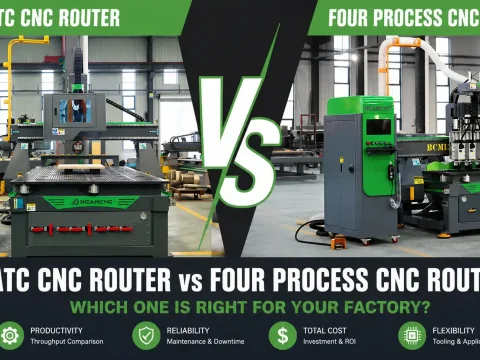
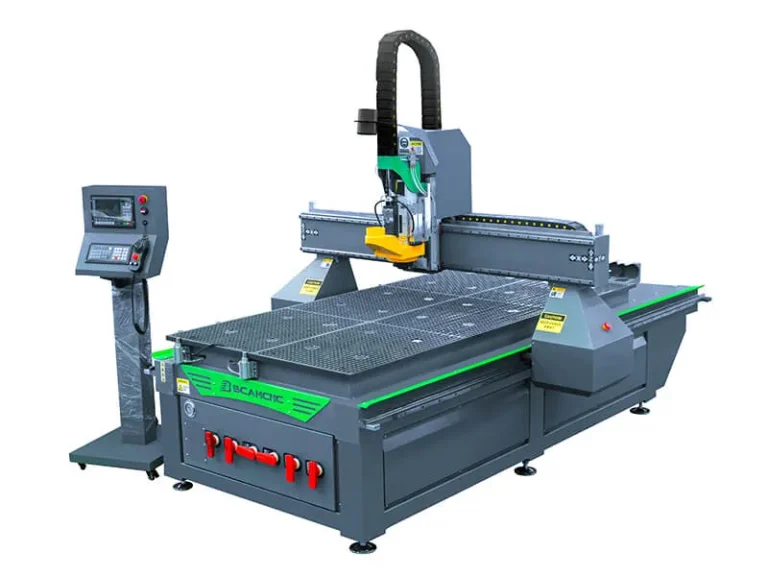
ATC stands for Automatic Tool Changer. BCAMCNC ATC routers are built for industrial woodworking and cabinet factories that need stable, repeatable production.
1. Automatic Tool Changing = Continuous Workflow
BCAMCNC ATC machines automatically switch tools during processing. This allows one machine to complete:
- Panel cutting
- Slotting
- Drilling hinge holes
- Pocket milling
- Engraving or shaping
All in one cycle without stopping.
Result: Faster production and higher daily panel output.
2. Ideal for Nested Cabinet Production
Batch cabinet manufacturing often uses nested-based production. BCAMCNC ATC routers support nesting software, which optimizes material usage and reduces waste.
Benefits include:
- Maximum sheet utilization
- Less leftover board waste
- Faster panel sorting and labeling
This is especially important for cabinet factories processing MDF, plywood, particle board, and laminated panels.
3. Reduced Labor Cost
With an ATC CNC router:
- One operator can manage multiple machines
- Less manual intervention is needed
- Production becomes more automated
For growing cabinet manufacturers, this significantly lowers long-term labor expenses.
4. Better Consistency for Batch Orders
Cabinet production requires high repeat accuracy. BCAMCNC ATC routers offer:
- Stable machine frame construction
- High-precision servo systems
- Consistent drilling and cutting depth
This ensures that every cabinet panel fits perfectly during assembly, reducing rework.
5. Higher Daily Output
Compared with entry-level routers, an ATC CNC machine can increase productivity by 30%–60%, depending on workflow and panel design complexity.
For factories handling bulk orders, faster output directly means:
- Shorter delivery times
- Ability to accept larger contracts
- Higher production revenue
When Should You Upgrade to an ATC CNC Router?
You should consider upgrading if:
✔ Your workshop processes large quantities of cabinet panels daily
✔ Manual tool changes are slowing your workflow
✔ Labor cost is rising
✔ You want to move toward automated production
✔ You plan to expand into kitchen cabinets, wardrobes, or office furniture
If these situations sound familiar, a BCAMCNC ATC CNC router is a practical next step.
Why BCAMCNC ATC Machines Are Built for Cabinet Factories
BCAMCNC designs ATC CNC routers specifically for woodworking production lines. Features often include:
- Linear or carousel automatic tool changers
- Heavy-duty machine structure for stability
- Vacuum table for strong panel holding
- Compatibility with cabinet design and nesting software
- Optional loading/unloading systems for automation
These features make BCAMCNC machines suitable not just for small workshops, but for professional cabinet manufacturers aiming for industrial efficiency.
Conclusion
Entry-level manual CNC routers are a good starting point, but they are not built for high-volume cabinet production. As order volume increases, efficiency, speed, and consistency become more important than initial machine cost.
BCAMCNC ATC CNC routers provide the automation and productivity needed for batch cabinet manufacturing. They reduce manual work, improve accuracy, and help factories scale their production capacity with confidence.
If your goal is to grow from a small workshop into a professional cabinet production facility, upgrading to an ATC CNC router is a smart long-term investment.
FAQ Section
Q1: Is a manual CNC router suitable for cabinet batch production?
A manual CNC router is not ideal for batch cabinet production because frequent manual tool changes slow down processing speed and increase labor dependency. For higher efficiency, an ATC CNC router is more suitable.
Q2: Why do cabinet factories choose ATC CNC routers?
Cabinet factories choose ATC CNC routers because they support automatic tool changing, nested-based manufacturing, and continuous multi-process machining, which significantly improves daily output and production consistency.
Q3: What type of CNC router is best for kitchen cabinet manufacturing?
For kitchen cabinet manufacturing, an ATC CNC router with nesting capability is considered the most efficient solution. Machines like BCAMCNC ATC CNC routers are designed specifically for cabinet panel cutting, drilling, and grooving in a single automated cycle.