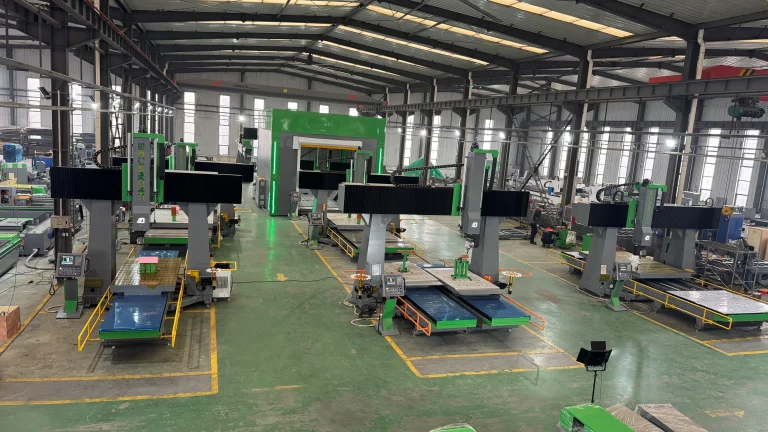

Investing in a 5 axis CNC router can transform your production capability. These machines allow you to cut complex 3D shapes, reduce manual repositioning, and improve overall accuracy. However, not every 5 axis CNC router fits every factory. The right choice depends on your industry, materials, part size, and production goals.
This guide will help you understand what really matters before buying a 5 axis CNC router.
Understand Your Industry and Materials
The first step is to clearly define what you will machine. Different industries require different machine structures, spindle power, and head configurations.
In aerospace manufacturing, parts like turbine components and structural molds often involve aluminum or composite materials. These jobs need high precision and stable multi-angle cutting. Automotive applications may include metal molds, engine parts, or battery housing components, which require stronger rigidity and higher cutting forces.
Mold making usually focuses on deep cavities and complex surface details. This demands smooth 5-axis motion and excellent surface finish capability. In woodworking, especially for solid wood furniture and 3D carving, the focus is more on speed, surface quality, and reliable vacuum holding systems.
The spindle head angle is also important. Soft materials such as wood, foam, and aluminum are often processed efficiently with a 90-degree vertical head. Harder metals typically require a 50-degree head design for better cutting strength and tool engagement.
Choose the Right Machine Size and Structure
Work area is one of the most practical selection factors. Always compare the machine’s effective travel with the largest part you plan to produce, not just your current jobs but future orders as well.
Large-format 5 axis CNC routers are often used in aerospace, marine, or large mold industries where parts can be several meters long. Smaller machines are more suitable for furniture factories, cabinet production, and medium-size molds. Choosing a machine that is too small will limit your business growth, while an oversized machine increases cost and space requirements.
Machine structure also affects performance. Heavy-duty frames are better for metal cutting and long-term stability. Lighter structures may be acceptable for wood and plastic but are not ideal for hard material machining.
Pay Attention to Core Components
The quality of key components directly determines machine life, accuracy, and reliability.
The control system is the brain of the machine. A professional 5-axis controller with RTCP (Rotational Tool Center Point) function allows accurate multi-angle machining without complicated manual calculations. This is essential for true 5-axis simultaneous cutting.
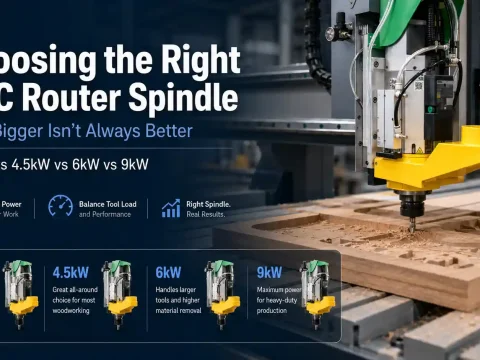
The spindle is another critical part. Liquid-cooled spindles with stable power output are better for long working hours and demanding materials. Power should match your application: woodworking may not need the same torque as aluminum or composite machining.
An automatic tool changer greatly improves efficiency. When machining complex parts that require multiple tools, an 8-position or larger tool magazine can save a significant amount of time and reduce human error.
Servo motors and drive systems also matter. High-quality servo systems ensure smooth motion, better surface finish, and consistent accuracy even at high speeds.
Rigidity and Stability Are Essential
A 5 axis CNC router must stay stable during multi-directional cutting. Weak structures cause vibration, poor surface finish, and reduced tool life.
Look for machines built with thick welded steel frames that have been stress-relieved through proper heat treatment. This process reduces deformation over time. The transmission system also plays a role. Rack and pinion systems are often used for larger machines where speed and long travel are important, while ball screw systems are common in smaller machines that focus on very high precision.
The heavier and more stable the base structure, the better the machine will perform when cutting metals or dense materials.
Software and Smart Functions
Modern 5 axis machining depends heavily on software. The machine should be compatible with mainstream CAD/CAM software such as Mastercam or UG, making it easier to generate accurate toolpaths.
Optional accessories like a 3D probing system can further improve accuracy. Probes allow the machine to automatically measure the workpiece and compensate for small positioning errors, which is very helpful for mold and high-precision parts.
Simulation functions are also valuable. They help you preview toolpaths and avoid collisions before actual cutting begins.
Accuracy and Quality Control
Precision is the core value of a 5 axis CNC router. Always check how the manufacturer ensures accuracy. Professional builders use laser calibration systems and advanced measuring equipment to align each axis and verify repeatability.
Consistent repeat positioning accuracy ensures that parts remain identical across batches, which is especially important for aerospace, automotive, and mold industries.
Balance Budget and Production Needs
Price differences between 5 axis CNC routers usually come from machine size, component brands, automation level, and structural strength. An economy model may be suitable for lighter materials and general 3D work, while heavy-duty industrial models are necessary for large molds or metal cutting.
Instead of choosing the cheapest option, focus on value: machine life, service support, upgrade potential, and production efficiency.
Final Thoughts
Choosing the right 5 axis CNC router is about matching the machine to your real production tasks. Consider your materials, part size, required precision, and long-term business plans. Pay close attention to structure, control system, spindle quality, and software compatibility.
A well-selected 5 axis CNC router will not only improve machining capability but also reduce labor, shorten production cycles, and open doors to higher-value projects.
BCAMCNC has over 15 years of experience in manufacturing industrial 5 axis CNC routers for aerospace, automotive, mold making, and woodworking industries. With multiple machine configurations and global certifications, BCAMCNC helps manufacturers find the right balance between performance, reliability, and cost.