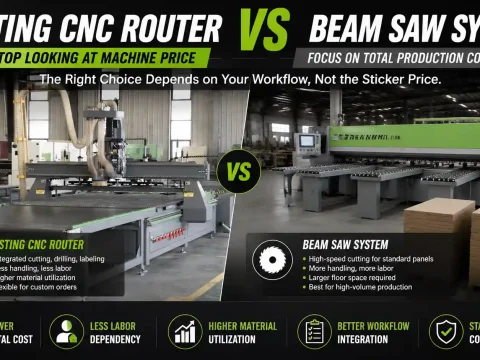

If you choose between a nesting CNC router and a beam saw based only on purchase price or cutting speed, you will almost always misjudge the real cost of production.
In real cabinet factories, the real bottleneck is not cutting itself, but everything that happens after cutting:
- Sorting and handling parts
- Secondary drilling and machining
- Edge banding workflow stability
- Work-in-progress (WIP) accumulation
- Operator dependency and error rate
A beam saw can cut panels very fast, but it produces large stacks of loose parts that must be manually managed.
A nesting CNC router integrates cutting, drilling, and labeling into a single digital workflow, reducing downstream handling—but increasing dependence on vacuum stability, tooling condition, and process control.
The real decision is not “which machine is faster”.
It is:
Which system produces the lowest total cost per finished cabinet set.
Where Beam Saw Still Works Well, and Where It Quietly Creates Hidden Cost
Stable Cutting, Predictable Output, Low Operator Sensitivity
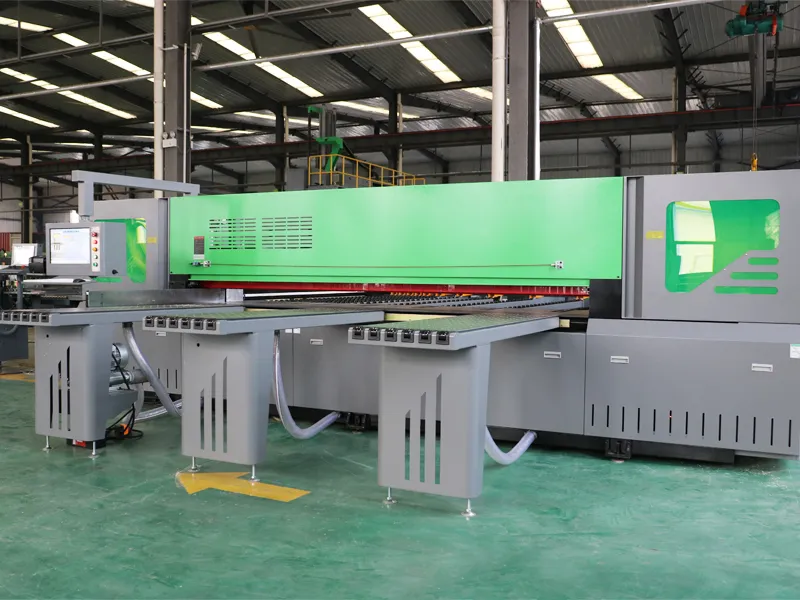
Beam saw systems are widely used in industrial cabinet production because they are stable and repeatable.
In typical production conditions:
- Panel thickness: 16–25mm MDF or particle board
- Dimensional tolerance: typically around ±0.2–0.3mm depending on calibration
- Fixed blade-based cutting system
- Low sensitivity to programming complexity
Once properly calibrated, beam saws can maintain stable output across shifts with relatively low variation.
The main advantage is not precision, but consistency under different operators.
The Hidden Problem: Post-Cutting Workflow Load
Beam saws separate production into multiple stages:
- Cutting
- Sorting
- Drilling
- Hardware processing
- Edge banding preparation
Each transfer between processes introduces:
Hidden labor cost – more manual handling
Higher error risk – mis-sorting or missing parts
Inventory pressure – WIP stacking in production area
In many factories, the beam saw is not the bottleneck.
The bottleneck appears in logistics and handling after cutting.
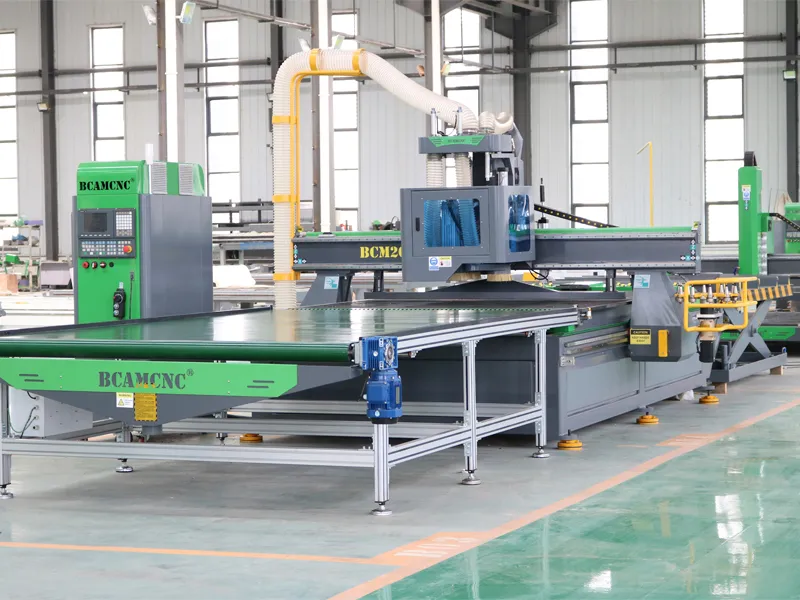
Where Nesting CNC Router Wins, and Where It Becomes Sensitive
Integrated Production Reduces Handling, But Increases System Dependency
A nesting CNC router changes the production logic completely.
Instead of:
Cut → Sort → Drill → Process
It becomes:
CAD/CAM → Nesting → Full-sheet machining → Ready-to-assemble parts
This removes:
- Manual sorting errors
- Labeling mistakes
- Secondary drilling alignment issues
But it introduces dependency on system stability:
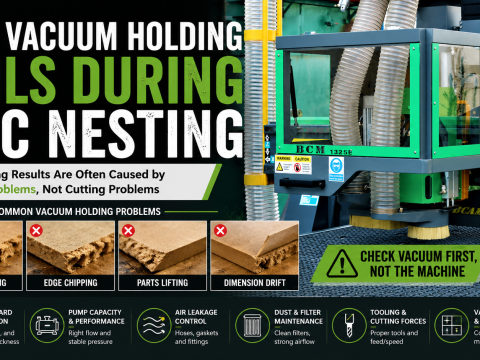
- Vacuum holding performance
- Tool wear consistency
- Feed rate balance
- Dust extraction efficiency
Unlike beam saws, CNC nesting performance is not only mechanical—it is process-driven.
Material Utilization Depends on More Than Nesting Software
Material savings are often associated only with nesting optimization.
In real production, utilization is affected by:
- Cutting layout strategy
- Kerf width
- Vacuum stability during machining
- Operator setup discipline
Nesting CNC routers typically use compression bits in the range of roughly 6–12mm depending on application.
Beam saw kerf is often narrower, but nesting systems reduce waste in other ways:
Better sheet utilization efficiency
Less offcut fragmentation
Reduced human handling loss
So the real advantage is not only material saving—it is process consistency.
Comparison: Real Factory Operating Reality
| Factor | Nesting CNC Router | Beam Saw |
|---|---|---|
| Cutting Method | Digital nesting + routing | Blade-based straight cutting |
| Labor Requirement | Lower (single operator possible) | Higher (cutting + sorting required) |
| Workflow Integration | High (cut + drill + label) | Low (requires secondary process) |
| Material Utilization | Higher (optimized nesting) | Lower (fixed cutting logic) |
| Flexibility | High (custom orders easy) | Low (best for standard panels) |
| Process Sensitivity | High | Low |
| Downstream Bottleneck Risk | Medium (vacuum/tooling dependent) | High (sorting + drilling dependent) |
Real Factory Case: When Cutting Speed Increased Total Cost
A mid-sized cabinet manufacturer originally used a beam saw system and later introduced a nesting CNC router.
The expectation was simple:
Reduce labor and increase efficiency.
What actually happened was more complex.
Beam saw performance:
- Efficient at high-volume standard panel cutting
- Stable output with minimal variation
Nesting CNC performance:
- Flexible for custom parts and small batches
- Reduced manual drilling steps
- Improved design adaptability
But after scaling production:
The bottlenecks shifted.
Beam saw side:
- Increased material handling workload
- Large WIP accumulation
- Sorting complexity increased
Nesting CNC side:
- Vacuum stability sensitivity became visible
- Tool wear variation affected consistency
- Operator setup quality became critical
The final conclusion from the factory was not:
“Which machine is better?”
But:
Each system creates a different type of production bottleneck.
Maintenance and Stability Factors That Are Often Ignored
Beam Saw System Dependencies
Beam saw performance depends heavily on:
- Pneumatic pressure stability (commonly around 6–7 bar in many setups)
- Blade sharpness consistency
- Mechanical alignment of cutting system
If air pressure fluctuates during production, clamping stability may be affected, leading to movement or dimensional variation.
Nesting CNC System Dependencies
Nesting CNC performance depends heavily on:
- Vacuum holding stability
- Spoilboard condition and sealing performance
- Dust extraction efficiency
- Tool condition and runout control
If vacuum sealing is weak, even small parts may shift during cutting, causing scrap and rework.
Why Many ROI Calculations Fail in Real Factories
Most investment decisions are based on:
- Machine price
- Cutting speed
- Tooling cost
But real factory cost is driven by:
- Labor between processes
- WIP accumulation
- Rework rate
- Setup sensitivity
- Workflow interruptions
A cheaper machine is not always cheaper in production.
A faster machine is not always more productive.
The real metric is:
Cost per finished and correctly assembled cabinet set.
FAQ
Is a nesting CNC router always better than a beam saw?
No. Beam saws are still highly efficient for standardized high-volume panel cutting. Nesting CNC routers are better for flexible and mixed production.
Does nesting CNC reduce material waste?
Yes, but only when nesting strategy, vacuum stability, and operator discipline are properly controlled.
Why do CNC nesting parts sometimes not fit correctly?
Common causes include vacuum instability, tool wear variation, and process parameter mismatch rather than machine accuracy alone.
Can a beam saw replace a CNC nesting router?
Only in highly standardized production environments. In most cabinet factories, both systems coexist.
Which system is more profitable long term?
It depends on production structure. Beam saws favor stability and volume. CNC nesting favors flexibility and integration.
Final Perspective: This Is Not a Machine Choice Problem
Factories often try to compare machines as isolated equipment.
In real production, both systems are part of a larger workflow.
Beam saws optimize:
- Stability
- Speed
- Standardized output
Nesting CNC routers optimize:
- Flexibility
- Integration
- Reduced handling
The most efficient factories are not those that choose one system.
They are those that design a workflow where both systems complement each other rather than compete.
The real decision is not which machine to buy.
It is how your production system handles parts from cutting to final assembly.