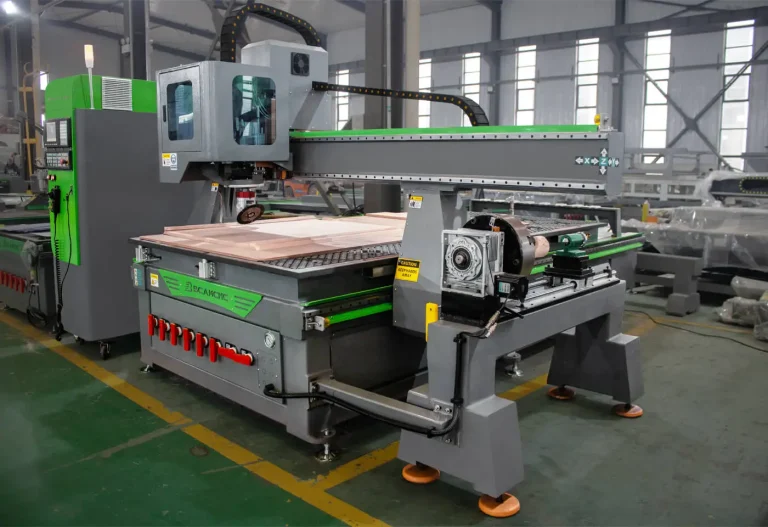

Investing in a 5 axis CNC router is not just about adding more axes—it’s about achieving higher precision, better surface finish, and fewer setups.
But many manufacturers face the same issue:
- Visible mismatch lines on complex surfaces
- Poor surface finish after long machining cycles
- Increasing polishing and rework costs
If this sounds familiar, the problem is rarely your CAM software.
In most cases, the real issue is inaccurate kinematic calibration.
The Real Challenge in 5 Axis CNC Machining
A standard 3-axis CNC machine relies on X, Y, Z linear motion. Accuracy depends mainly on axis straightness and perpendicularity.
A 5 axis CNC router introduces two additional rotational axes (A/B or A/C).
This significantly increases complexity.
For accurate simultaneous machining (RTCP / TCPM), the controller must know:
- Exact rotation center positions
- Spatial relationship between rotary and linear axes
- Real-time tool tip position during movement
Even a small deviation creates large errors.
A 10 μm error in the rotary axis center can amplify into critical deviation at the tool tip, especially with long tools or large tilt angles.
This is one of the most common causes of:
- Scrap parts
- Inconsistent accuracy
- Poor finishing quality
Kinematic Calibration: The Key to True 5-Axis Accuracy
Most 5-axis machining errors are not caused by machine structure—but by uncalibrated kinematics.
Kinematic calibration ensures that:
- Rotary axis centers are accurately defined
- Machine geometry matches controller calculations
- RTCP compensation works correctly
Without this, even a high-end 5 axis CNC router cannot deliver true precision.
How Kinematic Calibration Works in Practice
A typical calibration setup includes:
Datum Sphere (Reference Standard)
A high-precision sphere fixed on the machine table, acting as a 3D reference.
Wireless Touch Probe
Installed in the spindle to measure surface points with high sensitivity.
5-Axis Head System
Controls rotary movements during measurement.
The process:
- The probe measures the sphere from multiple angles
- Thousands of data points are collected
- The system compares actual vs theoretical positions
- Geometric errors are calculated and compensated
This ensures the machine maintains micron-level accuracy during real machining.
When Should You Calibrate a 5 Axis CNC Router?
Kinematic calibration is not a one-time setup.
It must be maintained continuously.
You should perform calibration:
Machine Installation
Establish baseline accuracy on-site.
Thermal Changes
Temperature variation affects machine structure and geometry.
Regular Maintenance
Weekly or monthly checks are common in precision machining.
After Any Collision
Even minor impacts can shift rotary axis alignment.
Ignoring calibration leads directly to accuracy loss and production instability.
The BCAMCNC Approach to 5-Axis Precision
At BCAMCNC, we design every 5 axis CNC router with both mechanical rigidity and calibration capability in mind.
Our solutions include:
- High-rigidity machine structures to reduce thermal drift
- Compatibility with advanced probing systems
- Automated kinematic calibration cycles
- Full technical support and operator training
We don’t just deliver machines—we ensure you can achieve real, repeatable 5-axis accuracy in daily production.
Stop Losing Accuracy in 5-Axis Machining
If your parts show:
- Surface mismatching
- Accumulated dimensional errors
- Excessive manual finishing
Your machine likely needs proper kinematic calibration.
Get Your 5-Axis Machining Solution
Upload your part drawing and get:
- Machining strategy recommendations
- Accuracy optimization advice
- Calibration and process suggestions
Talk to BCAMCNC engineers and improve your 5-axis machining performance today.