
Most factories do not buy a 5-axis CNC router because they need five axes. They buy it because someone is tired of flipping a large mold three times a day, spending hours building fixtures, or explaining why a finished part still needs another shift of manual sanding.
That is usually where the real discussion starts.
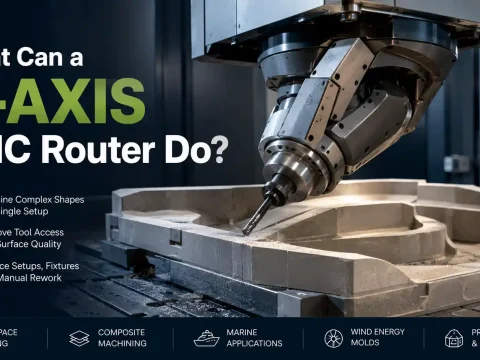
A 5-axis CNC router can reduce setups, improve tool access, and help machine complex geometries that are difficult or inefficient on a traditional 3-axis machine. It can also introduce new costs, new maintenance requirements, and a higher level of programming complexity.
The important question is not whether a 5-axis machine can do more.
The important question is whether it can remove one of the expensive bottlenecks in your production process.
Where a 5-Axis CNC Router Creates Real Value
Understanding What Changes Compared to a 3-Axis Machine
A standard CNC router moves in X, Y, and Z directions.
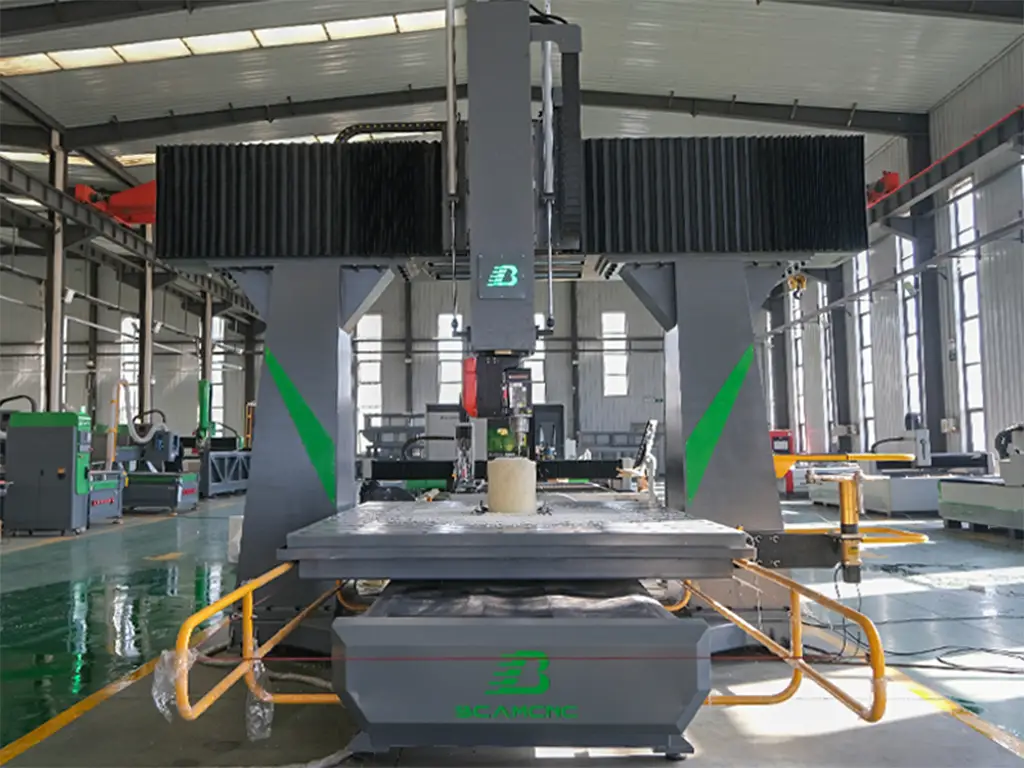
A 5-axis CNC router adds two rotational axes, allowing the spindle to approach the workpiece from different angles.
On paper, that sounds like a simple upgrade.
On the shop floor, it changes how parts are produced.
With a 3-axis machine, many complex parts require multiple operations:
- Machine one side
- Remove the part
- Build or adjust a fixture
- Reposition the workpiece
- Re-establish the work coordinate system
- Machine the next feature
Every time a part is moved, another opportunity for error is introduced.
The machine may be accurate.
The fixture may be accurate.
The operator may be experienced.
Yet dimensional variation can still accumulate across multiple setups.
A 5-axis machine often reduces or eliminates those repositioning operations.
For many manufacturers, that is where the return on investment comes from.
Not spindle speed.
Not marketing claims.
Setup reduction.
Machining Large Molds and Tooling
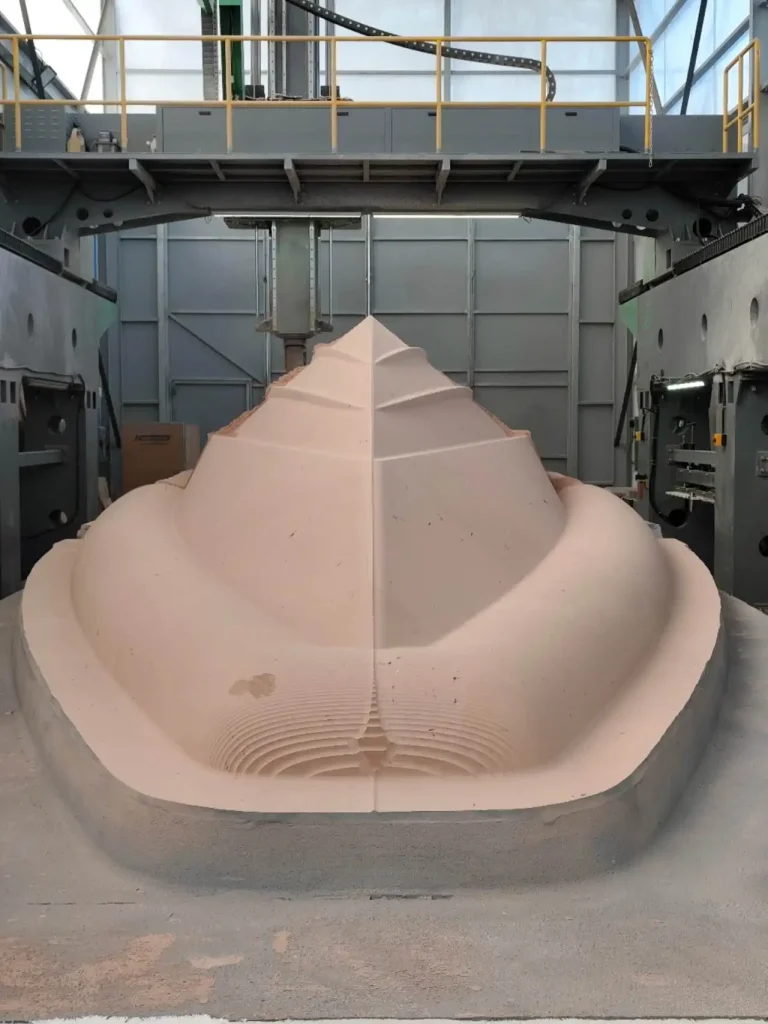
Large mold manufacturing is one of the most common reasons companies invest in a 5-axis CNC router.
This includes:
- Aerospace tooling
- Composite molds
- Marine molds
- Automotive molds
- Wind turbine blade molds
- Pattern and plug production
The challenge with these applications is rarely material removal.
The challenge is geometry.
Large molds often contain:
- Deep cavities
- Compound curves
- Variable draft angles
- Complex transitions between surfaces
On a 3-axis machine, reaching these areas may require extremely long tools.
Long tools create their own problems.
Tool deflection increases.
Vibration becomes more difficult to control.
Surface quality may suffer.
Cycle time often increases because feed rates must be reduced to maintain stability.
A 5-axis spindle can approach difficult areas at different angles, allowing shorter tool assemblies and more consistent cutting conditions.
The result is often better surface quality and less downstream finishing work.
Carbon Fiber and Composite Material Machining
Many buyers assume composite machining is primarily about spindle power.
In reality, tool access and cutting strategy often have a greater impact on finished part quality.
Carbon fiber, fiberglass, honeycomb panels, and other composite materials behave differently from wood or aluminum.
Factors such as:
- Fiber orientation
- Resin content
- Laminate structure
- Material thickness
can influence machining results significantly.
In some applications, adjusting the cutting angle can help reduce issues such as edge fraying or fiber pull-out.
A 5-axis machine gives programmers more flexibility when creating toolpaths around complex contours.
This does not eliminate the need for proper tooling.
Tool selection, dust extraction, spindle speed, feed rate, and machine rigidity remain critical factors.
Many composite manufacturers spend more time discussing dust control and tool wear than spindle horsepower.
That reality rarely appears in machine brochures.
Aerospace and Marine Applications
Some of the most demanding 5-axis router applications are found in aerospace and marine manufacturing.
Large composite structures often contain complex curved surfaces that are difficult to machine efficiently using multiple setups.
Examples include:
- Composite molds
- Trim fixtures
- Assembly tooling
- Hull molds
- Deck molds
- Interior composite structures
In these environments, consistency is often more important than absolute speed.
If a large mold requires repeated repositioning during machining, every setup introduces additional inspection requirements and additional opportunities for deviation.
Reducing those setup changes can improve process stability throughout the entire production cycle.
Prototype and Low-Volume Manufacturing
Not every application involves high production volume.
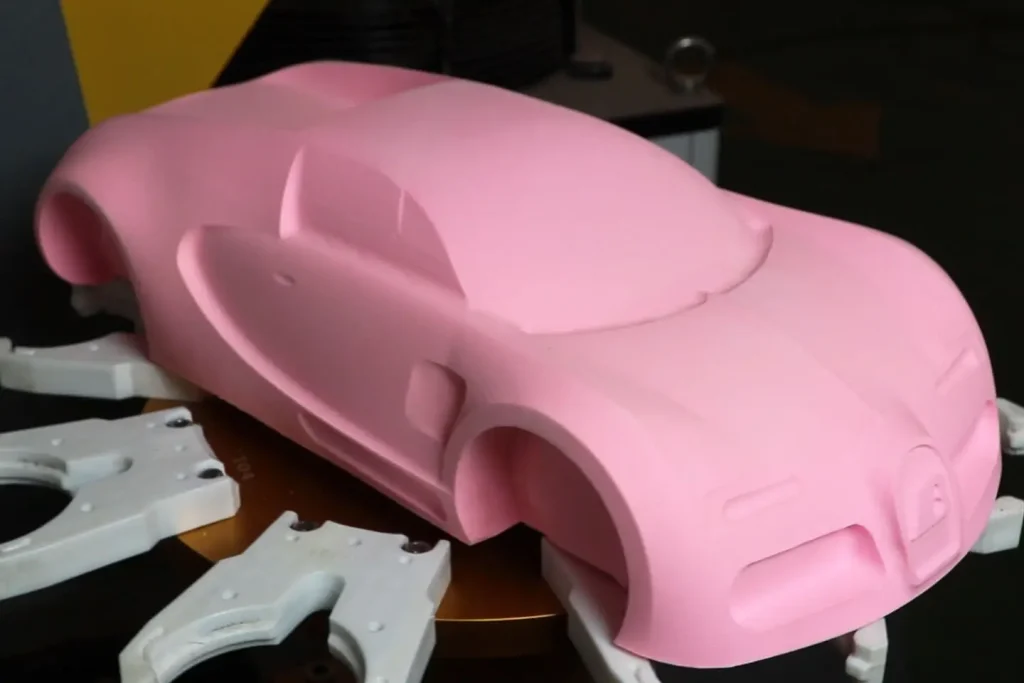
Many manufacturers use 5-axis routers for prototype development and custom production work.
The ability to machine multiple surfaces in a single setup can reduce lead times when producing:
- Design verification models
- Automotive prototypes
- Aerospace tooling prototypes
- Architectural components
- Custom composite structures
For low-volume manufacturing, setup time often represents a larger percentage of total production cost than actual cutting time.
This is one reason why 5-axis technology is frequently adopted in engineering-driven industries.
What Sales Brochures Usually Don’t Explain
Most machine specifications focus on:
- Travel ranges
- Spindle power
- Rapid speeds
- Controller features
Those specifications matter.
But several practical issues often have a greater impact on daily production.
Programming Complexity
A 5-axis machine requires more advanced CAM programming.
Without a reliable post-processor and proper machine simulation, programming errors can become expensive very quickly.
A machine capable of five-axis movement is only as productive as the quality of the toolpaths it receives.
Many shops discover that their first bottleneck is not the machine.
It is programming capacity.
Tool Center Point Management
Accurate Tool Center Point (TCP) control becomes increasingly important when machining complex geometries.
Poor calibration can affect dimensional accuracy, especially when machining large parts with multiple tool orientations.
Routine verification procedures should become part of preventive maintenance.
Vacuum Holding Challenges
Holding a flat sheet is relatively straightforward.
Holding a complex three-dimensional workpiece while the spindle approaches from multiple angles is not.
Vacuum zoning, fixture design, and workholding strategy become increasingly important as part complexity increases.
Maintenance Requirements
Every additional axis introduces additional components.
Depending on machine design, this may include:
- Rotary bearings
- Servo motors
- Gear systems
- Feedback devices
- Additional cable management systems
Maintenance planning becomes more important as machine complexity increases.
A 5-axis machine that is not maintained properly can quickly become an expensive source of downtime.
3-Axis vs. 5-Axis CNC Router Comparison
| Feature | 3-Axis CNC Router | 5-Axis CNC Router |
|---|---|---|
| Setup Requirements | Multiple setups often required | Many parts can be completed in a single setup |
| Programming Difficulty | Moderate | High |
| Fixture Complexity | Often higher | Often lower |
| Tool Access | Limited to vertical approach | Multi-angle access |
| Mold Manufacturing | Limited on complex surfaces | Well suited |
| Composite Trimming | May require repositioning | Better access for complex contours |
| Operator Skill Requirement | Moderate | Higher |
| Initial Investment | Lower | Higher |
A Real Production Example
A composite mold manufacturer was producing large marine tooling components using a conventional 3-axis router.
The machining process itself was reasonably efficient.
The problem appeared between machining operations.
Large molds required repeated repositioning to access different areas.
Each setup required:
- Alignment checks
- Fixture verification
- Coordinate system confirmation
- Additional inspection time
Management initially focused on reducing cycle time.
After reviewing production records, they discovered setup operations were consuming a significant portion of total manufacturing time.
A 5-axis machine was later introduced for these projects.
The largest improvement did not come from faster cutting.
It came from reducing the number of times operators needed to handle the mold during production.
Less handling led to more consistent results and fewer opportunities for alignment-related issues.
That benefit was visible in production reports long before it appeared in machine utilization statistics.
When a 5-Axis CNC Router Makes Sense
A 5-axis CNC router is often worth considering when your operation involves:
- Large molds
- Composite materials
- Aerospace tooling
- Marine manufacturing
- Multi-surface machining
- Complex prototypes
- Parts requiring frequent repositioning
It may be unnecessary for operations focused primarily on:
- Flat panel nesting
- Standard cabinet production
- Basic woodworking components
- High-volume rectangular parts
In those situations, a properly configured 3-axis machine may provide a better return on investment.
The goal should not be to buy the most advanced machine available.
The goal should be to remove the most expensive constraint in the production process.
Frequently Asked Questions
Do I need a 5-axis CNC router for cabinet manufacturing?
In many standard cabinet production environments, a high-performance 3-axis nesting machine is often sufficient. A 5-axis router may only become necessary when complex machining requirements justify the additional investment.
Is 5-axis programming more difficult?
Yes. Effective 5-axis machining requires suitable CAM software, accurate post-processing, and a solid understanding of machine kinematics.
Can a 5-axis CNC router machine aluminum?
Many industrial 5-axis routers can machine aluminum. Actual performance depends on machine rigidity, spindle characteristics, tooling, cutting parameters, and application requirements.
Does a 5-axis machine eliminate manual finishing?
No. It can reduce sanding, trimming, and polishing work in some applications, but manual finishing remains part of many manufacturing processes.
What is the biggest benefit of a 5-axis CNC router?
For many manufacturers, the biggest benefit is reducing setups and improving access to complex geometries rather than simply increasing cutting speed.
Final Thoughts
Before comparing spindle power, rapid speeds, or controller brands, look at what is happening around the machine.
Which parts require the most repositioning?
Which jobs need the most fixtures?
Where is manual sanding consuming labor hours?
Which products create the most setup-related delays?
Those answers usually reveal whether a 5-axis CNC router is the right investment.
In many factories, the true value of a 5-axis machine is not that it cuts faster.
It is that fewer people need to touch the part before it reaches the next production stage.
That is often where the real manufacturing cost disappears—and where the strongest return on investment is found.