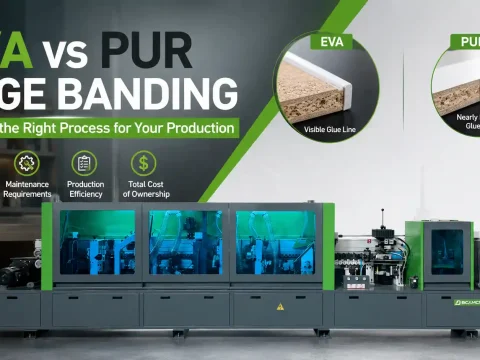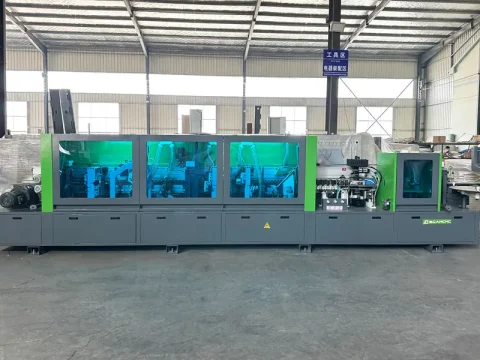

If you are currently debating between EVA and PUR for your edge banding process, you are not simply choosing an adhesive. You are choosing a maintenance system, a quality standard, and a level of production discipline that your factory will have to live with every day.
Many furniture manufacturers assume PUR is automatically superior because it offers better moisture resistance and a thinner glue line. On paper, that is true. On the shop floor, things are rarely that simple.
A well-managed EVA edge banding machine can produce years of reliable output with minimal downtime. A poorly maintained PUR system can become an expensive source of machine stoppages, cleaning issues, and operator frustration.
The first question should not be “Which glue is better?”
The first question should be:
“What kind of furniture are we producing, and can our production team consistently support the process requirements?”
Why Adhesive Selection Is a Production Decision, Not a Purchasing Decision
Many equipment purchases begin in the purchasing office but end in the maintenance department.
This is especially true for edge banding.
The adhesive affects:
- Product durability
- Machine utilization
- Maintenance workload
- Warranty claims
- Energy consumption
- Spare parts consumption
- Operator training requirements
A furniture factory producing office desks for dry indoor environments faces completely different requirements than a manufacturer supplying kitchen cabinets, laboratory furniture, or hospitality projects.
The mistake is assuming both factories need the same adhesive technology.
Understanding What Makes EVA and PUR Different
EVA Is a Thermoplastic Adhesive
EVA (Ethylene Vinyl Acetate) softens when reheated.
This makes it relatively forgiving.
Glue pots are easier to clean.
Production interruptions are easier to manage.
Operators can usually recover from minor process mistakes without causing major damage to the machine.
Most EVA systems commonly operate within a temperature range specified by the adhesive supplier, often around 180°C–200°C for many woodworking applications.
PUR Is a Reactive Adhesive
PUR (Polyurethane Reactive Hot Melt) behaves differently.
After application, it reacts with moisture from the surrounding environment and substrate.
Once cured, the bond is no longer thermoplastic.
This creates significant advantages in moisture resistance and durability.
It also creates maintenance requirements that many first-time PUR users underestimate.
EVA vs PUR: Practical Comparison From a Factory Perspective
| Item | EVA Edge Banding | PUR Edge Banding |
|---|---|---|
| Initial Equipment Investment | Lower | Higher |
| Adhesive Cost | Lower | Higher |
| Moisture Resistance | Moderate | High |
| Heat Resistance | Moderate | High |
| Glue Line Appearance | Visible | Very Thin |
| Cleaning Difficulty | Low | High |
| Operator Skill Requirement | Moderate | Higher |
| Downtime Risk | Lower | Higher |
| Rework Possibility | Easier | More Difficult |
| Suitable Product Positioning | Standard Furniture | Premium Furniture |
The table looks straightforward.
The reality becomes more complicated once production starts.
The Hidden Costs of PUR That Sales Brochures Rarely Mention
PUR Requires Process Discipline
Many factory owners see PUR as a quality upgrade.
The maintenance team often sees it differently.
PUR begins reacting once exposed to moisture.
That reaction is beneficial inside the bond line.
It becomes a problem when adhesive remains inside the glue application system.
If shutdown procedures are not followed correctly, cured adhesive can accumulate inside hoses, nozzles, glue pots, and application components.
The result is not usually immediate failure.
The result is gradual performance deterioration, unstable glue application, additional cleaning work, and eventually unexpected maintenance costs.
Factories switching from EVA to PUR often discover that operator discipline becomes just as important as machine quality.
Maintenance Becomes Part of Production
Many manufacturers focus on adhesive price per kilogram.
The larger cost often comes from labor.
PUR systems may require:
- More frequent cleaning procedures
- Dedicated cleaning materials
- Controlled shutdown routines
- Additional operator training
- More attention during extended production stoppages
If your factory regularly stops production for several days or frequently changes production schedules, these factors deserve serious consideration.
Why EVA Continues to Dominate Much of the Furniture Industry
EVA remains widely used because it is practical.
Not because factories are unwilling to upgrade.
Many furniture manufacturers prioritize:
- High machine utilization
- Lower maintenance burden
- Flexible production schedules
- Faster adhesive changes
- Lower operating complexity
For wardrobes, office furniture, retail displays, shop fittings, and many standard cabinet applications, EVA often provides a balance of cost, productivity, and acceptable product performance.
There is nothing outdated about choosing EVA when it aligns with the product requirements.
When PUR Starts Making Financial Sense
PUR usually becomes attractive when warranty risk becomes expensive.
Factories supplying:
- Kitchen cabinets
- Bathroom furniture
- Hospitality projects
- Laboratory furniture
- High-gloss panel products
- Export furniture for humid regions
often face different customer expectations.
A premium kitchen cabinet may spend years in environments exposed to steam, cleaning chemicals, temperature fluctuations, and high humidity.
In these situations, reducing the risk of edge failure may justify the additional maintenance requirements associated with PUR.
The decision is often less about adhesive performance and more about risk management.
The Part Many Factories Overlook: Panel Quality
A surprising number of edge banding issues are not caused by glue.
They originate in the panel.
Board Moisture Content
MDF and particleboard performance can vary depending on storage conditions, environmental humidity, and supplier consistency.
Excessive moisture variation can affect adhesive bonding performance.
When edge lifting occurs, experienced engineers often inspect the material first before changing machine parameters.
Panel Surface Quality
Dust contamination, poor machining quality, damaged edges, or inconsistent board density can reduce bonding effectiveness regardless of adhesive type.
Changing from EVA to PUR will not automatically solve these problems.
Machine Parameters Still Matter More Than Marketing Claims
Many edge banding defects originate from process instability rather than adhesive selection.
Temperature Control
Temperature fluctuations can influence adhesive viscosity and application consistency.
Following the adhesive supplier’s recommended operating range is essential.
Overheating can degrade adhesive performance.
Insufficient temperature may result in poor wetting and inadequate bonding.
Air Pressure Stability
Most industrial edge banding machines typically operate within compressed air ranges around 0.6–0.8 MPa, depending on machine configuration.
Insufficient pressure can reduce roller effectiveness and bonding quality.
Pressure Roller Performance
Proper pressure application remains one of the most critical factors in successful edge banding.
Even the best adhesive cannot compensate for inadequate mechanical pressure.
A Real Production Scenario
Several years ago, a cabinet manufacturer located in a humid coastal region experienced recurring customer complaints involving edge lifting.
The company initially focused on adhesive suppliers.
Multiple glue brands were tested.
The problem remained.
After reviewing production conditions, the engineering team identified inconsistent environmental conditions in the board storage area.
Material exposed to seasonal humidity changes entered production with varying moisture levels.
The factory eventually improved material storage control and adjusted process management practices.
According to the manufacturer’s internal observations, warranty complaints decreased significantly over the following production cycles.
The lesson was simple.
Not every edge banding problem starts at the glue pot.
FAQ
Can EVA and PUR be used on the same edge banding machine?
Some modern edge banding machines can support both systems through dedicated or interchangeable glue units. Compatibility depends on machine design and manufacturer recommendations.
Is PUR always stronger than EVA?
Under many conditions, PUR offers higher moisture resistance and durability. Actual performance still depends heavily on machine setup, material quality, and process control.
Does PUR increase production costs?
Usually yes. Adhesive cost is only part of the equation. Maintenance procedures, cleaning requirements, operator training, and potential downtime should also be considered.
Does every kitchen cabinet manufacturer need PUR?
Not necessarily. Product positioning, customer expectations, environmental exposure, and warranty requirements all influence the decision.
What compressed air pressure is typically required for edge banding machines?
Many industrial edge banders operate around 0.6–0.8 MPa, although requirements vary by machine model and configuration.
Can PUR completely eliminate edge lifting?
No. Panel quality, machining accuracy, storage conditions, pressure settings, and process consistency all contribute to bond quality.
Which adhesive is easier for small factories to manage?
In many cases, EVA is easier to maintain and more forgiving for factories with limited maintenance resources or highly variable production schedules.
Choosing the Process That Fits Your Factory
The best edge banding process is not determined by marketing claims or adhesive specifications alone.
It is determined by the products you manufacture, the environments those products will operate in, the skills of your production team, and the level of process discipline your factory can consistently maintain.
If your priority is operational simplicity, production flexibility, and lower maintenance requirements, EVA remains a practical and proven solution.
If your business depends on premium furniture, moisture resistance, and minimizing long-term warranty risk, PUR may provide a strong return despite the additional complexity.
Before investing in a new edge banding machine or switching adhesive technologies, evaluate the entire production system—not just the glue.
In most factories, the real cost of edge banding is not found in the adhesive drum.
It shows up months later in machine downtime, warranty claims, and customer complaints.