
What Actually Matters When Machining 15-Meter Ship Molds
Most shipyards do not move to a 5 axis CNC router because they suddenly want “advanced manufacturing.” They move because manual fairing, template correction, and assembly mismatch start consuming too much labor, too much floor time, and too much project margin.
Once marine molds exceed 10 meters, traditional 3 axis workflows begin creating problems that are difficult to hide:
- long sanding cycles
- unstable surface consistency
- fixture repositioning errors
- excessive hand correction
- dimensional drift between sections
- delayed downstream assembly
At that scale, the problem is no longer whether the machine can cut the material.
The problem becomes whether the entire production chain remains stable after 18 hours of continuous machining in a dusty composite workshop where temperature, humidity, resin behavior, and operator habits are all changing at the same time. Humans managed to build luxury yachts worth millions of dollars, then still rely on workers with sanding boards fixing mold transitions by hand. Industrial progress has always been slightly chaotic.
Why Shipbuilding Pushes 5 Axis Routers Harder Than Most Industries
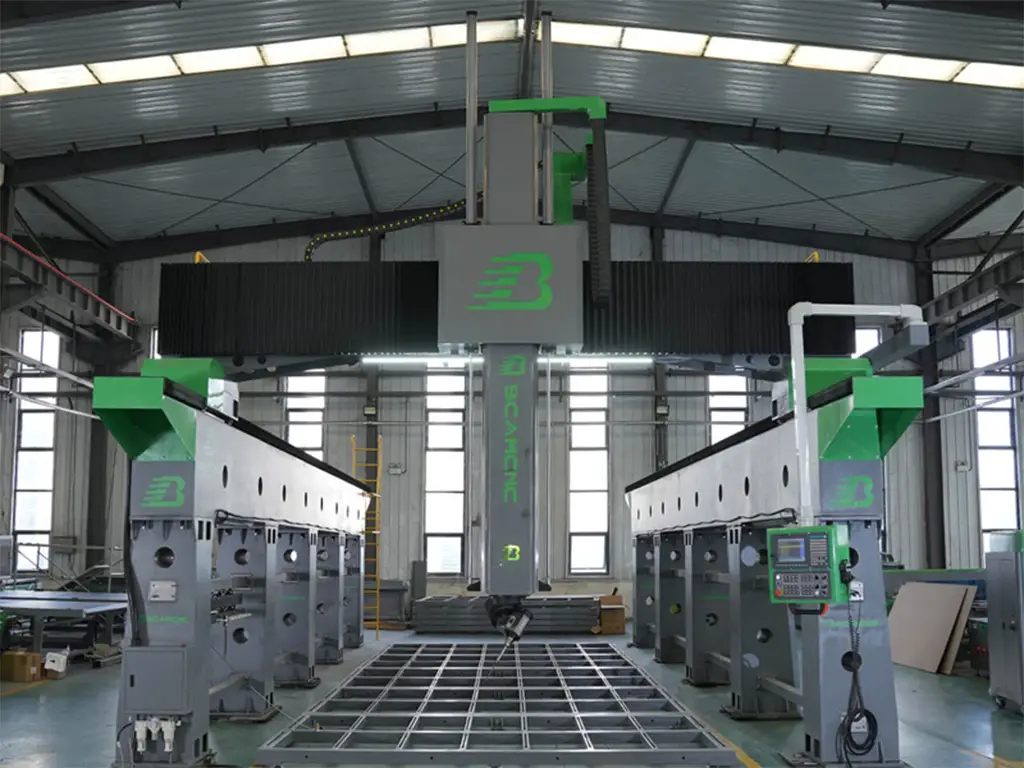
Marine molds are physically large, but the tolerance chain is surprisingly unforgiving
Large ship molds do not require aerospace-level tolerances everywhere. But cumulative deviation becomes a serious issue once sections start joining together.
In real marine production:
- a 1 mm deviation on one section is manageable
- several small deviations across multiple mold zones become a fitting nightmare
- manual correction increases resin use and finishing time
- assembly teams begin compensating on-site
- repeatability between production batches disappears
This is why many shipyards eventually realize the real bottleneck is not cutting speed.
It is process consistency.
For large composite molds, most factories typically target:
| Application | Practical Tolerance Range |
|---|---|
| Large hull mold roughing | ±0.8 mm to ±1.5 mm |
| Mold finishing surfaces | ±0.2 mm to ±0.5 mm |
| Deck interface zones | ±0.3 mm |
| Interior composite structures | ±0.2 mm to ±0.8 mm |
Holding those tolerances continuously across a 15-meter workpiece is where machine rigidity, thermal stability, and rotary-axis accuracy start mattering far more than brochure spindle speeds.
The machine structure matters more than advertised rapid speed
A lot of buyers focus first on:
- spindle power
- rapid movement speed
- maximum RPM
Those matter.
But for large marine molds, the real questions are:
- How stable is the gantry under long-travel cutting?
- How much vibration appears at deep Z-axis extension?
- How does the rotary head behave during continuous contour machining?
- How much geometry drift appears after 10 hours of operation?
Large mold machining creates long leverage forces.
If the machine frame is too light, operators start hearing it before they see it:
- unstable cutting sound
- low-frequency vibration
- visible chatter patterns
- inconsistent surface finish
- excessive polishing time afterward
A machine can still “finish the job” while quietly creating downstream labor costs.
That part rarely appears in sales presentations.
Real Production Case: BCAMCNC 5 Axis Router for a 15-Meter Ship Mold in Greece
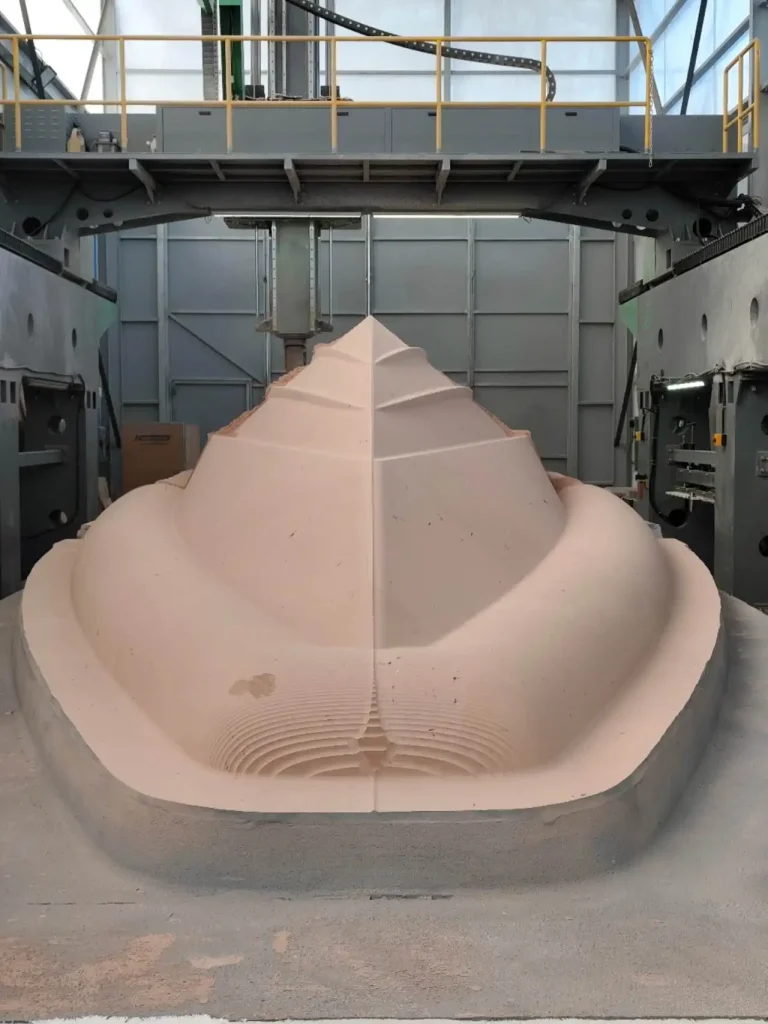
One of BCAMCNC’s customers in Greece used a large-format 5 axis CNC router for machining a 15-meter composite ship mold used in yacht manufacturing.
The customer’s previous workflow relied heavily on:
- sectional machining
- manual template alignment
- hand fairing after assembly
- extensive polishing before coating
The biggest issue was not rough machining accuracy.
It was accumulated deviation after joining large sections together.
Operators spent too many hours correcting:
- transition areas
- flange alignment
- curved surface continuity
- bonding edge mismatch
The customer eventually moved to a full 5 axis process mainly to reduce secondary finishing work.
Production configuration
Typical production setup included:
- large-format 5 axis gantry structure
- high-speed Italian spindle
- vacuum plus mechanical positioning
- long-reach finishing tools
- EPS foam and composite tooling board processing
- continuous multi-surface machining
During early production, one issue appeared repeatedly:
the CAM output contained excessive point density on long curved surfaces.
This caused:
- unstable machine motion
- unnecessary rotary-axis movement
- visible micro-vibration marks
- higher spindle temperature during finishing passes
The machine itself was stable.
The bottleneck came from old programming habits carried over from earlier 3 axis workflows.
After optimizing:
- spline smoothing
- toolpath segmentation
- acceleration settings
- post processor output
the customer saw:
- noticeably smoother mold surfaces
- reduced polishing time
- more stable tool life
- lower manual correction workload
This is common when shipyards transition into full 5 axis production.
The machine upgrade is usually easier than the workflow upgrade.
Composite dust becomes a long-term maintenance issue
Marine composite machining creates extremely aggressive dust conditions.
Fiberglass and carbon dust do not simply “make the shop dirty.”
Over time, they attack:
- linear guides
- spindle seals
- rotary-axis protection
- lubrication systems
- electrical cabinets
- pneumatic components
In the Greece project, dust extraction design became nearly as important as spindle selection.
Poor extraction usually creates a chain reaction:
- heat buildup increases
- chips stop evacuating efficiently
- tool wear accelerates
- spindle load rises
- surface quality drops
Some factories respond by lowering feed speed.
That often makes the problem worse because the cutter starts rubbing instead of cutting properly.
For marine composite machining, localized extraction near the spindle is not optional. Especially during long finishing operations where fine dust continuously circulates around the machine head.
3 Axis vs 5 Axis in Large Marine Mold Manufacturing
| Factor | Traditional 3 Axis Workflow | 5 Axis CNC Router |
|---|---|---|
| Workpiece repositioning | Frequent | Minimal |
| Manual fairing workload | High | Much lower |
| Surface continuity | Operator-dependent | More consistent |
| Access to complex curves | Limited | Excellent |
| Long-tool vibration risk | Higher | Reduced through tool orientation |
| Production repeatability | Moderate | Stronger |
| CAM complexity | Lower | Higher |
| Operator dependency | Very high | More process-controlled |
| Mold finishing time | Long | Significantly reduced |
Hidden Costs Many Buyers Ignore
Machine foundation matters more than people expect
One issue that appears frequently in large marine installations is floor stability.
Large-format 5 axis routers are heavy machines running dynamic loads over long travel distances.
If the concrete foundation lacks rigidity or proper leveling:
- geometry drift appears
- long-axis alignment changes
- surface accuracy becomes inconsistent
Several shipyards discover this only after installation.
Buying a high-end machine while placing it on a weak floor is like mounting a precision spindle onto a vibrating scaffold.
Long Z-axis travel creates leverage problems
Ship molds often require deep machining reach.
But large Z-axis travel introduces:
- increased vibration
- leverage amplification
- reduced rigidity at full extension
This becomes especially visible during finishing passes using long-reach ball nose tools.
In practical production, experienced operators usually prefer:
- the shortest possible tool
- staged machining strategies
- optimized tool orientation
- conservative acceleration during finishing
Those decisions improve surface stability far more than simply increasing spindle RPM.
FAQ
Is a 5 axis CNC router necessary for all ship mold production?
No.
For simple flat marine panels or standard nesting production, a high-quality 3 axis router may still be the better economic choice.
5 axis becomes valuable when:
- mold geometry becomes complex
- manual finishing consumes too much labor
- section alignment becomes difficult
- production repeatability becomes critical
What materials are commonly machined in marine mold production?
Typical materials include:
- EPS foam
- polyurethane tooling board
- fiberglass composites
- carbon fiber composites
- marine plywood
- honeycomb structures
Each material behaves differently under heat, vibration, and cutting pressure.
What is one of the biggest hidden operational costs?
Dust management.
Poor extraction systems shorten machine life significantly, especially in composite processing environments.
Does 5 axis machining immediately reduce labor costs?
Usually not immediately.
Most factories experience a transition period involving:
- CAM optimization
- tooling adjustment
- operator training
- fixture redesign
- process standardization
The major efficiency gains usually appear after workflows stabilize.
Final Thoughts from the Production Floor
A 5 axis CNC router does not magically solve shipyard problems.
What it does, when integrated properly, is reduce production uncertainty:
- fewer manual corrections
- fewer fitting surprises
- fewer polishing hours
- fewer assembly delays
- more stable mold repeatability
For large marine mold production, that stability matters more than peak cutting speed.
The factories getting the best long-term results are usually not the ones chasing the most aggressive machine specifications.
They are the ones building stable production systems around the machine:
- proper CAM workflow
- realistic tooling strategy
- disciplined maintenance
- dust management
- experienced operators
- solid machine foundations
That is where 5 axis machining starts becoming a real manufacturing advantage instead of just an expensive piece of equipment on the workshop floor.
Consulting with BCAMCNC
At BCAMCNC, we work with manufacturers processing large marine molds, composite structures, and complex curved components where production stability matters more than marketing specifications.
If your current workflow still depends heavily on manual fairing, repeated alignment correction, or excessive finishing labor, the issue may not be labor efficiency alone. It may be the entire machining process behind it.
Our engineering team can evaluate:
- mold dimensions
- material type
- production workflow
- machine configuration
- workshop conditions
- downstream process requirements
before recommending whether a large-format 5 axis CNC router is actually the right solution for your production environment.