
Choosing the right CNC router size is one of the most important decisions you will make before buying a machine. The correct size affects what materials you can process, how efficient your workflow is, and how much return you get on your investment. In this guide, we explain CNC router sizes in simple terms and help you decide which size fits your business best.
Why CNC Router Size Matters
The size of a CNC router mainly refers to its working area (cutting area). This determines the maximum size of material you can load and process in one setup.
If the machine is too small:
- Large panels must be cut in multiple steps
- Accuracy may decrease
- Production time increases
If the machine is too large:
- Cost is higher than necessary
- More floor space is required
- Power consumption increases
The goal is to choose a size that matches your materials, products, and production volume.
Common CNC Router Sizes
Below are the most common CNC router sizes used in woodworking and industrial applications.
1. Small CNC Router (600×900 mm / 2×3 ft)
Best for:
- Hobby users
- Small workshops
- Sign making
- Crafts and small parts
Advantages:
- Low cost
- Small footprint
- Easy to operate
Limitations:
- Cannot process full-size sheets
- Not suitable for mass production
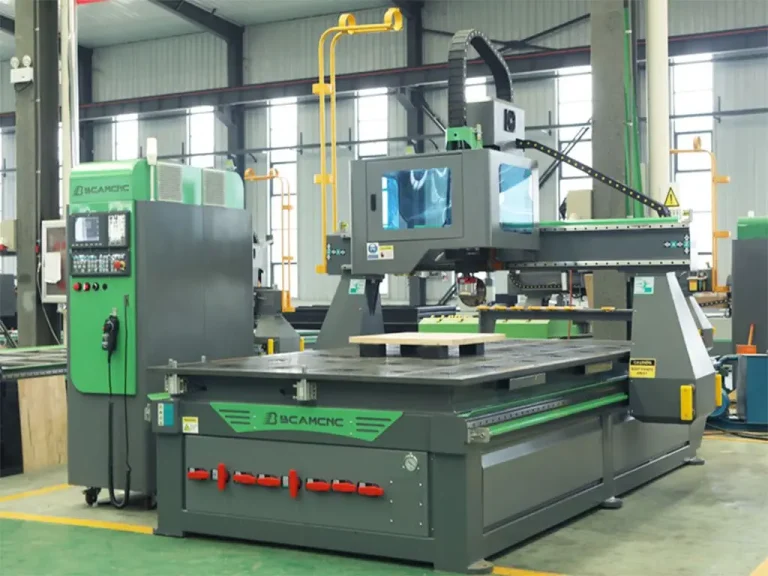
2. Medium CNC Router (1325 / 4×8 ft)
Working area: approx. 1300×2500 mm
Best for:
- Cabinet making
- Furniture panels
- Advertising and signage
- Wood, MDF, plywood, acrylic
Advantages:
- Can process standard 4×8 sheets
- High cost-performance ratio
- Most popular size in the market
This size is ideal for most professional woodworking businesses.
3. Large CNC Router (1530 / 5×10 ft)
Working area: approx. 1500×3000 mm
Best for:
- Large furniture panels
- Doors and wardrobes
- Batch production
- Reduced material waste
Advantages:
- Handles oversized sheets
- Fewer material repositioning steps
- Higher efficiency for factories
This size is common in medium to large factories.
4. Extra-Large CNC Router (2030, 2040, 2060)
Best for:
- Industrial manufacturing
- Boat building
- Mold making
- Composite and aluminum sheets
Advantages:
- Supports very large workpieces
- Suitable for heavy-duty cutting
Limitations:
- High machine and installation cost
- Requires large workshop space
How to Choose the Right Size CNC Router
Before buying, ask yourself these questions:
1. What material size do you use most?
If you mainly use standard 4×8 sheets, a 1325 CNC router is enough. If you often cut larger panels, consider a 1530 or bigger.
2. What products do you make?
- Signs, crafts: small or medium size
- Cabinets, furniture: 1325 or 1530
- Doors, panels, molds: large size
3. How much space do you have?
Always leave extra space for:
- Loading and unloading material
- Maintenance access
- Dust collection system
4. Do you plan to expand in the future?
If your business is growing, choosing a slightly larger machine can save upgrade costs later.
Other Factors Besides Size
CNC router size is important, but do not ignore these factors:
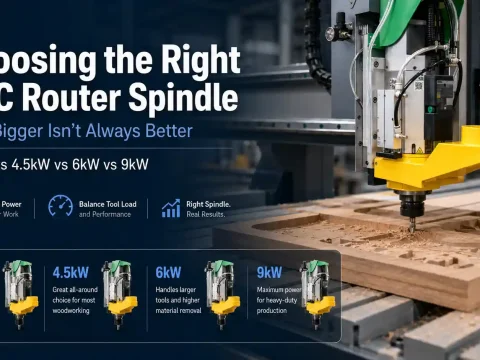
- Spindle power
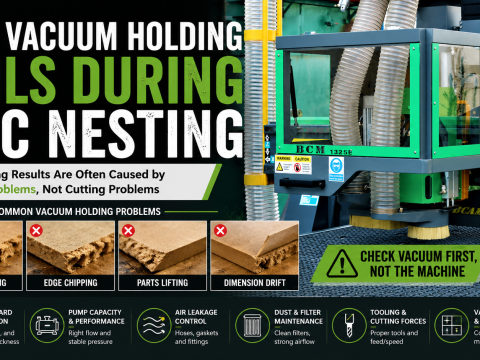
- Vacuum table or T-slot table
- ATC (Automatic Tool Changer)
- 4-axis or 5-axis capability
- Machine frame and stability
A well-matched configuration often matters more than size alone.
Final Recommendation
For most woodworking and furniture manufacturers, a 4×8 ft (1325) CNC router is the best starting point. It balances price, performance, and flexibility. For higher output or larger panels, a 5×10 ft (1530) CNC router offers better efficiency.
If you are unsure which size fits your application, consulting with an experienced CNC router manufacturer can help you avoid costly mistakes.
About BCAMCNC
BCAMCNC provides a full range of CNC routers, from compact machines to large industrial models. Our team helps customers choose the right size and configuration based on real production needs.