
When buyers compare CNC routers, they often focus on spindle power, control systems, or tool changers. However, one critical factor is frequently underestimated: machine frame design.
In reality, the frame is the foundation of a CNC router. It directly affects accuracy, stability, lifespan, and long-term return on investment.
For manufacturers, furniture factories, and woodworking shops, understanding frame design helps avoid costly mistakes.
The Frame Is the Backbone of a CNC Router
The machine frame supports every moving component, including the gantry, spindle, motors, and linear guides. If the frame lacks rigidity, no advanced configuration can compensate for it.
A well-designed frame ensures:
- Stable machining at high speeds
- Consistent cutting accuracy
- Reduced vibration and noise
- Longer service life of mechanical parts
In short, the frame determines how well a CNC router performs under real production conditions.
How Frame Design Affects Machining Accuracy
Accuracy in CNC routing depends on repeatable, controlled motion. Poor frame design can cause flexing or deformation during cutting, especially when machining hardwood, MDF, or aluminum.
Key impacts include:
- Tool deflection during heavy cuts
- Inconsistent depth and edge quality
- Alignment drift over time
Industrial-grade frames maintain geometry even under continuous load, which is essential for cabinet making, furniture production, and precision parts.
Vibration Control and Surface Finish
Vibration is a common issue in lightweight or poorly welded CNC frames. Excess vibration leads to:
- Chatter marks on the surface
- Reduced tool life
- Lower feed rates to maintain quality
High-quality CNC routers use thick steel structures and reinforced crossbeams to absorb vibration. This results in smoother finishes and higher productivity.
Welded Steel vs. Cast or Lightweight Frames
Not all frames are built the same. Common types include:
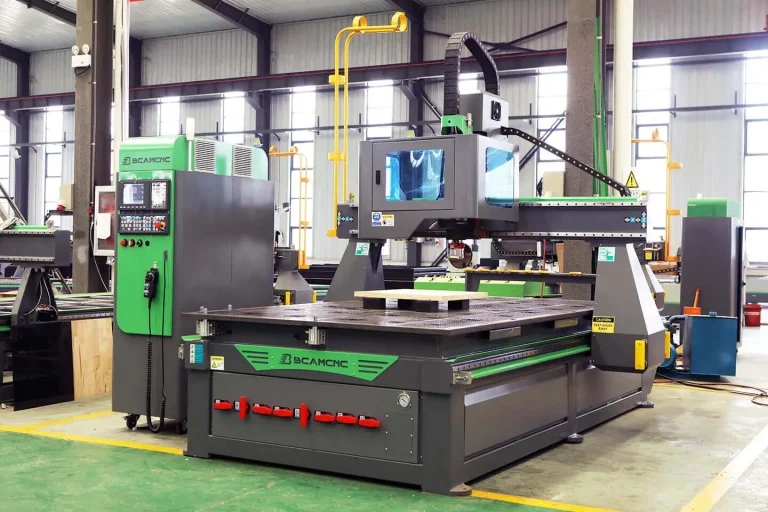
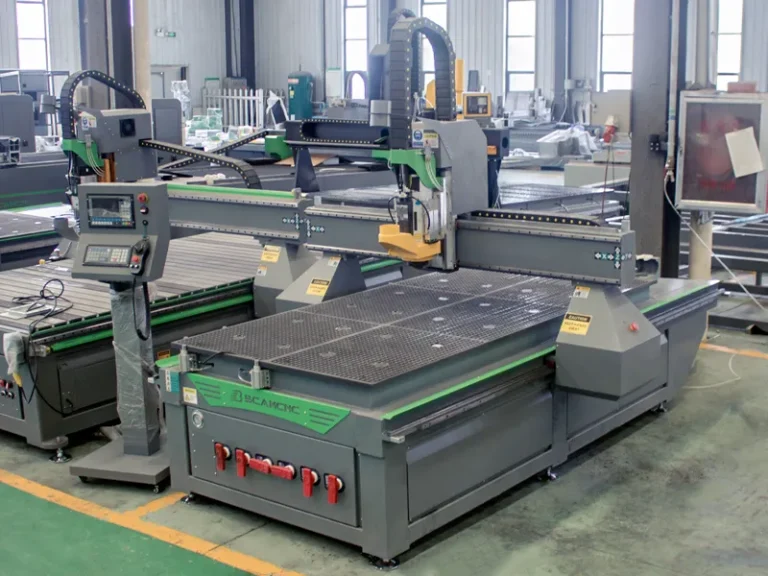
Welded Steel Frames
- High rigidity
- Suitable for industrial production
- Better resistance to long-term deformation
Lightweight or Aluminum Frames
- Lower cost
- Easier to transport
- Limited stability for heavy-duty work
For professional workshops and factories, welded steel frames are the preferred choice for reliability and precision.
Heat Treatment and Stress Relief
Frame material alone is not enough. Professional CNC router manufacturers apply stress relief processes after welding. This prevents internal tension from causing deformation during long-term use.
Without proper stress relief:
- Accuracy may decrease over time
- Linear rails may lose alignment
- Maintenance costs increase
This process is especially important for large-format and 5-axis CNC routers.
Why Frame Design Matters More for 5-Axis CNC Routers
5-axis CNC routers perform complex, multi-directional cutting. This places significantly higher demands on the machine structure.
A rigid, well-balanced frame ensures:
- Stable simultaneous 5-axis motion
- Accurate angular positioning
- Safe operation at high spindle speeds
For advanced applications, frame quality is not optional—it is critical.
Long-Term Value and Total Cost of Ownership
A CNC router with a strong frame may cost more initially, but it offers:
- Higher production efficiency
- Lower maintenance frequency
- More consistent output quality
Over time, this translates into a lower total cost of ownership and higher profitability.
Final Thoughts
Machine frame design is not a hidden detail—it is a core performance factor. Whether you are purchasing a standard CNC router or a high-end 5-axis system, the frame determines how the machine performs today and years from now.
For businesses that value precision, stability, and long-term reliability, investing in a well-engineered CNC frame is a smart decision.