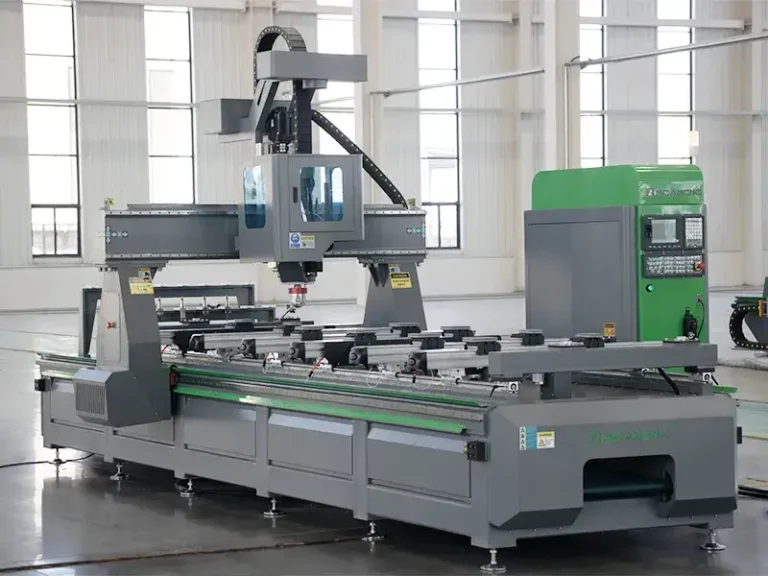


5-axis CNC routers are a practical solution for improving precision and efficiency in selected stages of wind turbine blade manufacturing. At BCAMCNC, these applications are approached with a focus on real production constraints—machine stability, composite material behavior, and process integration—rather than theoretical capability alone. When properly configured, 5-axis systems contribute to consistent machining results, but their value depends on how well they are adapted to specific production environments.
1. Industry Context and Practical Challenges
Wind turbine blades are typically made from fiberglass or carbon fiber composites. After molding and curing, secondary machining is required for trimming, drilling, and finishing.
In real factory conditions, manufacturers face several constraints:
- Large workpiece size and limited handling flexibility
- Sensitivity of composite materials to heat and vibration
- High requirements for dimensional consistency across batches
At BCAMCNC, equipment design and configuration are typically aligned with these constraints, rather than assuming ideal machining conditions.
2. Core Applications with Process-Oriented Perspective
2.1 Edge Trimming
Edge trimming is one of the most common post-processing steps.
- 5-axis routers allow controlled tool orientation along curved blade edges
- This helps maintain more stable cutting conditions
- In practice, proper spindle selection and dust extraction are equally important to ensure consistent results
To reduce the risk of delamination in composite materials, BCAMCNC recommends using down-cut or compression bits during trimming. This approach requires the 5-axis system to maintain precise tool orientation relative to the surface normal, ensuring consistent cutting forces and minimizing fiber pull-out along the edge.
BCAMCNC systems are typically configured with attention to vibration control and toolpath smoothness, which are critical in composite trimming.
2.2 Root Section Drilling
The blade root requires accurate hole positioning for structural assembly.
- Multi-axis capability enables drilling at different angles without repositioning
- This reduces cumulative positioning errors
From a practical standpoint, BCAMCNC focuses on machine rigidity and positioning stability, as these directly affect hole accuracy in large components.
2.3 Machining Complex Surfaces
Blade geometry involves continuous curvature and varying thickness.
- 5-axis motion improves tool accessibility to complex regions
- It reduces the need for multiple setups
However, real performance depends on machine kinematics and control system tuning. BCAMCNC emphasizes stable motion control and coordinated axis movement to handle large-format machining more reliably.
2.4 Mold and Tooling Production
Mold accuracy directly affects blade quality.
- 5-axis CNC routers are used to produce large composite molds and master patterns
- Surface consistency and repeatability are key factors
In this area, BCAMCNC typically prioritizes structural machine design and long-term accuracy retention, which are critical for large mold machining.
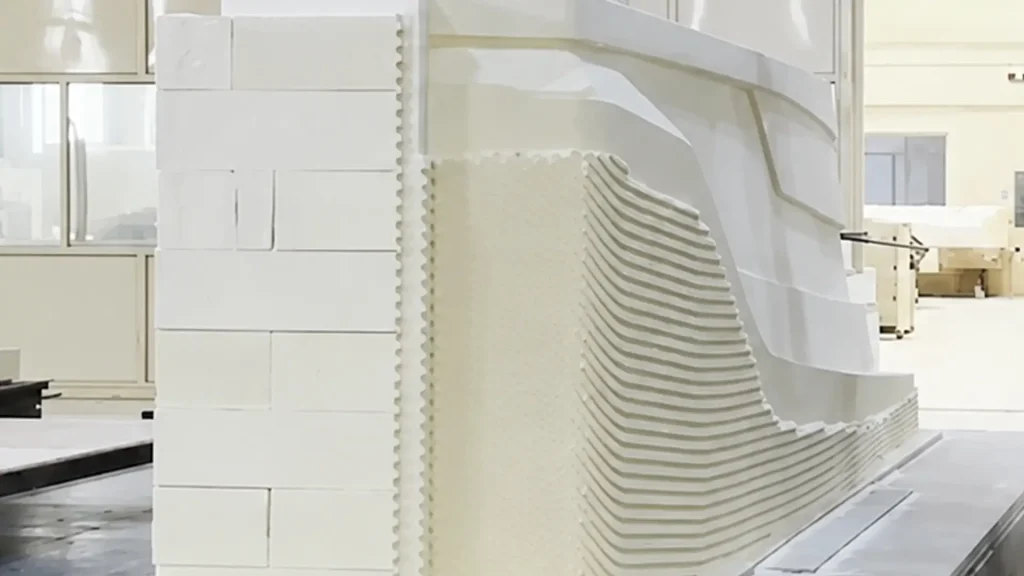
BCAMCNC 5-Axis CNC Router Machining a Large-Scale Composite Wind Turbine Blade Mold. Note the articulated spindle head for simultaneous A/C axis movement, maintaining tool orientation normal to the complex, curved surface.
3. Practical Advantages in Industrial Use
3.1 Process Stability over Theoretical Speed
While 5-axis machining can reduce setup steps, the more relevant benefit in blade manufacturing is process stability.
- Fewer repositioning operations reduce alignment risks
- Stable tool orientation improves repeatability
3.2 Adaptation to Composite Materials
Composite machining introduces challenges such as dust, delamination, and tool wear.
- Effective dust extraction and tool selection are necessary
- Machine configuration plays a role in maintaining consistent cutting conditions
BCAMCNC systems are generally integrated with these considerations in mind, rather than treating them as secondary factors.
4. Limitations and Realistic Considerations
5-axis CNC routers are not a universal solution:
- Higher investment and integration costs
- Increased programming complexity, requiring experienced operators
- Maintenance requirements, especially for multi-axis components
- Dependence on overall process setup, not just machine capability
At BCAMCNC, the focus is typically on helping users match machine configuration to actual production needs, avoiding over-specification.
5. Implementation Approach at BCAMCNC
Instead of positioning 5-axis routers as standalone solutions, BCAMCNC generally approaches them as part of a complete process:
- Matching machine size and structure to blade dimensions
- Optimizing spindle and tooling for composite materials
- Integrating dust extraction and environmental control
- Supporting customers with application-based configuration guidance
This approach reflects practical experience in CNC applications rather than purely theoretical performance claims.
6. Conclusion
5-axis CNC routers play a defined and valuable role in wind turbine blade manufacturing, particularly in trimming, drilling, and mold production. Their effectiveness depends less on the number of axes and more on how well the system is adapted to real production conditions.
At BCAMCNC, the emphasis is on aligning machine capability with application requirements, ensuring that 5-axis technology delivers consistent, reliable results without overstating its scope.