
Buying a CNC Router is a long-term investment, not a short-term purchase.
Many buyers focus only on price, but later discover that the machine does not meet their real production needs. In most cases, the problem is not the brand—it is that key technical parameters were not clearly confirmed before purchase.
This article explains the 10 most important technical parameters you must check before buying a CNC Router, especially for industrial and factory-level applications.
1. Working Area (Effective Cutting Size)
The working area defines the maximum material size the CNC router can process.
Before choosing a machine, you should confirm:
- Maximum sheet size (for example, 1300×2500 mm or 2000×4000 mm)
- Actual usable cutting area (not just table size)
- Z-axis working height for thick materials or 3D shapes
Choosing a machine that is too small limits production.
Choosing one that is too large increases unnecessary cost.
Always match the working area to your real product dimensions, not future assumptions.
2. Machine Frame and Structure
The frame structure directly affects accuracy, vibration, and long-term stability.
Key points to confirm:
- Welded steel frame or cast structure
- Frame weight and wall thickness
- Stress relief treatment (aging process)
For industrial CNC routers, a heavy-duty steel frame is essential.
A lightweight structure may work at the beginning but will lose precision over time.
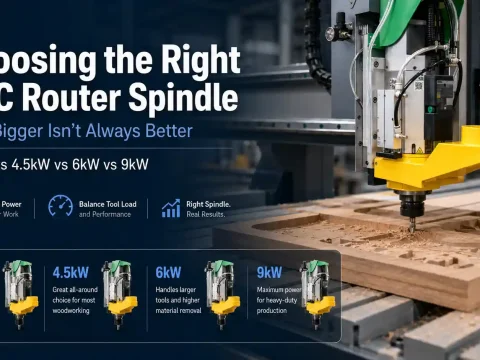
3. Spindle Power and Type
The spindle determines what materials you can cut and how fast you can work.
Important parameters include:
- Power rating (e.g. 6 kW, 9 kW, 12 kW)
- Air-cooled or water-cooled
- Maximum RPM
- Tool holder type (ISO, HSK, ER)
High spindle power is especially important for:
- Hardwood
- Aluminum
- Long continuous cutting
Do not choose spindle power based only on price—match it to material hardness and cutting depth.
4. Axis Configuration (3 Axis, 4 Axis, or 5 Axis)
Axis configuration defines machining capability.
- 3 Axis CNC Router: flat panels, simple 3D surfaces
- 4 Axis CNC Router: rotary processing, columns, cylinders
- 5 Axis CNC Router: complex curves, undercuts, multi-angle machining
If you process complex shapes, molds, or curved furniture components, a 5 Axis CNC Router can reduce setups, improve accuracy, and save time.
5. Linear Guide Rails and Transmission System
Motion components directly affect precision and repeatability.
You should confirm:
- Linear guide brand and size
- Ball screw or rack and pinion drive
- Axis drive motor type (servo vs stepper)
Industrial machines typically use:
- Large-size linear guides
- Servo motors
- High-precision ball screws or helical racks
These components ensure stable performance during long production cycles.
6. Control System and Software Compatibility
The control system is the “brain” of the CNC router.
Important factors:
- Controller brand and model
- Supported file formats
- Compatibility with CAM software
Ease of operation and stability
A good control system should support:
- Smooth multi-axis interpolation
- Stable long-time operation
- Easy parameter adjustment
Software compatibility is especially important for 5-axis machining.
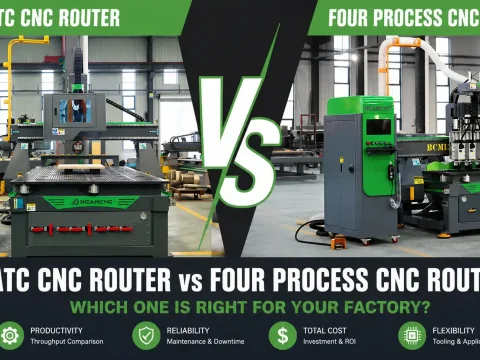
7. Tool Changer System (ATC)
Automatic Tool Changer (ATC) significantly improves efficiency.
You should check:
- Number of tool positions
- Tool change time
- Tool holder standard
- Magazine type (linear or carousel)
For factories producing multiple parts or complex jobs, ATC is no longer optional—it is a productivity requirement.
8. Positioning Accuracy and Repeatability
These two parameters define machining quality.
- Positioning accuracy: how close the machine moves to the target position
- Repeatability: how consistently it returns to the same position
These values are especially important for:
- Precision parts
- Assembly components
- Long-term batch production
Always request measured data, not just theoretical numbers.
9. Electrical Components and Safety Design
Electrical quality affects reliability and service life.
Confirm:
- Electrical component brands
- Cable protection and routing
- Overload and safety protection systems
- Compliance with international standards
Industrial CNC routers should be designed for continuous operation, not occasional use.
10. After-Sales Support and Technical Service Capability
This is often ignored but extremely important.
Before buying, confirm:
- Installation and training support
- Remote technical assistance
- Spare parts availability
- Long-term service capability
A CNC router is not a standalone product—it is part of your production system.
Reliable technical support reduces downtime and risk.
Final Thoughts
Choosing a CNC Router is not about finding the lowest price.
It is about matching technical parameters to your real production needs.
By confirming these 10 key parameters before purchase, you can avoid costly mistakes and ensure your machine delivers long-term value.
If you are planning to invest in an industrial CNC Router or 5 Axis CNC Router, a professional evaluation of these parameters will always pay off.