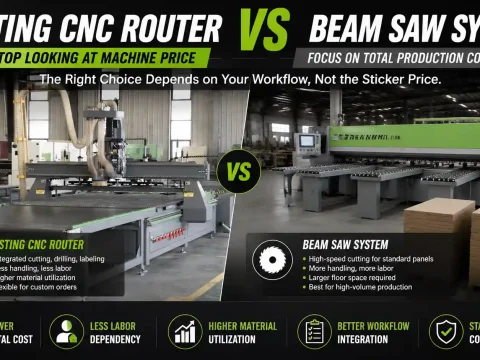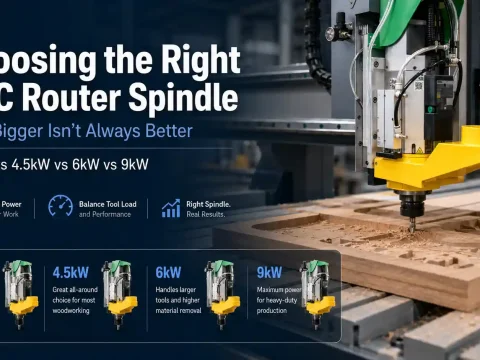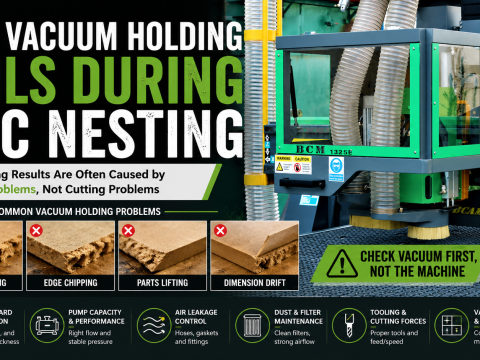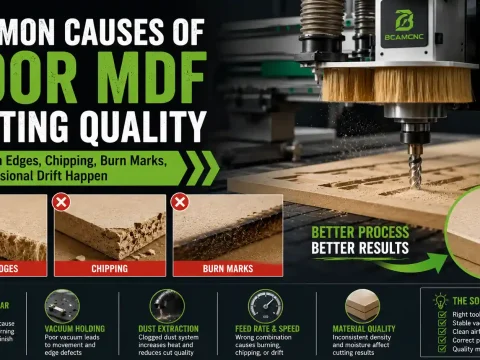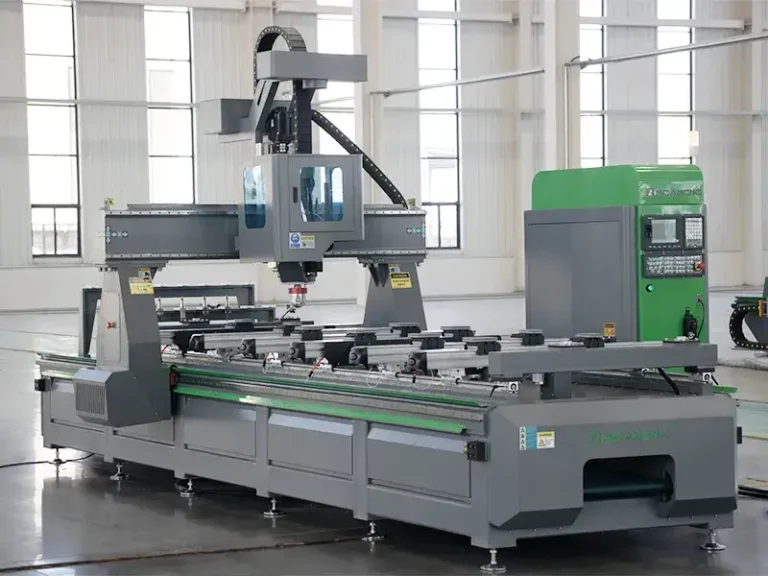

An ATC CNC router is a computer-controlled cutting machine with an Automatic Tool Changer (ATC).
Unlike a basic CNC router, it does not need the operator to stop the job and change tools by hand.
The machine changes tools by itself, saving time and reducing mistakes.
This makes ATC routers popular in furniture production, cabinet making, sign factories, and industrial manufacturing.
How an ATC System Works
An ATC system includes:
- Tool Magazine – holds different tools such as drill bits, end mills, and router bits.
- Tool Holder – locks each tool safely during cutting.
- ATC Arm or Spindle Mechanism – picks and places the tools automatically.
- Control System – tells the machine which tool to use based on the program.
The CNC reads the G-code and switches tools at the right moment without stopping the job.
Why ATC CNC Routers Are Better
1. Higher Efficiency
ATC routers reduce manual tool changes.
This saves a lot of time, especially for jobs that need 4–10 different tools.
2. More Precision
Automatic tool measurement helps keep cutting accuracy stable.
This is important for cabinets, molds, and detailed parts.
3. Better Safety
Operators do not need to handle hot or sharp tools during production.
4. Improved Productivity
One operator can manage multiple machines because the ATC system does most of the work.
Common Types of ATC CNC Routers
Linear ATC CNC Router
Tools are arranged in a row behind the machine.
The spindle moves to pick each tool.
Good for large production jobs.
Carousel ATC CNC Router
Tools rotate in a circular magazine near the spindle.
Tool changes are faster, ideal for high-speed production.
For complex 3D cutting, molds, aerospace parts, stone cutting, and high-precision machining.
What Materials Can an ATC CNC Router Cut?
- Wood: MDF, plywood, solid wood
- Plastics: PVC, acrylic, HDPE
- Aluminum and soft metals
- Composite materials
- Foam and EVA
- Artificial stone
This makes ATC routers suitable for many industries.
Who Should Use an ATC CNC Router?
An ATC CNC router is perfect for:
- Furniture factories
- Cabinet shops
- Door and panel manufacturers
- Sign makers
- Mold makers
- Metal and plastic part producers
If your production requires multiple tools in one job, an ATC router will greatly improve workflow.
Why Choose BCAMCNC ATC Wood Router Machine?
BCAMCNC machines are built for long-term industrial use.
They offer:
- Fast and stable automatic tool change
- Heavy-duty structure for better precision
- International-standard components
- CE certification
- Factory-direct price
- Local overseas service + 3-year after-sales support
- Free training and online assistance
BCAMCNC has helped thousands of customers upgrade their production with efficient ATC CNC routers.
Conclusion
ATC CNC routers make manufacturing faster, cleaner, and more accurate.
They remove manual tool changes and help businesses produce more in less time.
For factories that want reliable performance and higher profits, an ATC CNC router is a smart investment.
If you want a model suggestion or a price quote, BCAMCNC can help you choose the right machine.