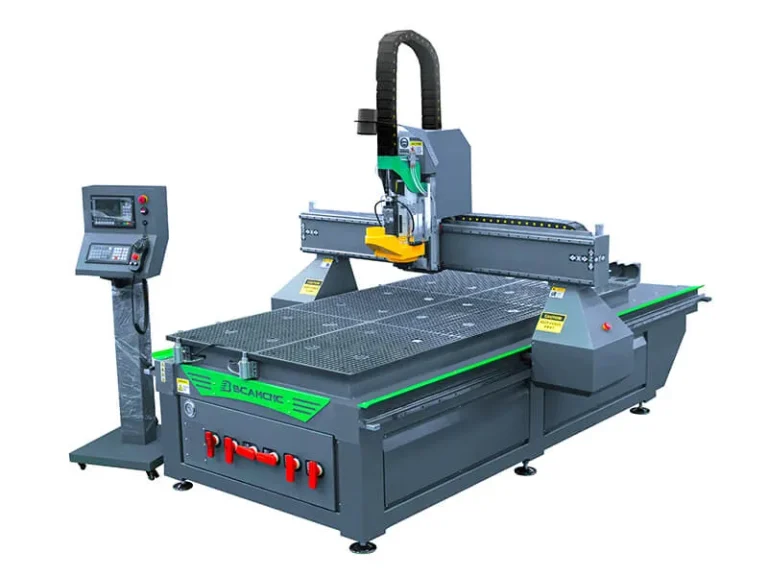

The bosses who bought the engraving machine all feel the same. The engraving machine will generate heat if it is used for a long time. At this time, the motor is too hot and it will cause some negative effects. We should consider how to dissipate heat. When the temperature of the stone engraving machine motor is too high, you can choose to stop the machine for a while and continue to work. You can also add heat radiation in the motor to ensure that the heat is emitted in time.
Here are some tips on heat dissipation: the electric heating temperature range depends on the insulation of the engraving machine motor. Generally, the internal insulation will be destroyed at a high temperature (130 degrees). As long as it does not exceed 130 degrees, the motor will not be damaged, but at this time, the surface temperature is below 90 degrees. Therefore, it is normal for the surface temperature of the motor to be 70-80 degrees. A simple temperature measuring point thermometer is useful, you can also roughly determine: 1-2 seconds hand touch, no more than 60 degrees, only hand touch, about 70, 80 degrees; a few drops of water quickly vaporize, then 90 degrees .
The heat dissipation of the engraving machine is also very important. Passive heat dissipation and air-cooled heat dissipation are commonly used. For low-power machines, passive heat dissipation can be used to solve the problem. Using the temperature difference between the ambient temperature and the equipment, and natural cooling, this is relatively simple and low cost. Suitable for heat dissipation of low-power, short-time equipment.
Air-cooled heat dissipation is more extensive, and most of them use this method to dissipate heat. Air-cooled heat dissipation uses a fan to blow away the heat, so as to quickly dissipate heat. But air cooling also has many drawbacks. For example, long hours of work, the noise is indeed very loud. And it is easy to accumulate dust, resulting in poor heat dissipation.
Water-cooling heat dissipation is to add a heat-absorbing cold head on the surface of the heating core, which can flow through water to transport heat to achieve the effect of cooling. Or a water-cooling device is installed externally, and the working principle is the same as the previous one. The disadvantage of water cooling is its high cost. The advantage is that its heat dissipation effect is quite good, and it will not be disturbed by dust.
With the increase of high-power engraving machines, the problem of heat dissipation has become increasingly serious. As a new trend in the field of heat dissipation, water-cooled heat dissipation will definitely play an increasingly important role. For more knowledge about engraving machines, we will continue to update you, please continue to pay attention, Bcam will serve you wholeheartedly.