
In metal fabrication, a fiber laser cutting machine is expected to deliver clean, stable, and precise results. However, many workshops and factories occasionally run into a common issue — cutting quality that fluctuates from one piece to another.
Rough edges, sections that fail to cut through, inconsistent kerf width, or varying surface smoothness often point to the same root problem: the cutting conditions are not fully optimized for the material.
This article breaks down the most common causes behind inconsistent cutting performance and offers actionable solutions you can apply directly on the shop floor.
Common Signs of Inconsistent Cutting Quality
You might be experiencing unstable cutting output if you notice:
Uneven or rough edges
Changes in cut depth across the sheet
Portions of the material not cut through
Irregular kerf width
Inconsistent slag on the backside
These issues may look unrelated on the surface, but they tend to originate from a few core technical factors.
1. Incorrect Combination of Laser Power and Cutting Speed
Laser power and speed must be balanced according to:
Material type
Material thickness
Heat absorption characteristics
When these two parameters don’t match:
Too low power or too fast speed → incomplete cuts, burrs
Too high power or too slow speed → overheating, melting, wide kerf
Even a small misalignment can significantly impact edge quality and cutting consistency.
2. Improper Focus Position
The laser’s energy density is highest at the focal point.
If the focus position is off — even by a small margin — cutting quality will vary across the part:
Focus too high → undercutting, incomplete penetration
Focus too low → wide kerf, excessive slag
Focus drifts during cutting → inconsistent results across the sheet
This is one of the most overlooked reasons behind unstable output.
3. Material Inconsistency or Surface Variations
Not all metal sheets are perfectly uniform. Variations in:
Surface oxidation
Coatings
Plate flatness
Density
Batch differences
…can all lead to visible fluctuations in cutting results, especially in stainless steel and carbon steel.
If you notice inconsistent results between sheets, the material itself may be part of the cause.
4. Unstable Assist Gas Pressure
Assist gas plays multiple roles: removing molten metal, cooling the cut, and stabilizing the cutting process.
When gas pressure is unstable:
Low pressure → slag accumulation, incomplete cuts
Excessive pressure → rough edges, turbulent kerf
Gas purity and dryness also influence cutting performance.
5. Incomplete or Outdated Cutting Parameter Database
Many factories use parameters copied from other machines or outdated settings. Without continuous optimization:
The machine behaves differently from batch to batch
Operators rely on “experience tuning” instead of standardized parameters
Cutting consistency becomes difficult to maintain
A structured parameter library is essential for stable long-term performance.
How to Achieve Consistent Cutting Quality?
1. Test & Confirm Cutting Parameters Before Production
Perform a quick test cut on scrap material to optimize:
Power
Speed
Frequency (if applicable)
Focus position
Assist gas type & pressure
Record the best-performing combination and apply it to production.
This simple step solves over 70% of “inconsistent cutting” cases.
2. Calibrate the Autofocus System Regularly
If your machine uses an automatic focusing system:
Clean the capacitive sensor ring
Check Z-axis calibration
Ensure the lens and protective window are clean
Perform periodic focusing tests
Stable focus = stable cutting quality.
3. Maintain Consistent Material Supply
For large production runs, try to use:
The same batch
The same supplier
The same surface finish
This minimizes unexpected variations during cutting.
4. Ensure a Stable Gas Supply System
Keep your gas source:
Dry
Clean
Pressure-stable
A reliable nitrogen, oxygen, or compressed air system is critical for smooth edge quality.
5. Build Your Own Cutting Process Database
Leading fabrication workshops build internal parameter tables by material type and thickness.
For example:
1 mm stainless steel – nitrogen
3 mm carbon steel – oxygen
6 mm aluminum – air
A personalized parameter library greatly improves production consistency and reduces operator error.
How the Right Machine Improves Cutting Stability (BCAMCNC Advantages)
Sometimes inconsistent cutting comes from the equipment itself, not just the parameters.
Machines with outdated algorithms, unstable power output, or weak gas control will struggle to maintain cutting quality.
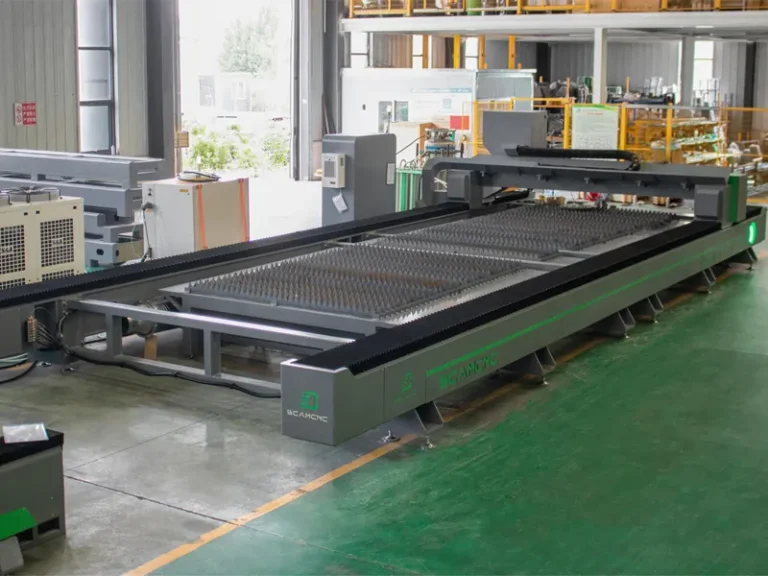
BCAMCNC fiber laser cutters are designed to ensure stable and repeatable cutting results:
High-precision autofocus system
Industrial-grade fiber laser sources with stable power output
High-speed servo motors and advanced motion control
Independent gas control for accurate and stable pressure
Pre-loaded cutting process database for common materials
These features help ensure that your cutting quality stays consistent, job after job.
Conclusion
Inconsistent cutting quality is usually caused by a combination of parameter settings, focal accuracy, gas stability, and material variations.
By optimizing these areas — and pairing them with a stable, high-performance laser cutting system — you can maintain clean, precise, and reliable results every time.
If you’d like material-specific cutting parameters or want to evaluate a more stable industrial laser cutting machine, BCAMCNC’s technical team is ready to help.