
Inventory of mahogany carving technology, what is the difference between embossing on woodworking engraving machine and manual carving? Since ancient times, the art of carving has played a very important role in people's lives. From home decoration to handicrafts, there is no shortage of carving art. The only difference is that wood engraving machine embossing for mechanical engraving equipment has gradually become popular, and there is a tendency to gradually replace manual engraving. The difference between the two engraving techniques is.
1, different engraving effects
Woodworking engraving machine embossing production is carried out by the engraving software to design the engraving path, and then input the computer for automatic engraving. Therefore, the details of the engraving are neat and unified. Whether it is a flower plate or a cloud bead, each place is the same size, and it looks like nothing different. This is extremely suitable for mass production, making furniture manufacturing more refined and perfect. Hand-engraving can not be compared with woodworking engraving machine regardless of the accuracy, but hand-engraving also has its own unique advantages. It can "pass through the branches" to carry out multiple layers of openwork, making the carved workpiece look full of life.
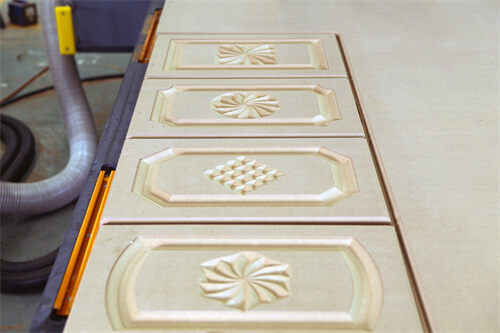
2, different engraving efficiency
is relatively hand-carved, woodworking engraving machine embossing production fast engraving efficiency, engraving accuracy, etc., is far from being comparable to hand-carving. There are also some customers who choose woodworking engraving machine to engrave, and then carry out manual modification, which can make the engraving efficiency and precision higher.
3, different carving details
Compared with hand-carving, woodworking engraving machine embossing has the same depth, and the transition point is smoother. When hand-carving, the carving depth is different, and the carving depth is limited.
If the same pair of Dapeng spread its wings, it can be embossed by a woodworking engraving machine to make mass production. The carving is exactly the same. It can show the power of the bird's wings. At the same time, it has the feeling of calling, which can save more time. Hand-carved, although it can be shaped, the lines are undulating, and the overall is three-dimensional, but it is a bit careless. The depth of the sculpture will affect the overall beauty of the picture.
4. Possible development trends of the engraving industry
It is undeniable that the embossing production of woodworking engraving machine will make the mahogany furniture market trend and prompt the mahogany furniture industry to adapt to survival quickly. The classification of mahogany furniture has been replaced by the exquisite CNC woodworking engraving machine furniture carving, which continues to occupy the high-end market. What can survive the tide of embossing on woodworking engraving machines must be hand-carved boutiques. From style to workmanship, it embodies unsurpassed manual craftsmanship like top luxury items, occupying the highest-end market of mahogany furniture. To be loved by connoisseurs and collectors.