
1. What is the Max height of the workpiece processed on your machine?
The Z height should not exceed the Gantry with a small technological gap. It is important to take into account the relief of the part and departure of the instrument. The machines have a power reserve of 50 mm more than the height of the gantry. This makes it possible to engrave the surface of the part close to the height of the gantry with the departure of the instrument up to 50 mm on the machine with the height of the gantry.2. What is the difference between a stepper motor and a servo motor?
2. What is the defference between step and Servo motors?
The servo motor reports the actual result of the command being executed to the servo controller. If the specified position is changed, it will receive a correction command.
3. What kind of spindle is better? Water-cooled or air-cooled?
If you choose a low-priced series, we recommend that you choose a water-cooled spindle.
4. Can I control the device directly from the computer?
You can realize this function by NC Studio control system ( S series DSP controller , C ,D,E sereis With Syntec Control system which allowed transfer file by WLAN ) .
5. What kind of CAM software can I use?
The preparation of the work program is carried out on the PC, running ArtCam, Vectric, TYPE 3 programs.
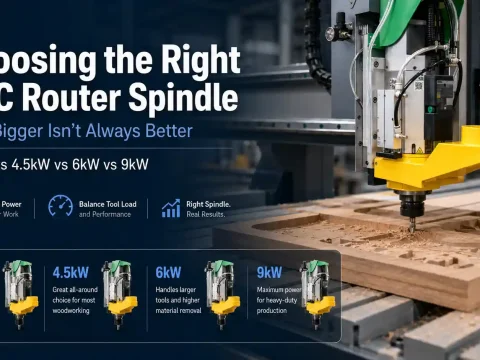
6. What power spindle do I need to choose?
If you plan to use a multi-rolling mill mainly for cutting plates, and the cutting tool diameter does not exceed 10 mm, a 3 kW spindle is sufficient.
If it is used to cut a tool with a diameter of more than 10 mm, a spindle in the range of 4.5 to 6 kW should be selected.
Engraving or 3D milling (usually performed by micro tools) requires a 1.5 kW spindle because this process involves the high-speed operation of a high-acceleration coordinate device. At the same time, these performances and machine tool performance will be achieved. The lighter the spindle and the pulley will be, and they can be moved slightly when processing complex terrain in a scanning or spiral manner.
If you want to use a machine tool for mold opening and 3D milling, the best choice is a 3.0 kW spindle.
7. What is the work list currently maintained by the machine? How often does it need to be executed?
Today, the machine must use compressed air or vacuum cleaner to clean the material to handle the product . This applies to guide rails, toothed guide rails, flexible cable circuits and air-cooled spindles. We highly recommend our unique design AirTech pro dust-free that can not only reduce dust to extend the life of the machine and protect the health of the operator, but also improve production efficiency.
8. Why do you provide a rather expensive oil-free vacuum pump? Isn't it a cheap water pump?
Oli-free pumps provide a deeper vacuum and are stronger than fixed processing materials, especially when processing small products.
9. Can I process aluminum on the machine?
All BCAM series machine have higher performance on this kind of metal, but aluminum processing can be carried out in C, D, E series, and the processing mode and tools are correctly selected.
10. Some substances in S series? What is the difference between him and the C series? S series is Manual Tools changer , it suitable for new one and also it entry level for lower investment business .
11. What is the difference between C series and D series? Where is the main replacement for the C series?
C series is Linear Automatic tools changer , D Series is Disk Automatic tools changer ,If you need Large Working table more than 2000*4000mm , we suggest you D series , D series with High spec of machine be sure with Highest performance .
12. How long is the production time for custom machine tools?
The manufacturing time of a customized serial-standard CNC milling machine is 30 to 50 working days, depending on the series and individual additional options. If the customer needs to make design changes to the product, the production period can be up to 90 working days.