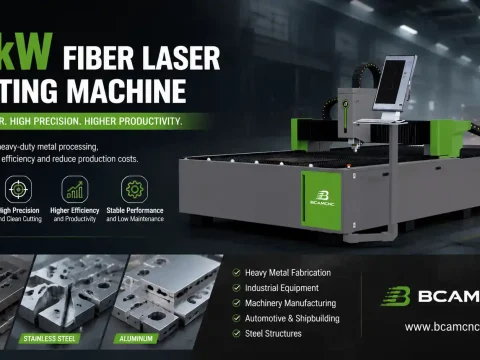

A 30kW fiber laser cutting machine represents a significant step forward in high-power metal processing, but higher power does not automatically mean every factory should choose the most powerful laser available.
The real question is not only “How thick can a 30kW fiber laser cut?”
The more important question is:
Can high-power laser technology improve your overall production process by reducing processing time, minimizing secondary operations, and improving manufacturing flexibility?
For factories processing heavy carbon steel, stainless steel, aluminum, and large metal components, high-power fiber laser cutting can provide advantages that traditional cutting methods often struggle to achieve.
However, the final production result still depends on many factors, including material type, thickness, gas selection, cutting head performance, machine structure, and process optimization.
Why Manufacturers Are Moving Toward High Power Fiber Laser Cutting
Traditional metal cutting methods such as flame cutting and plasma cutting have been widely used in heavy fabrication industries for many years.
They remain useful for certain applications, but manufacturers increasingly require:
- Faster production cycles
- Better edge quality
- Reduced secondary processing
- Higher automation levels
- More flexible production capability
A high-power fiber laser cutting machine addresses these requirements by delivering concentrated laser energy with precise control.
The advantage is not simply higher cutting speed.
The real value comes from improving the entire manufacturing workflow.
What Materials Can a 30kW Fiber Laser Cutting Machine Process?
A 30kW fiber laser cutting machine is mainly designed for demanding industrial applications where high productivity and processing capability are important.
Carbon Steel Cutting
Carbon steel is one of the most common materials in heavy fabrication.
Applications include:
- Structural components
- Industrial equipment
- Machinery parts
- Heavy metal fabrication
High-power laser cutting can help manufacturers improve productivity when processing thicker carbon steel materials, while maintaining accurate cutting paths and reducing the need for additional finishing operations.
Stainless Steel Cutting
Stainless steel requires careful control because surface quality and heat management directly affect the final appearance.
High-power fiber laser systems can help manufacturers process stainless steel components with:
- Clean cutting edges
- Reduced post-processing requirements
- Stable production quality
Typical applications include:
- Food equipment
- Industrial enclosures
- Precision metal structures
Aluminum Cutting
Aluminum has high reflectivity and thermal conductivity, which makes it more challenging than many traditional metals.
A suitable high-power fiber laser system with proper cutting parameters can provide manufacturers with a more efficient solution for aluminum processing.
Applications include:
- Transportation components
- Lightweight structures
- Industrial parts
Where High Power Fiber Laser Cutting Creates Real Value
The biggest advantage of a 30kW fiber laser cutting machine is not only the laser source power.
It is how the machine changes the production process.
Reducing Secondary Processing
Traditional cutting methods may leave:
- More heat-affected areas
- Rougher edges
- Additional cleaning requirements
When cutting quality improves, factories may reduce the time spent on grinding, polishing, or additional preparation.
This helps improve overall production efficiency.
Improving Material Utilization
Large metal components often involve expensive raw materials.
Modern laser cutting workflows combined with nesting software can help optimize sheet layout and reduce unnecessary material waste.
Better nesting efficiency means:
- More parts from each sheet
- Lower material cost
- Improved production planning
Supporting Automated Production
High-power fiber laser cutting machines are often integrated into automated production environments.
Depending on factory requirements, automation may include:
- Automatic loading systems
- Automatic unloading systems
- Production line integration
Automation helps manufacturers reduce manual handling and create more stable production processes.
30kW Fiber Laser Cutting vs Traditional Cutting Methods
| Processing Method | Main Advantages | Common Limitations |
|---|---|---|
| Flame Cutting | Suitable for heavy steel applications | Lower precision and more heat impact |
| Plasma Cutting | Flexible and widely used | Edge quality may require additional processing |
| Fiber Laser Cutting | High precision, automation capability, efficient processing | Higher initial investment |
The right technology depends on the production requirements.
For factories producing high-volume, precision metal components, fiber laser cutting can provide advantages in consistency and workflow efficiency.
Important Factors When Choosing a High Power Fiber Laser Cutting Machine
A high-power laser system is a production investment.
The laser power is only one part of the complete solution.
Machine Structure
Heavy-duty metal processing requires a stable machine structure.
During long cutting cycles, machine rigidity influences:
- Cutting stability
- Positioning accuracy
- Long-term performance
A suitable machine frame is especially important for industrial applications.
Laser Source and Cutting Head
The laser source and cutting head directly influence cutting performance.
Manufacturers should consider:
- Reliability
- Maintenance requirements
- Compatibility with production materials
- Technical support availability
Cutting Gas and Process Parameters
High-power laser cutting requires correct process adjustment.
Important factors include:
- Gas selection
- Gas pressure
- Focus position
- Cutting speed
- Material characteristics
The best results come from matching machine configuration with actual production conditions.
Real Production Consideration: Higher Power Does Not Always Mean Lower Cost
A common mistake during equipment selection is focusing only on maximum power.
A factory may purchase a higher-power machine but fail to achieve expected results if:
- The production volume does not justify the investment
- Material requirements do not need high power
- Automation planning is incomplete
- Operators are not properly trained
The correct approach is to evaluate the complete production process.
A 30kW fiber laser cutting machine creates value when it helps solve real manufacturing challenges:
- Long cutting cycles
- Heavy material processing
- High labor requirements
- Frequent secondary operations
Frequently Asked Questions
Is a 30kW Fiber Laser Cutting Machine Suitable for Every Factory?
No.
High-power laser systems are designed for factories with specific production requirements. The correct power level depends on material type, thickness range, production volume, and processing goals.
What Is the Main Advantage of a High Power Fiber Laser Cutting Machine?
The main advantage is improving production efficiency for demanding metal processing applications through higher processing capability, stable cutting performance, and reduced secondary work.
Is Fiber Laser Cutting Better Than Plasma Cutting?
It depends on the application.
Fiber laser cutting generally provides advantages in precision, automation, and edge quality, while plasma remains useful for certain heavy cutting applications.
What Should I Consider Before Buying a 30kW Fiber Laser Cutting Machine?
Consider:
- Materials you process
- Production volume
- Required working area
- Automation needs
- Maintenance support
- Long-term operating cost
Choosing the Right High Power Laser Solution for Your Factory
A 30kW fiber laser cutting machine is not simply a more powerful version of a standard laser cutter.
It represents a different approach to industrial metal processing.
For manufacturers handling large metal components, heavy fabrication, and high-volume production, high-power fiber laser technology can improve efficiency by reducing processing time, minimizing additional operations, and supporting more automated workflows.
At BCAMCNC, we help manufacturers evaluate suitable fiber laser cutting solutions based on their materials, production requirements, and long-term goals.
Choosing the right laser system is not about selecting the highest power available.
It is about selecting the configuration that creates the best production value for your factory.
Contact BCAMCNC to discuss your metal cutting requirements and find a suitable fiber laser cutting solution for your application.