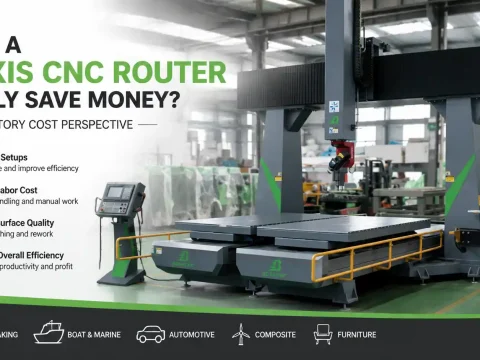

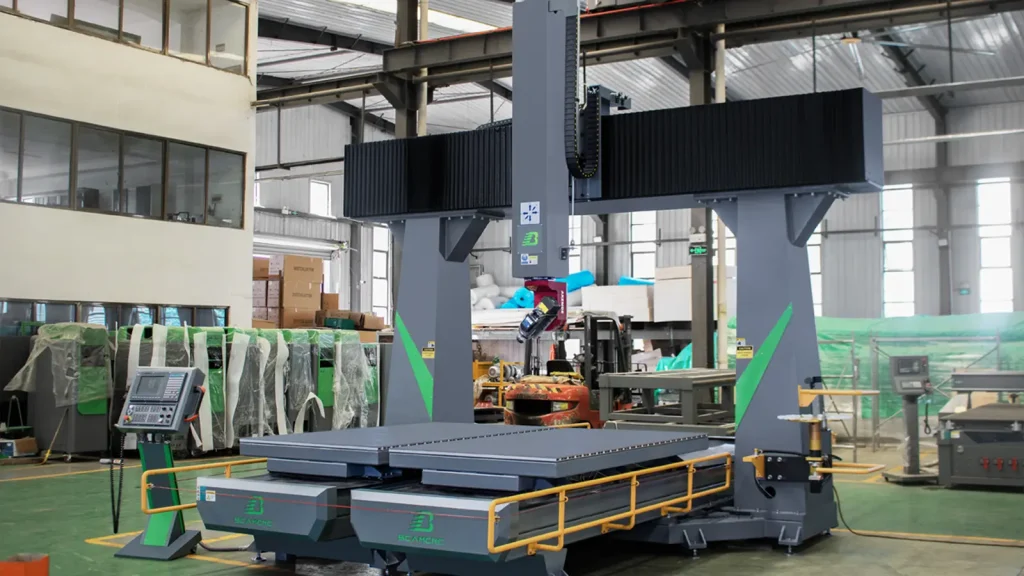
A 5 axis CNC router is rarely the cheapest machine option when a factory is comparing equipment prices. The initial investment is higher than a standard 3 axis CNC router, and many manufacturers naturally ask the same question: Will the additional investment actually reduce my production cost?
The answer depends on what you are manufacturing.
For simple flat panels or basic 2D cutting, a 5 axis CNC router may not provide enough financial advantage to justify the investment. However, for complex molds, curved components, composite parts, foam models, and large three-dimensional structures, the cost difference often comes from somewhere else: additional setups, manual finishing, fixture preparation, outsourcing, and production delays.
Experienced manufacturers do not evaluate a CNC machine only by purchase price. They evaluate how much total production cost the machine creates or removes over years of operation.
The Hidden Costs of 3 Axis Machining for Complex Parts
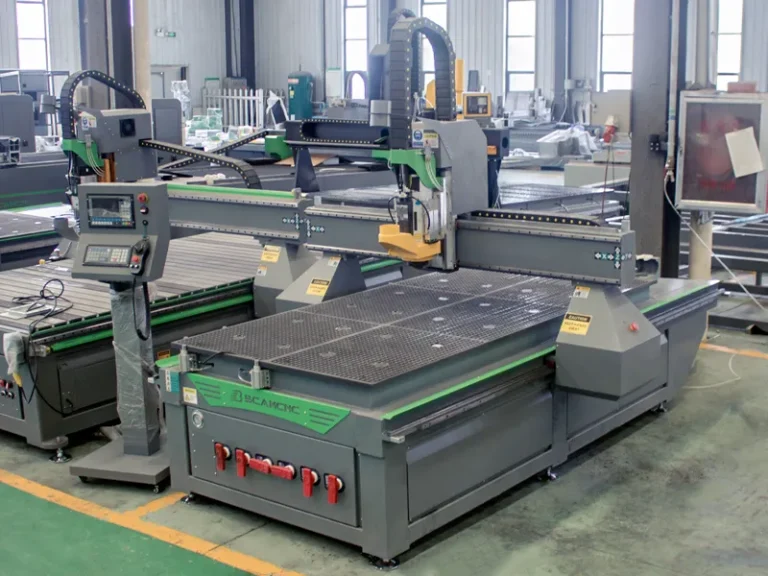
A 3 axis CNC router remains an excellent solution for many applications.
Flat cutting, engraving, cabinet components, and simple machining operations can often be completed efficiently with three axes.
The challenge begins when the part geometry becomes more complicated.
A typical complex machining process may require:
- Multiple fixture setups
- Manual repositioning
- Additional alignment checks
- Separate finishing operations
- More operator involvement
Every additional step introduces another opportunity for error.
The machine may complete the cutting operation successfully, but the total manufacturing process becomes longer.
This is where many factories underestimate their real cost.
Setup Time Is Often More Expensive Than Cutting Time
In many production environments, the spindle is not the biggest bottleneck.
The lost time between machining operations is.
For complex parts, operators may spend significant time:
- Preparing fixtures
- Checking workpiece position
- Re-zeroing the machine
- Adjusting cutting orientation
A 5 axis CNC router reduces many of these interruptions because the cutting tool can approach the workpiece from multiple angles in a single setup.
Fewer setups mean:
- Less handling
- Lower positioning error risk
- More consistent production
- Reduced operator workload
The saving is not always visible on the machine display, but it appears in production records.
How a 5 Axis CNC Router Creates Cost Advantages
A 5 axis CNC router does not save money by cutting every material faster.
Its value comes from improving the complete machining process.
Reducing Fixture and Handling Costs
Complex parts often require specially designed fixtures when produced on traditional equipment.
Fixtures take time to manufacture, install, and maintain.
For prototype production or low-volume custom manufacturing, fixture preparation can become a significant portion of the total cost.
Five axis machining allows many parts to be held once and machined from different angles.
This reduces the dependence on complex fixture systems.
Reducing Manual Finishing Work
Many industries using 5 axis CNC routers deal with curved surfaces.
Examples include:
- Automotive models
- Boat molds
- Composite tooling
- Foam patterns
- Industrial prototypes
When machining these parts, surface quality directly affects the next process.
Poor tool orientation can create visible machining marks that require additional sanding or polishing.
Five axis control allows better tool positioning on complex surfaces, which can reduce secondary finishing requirements.
Improving Production Flexibility
Manufacturing requirements rarely remain unchanged.
A factory may receive:
- Different product designs
- Custom orders
- Prototype requests
- Small batch production
A machine that can handle more complex geometries provides additional production flexibility.
This flexibility can reduce the need to outsource special jobs or purchase additional equipment later.
Cost Comparison: 3 Axis vs 5 Axis CNC Router
| Factor | 3 Axis CNC Router | 5 Axis CNC Router |
|---|---|---|
| Initial Investment | Lower | Higher |
| Flat Panel Cutting | Excellent | Excellent |
| Complex Curved Parts | Limited | Excellent |
| Number of Setups | More for complex parts | Fewer |
| Fixture Requirement | Higher | Lower for many applications |
| Operator Involvement | Higher for complex jobs | Reduced |
| Surface Quality on Curved Parts | Depends on setup | Improved tool orientation |
| Best Application | 2D/standard machining | Complex 3D machining |
The correct choice depends on the type of production, not simply the machine category.
When a 5 Axis CNC Router Does Not Make Financial Sense
A 5 axis machine is not automatically the right investment for every factory.
If your production mainly involves:
- MDF cabinet panels
- Simple engraving
- Flat cutting
- Standard nesting operations
A 3 axis CNC router may provide better return on investment.
The additional capability of five axis machining only creates value when the factory actually uses it.
The key question is not:
“Can we afford a 5 axis CNC router?”
The better question is:
“How much are our current processes costing us because we do not have one?”
Real Factory Example: Reducing Multiple Setups in Mold Production
A mold manufacturer producing large foam patterns was using traditional machining methods for complex shapes.
The main issue was not cutting capability.
The problem was the workflow.
Each part required multiple repositioning steps. Operators spent considerable time checking alignment before continuing machining.
The factory introduced a 5 axis CNC router for these complex components.
The biggest improvement was not simply machining speed.
The factory reduced:
- Manual repositioning
- Alignment adjustments
- Intermediate preparation work
- Finishing requirements caused by poor tool angles
The result was a more stable production process with fewer interruptions.
The machine created value by simplifying the workflow.
Other Factors That Affect 5 Axis CNC ROI
Purchasing a 5 axis CNC router is only one part of the investment.
Long-term results also depend on:
Programming Capability
Five axis machining requires suitable CAM software and experienced programming.
A powerful machine cannot compensate for poor tool paths.
Machine Configuration
Spindle type, control system, working size, and rotary axis design should match the application.
A machine designed for foam molds may require different specifications from one used for composite machining.
Operator Training
Proper training helps factories achieve the expected benefits instead of using a five axis machine like a basic three axis router.
Frequently Asked Questions
Is a 5 axis CNC router faster than a 3 axis CNC router?
Not always.
For simple cutting operations, the speed difference may be minimal. The main advantage of five axis machining is reducing setups and improving efficiency on complex parts.
What industries benefit most from 5 axis CNC routers?
Common applications include mold making, automotive prototypes, boat molds, composite manufacturing, aerospace components, and complex furniture parts.
Can a 5 axis CNC router replace a machining center?
It depends on the application.
A 5 axis router is often suitable for large-format materials such as foam, wood, composites, and some non-ferrous materials. Metal machining applications may require different machine structures.
How long does it take to recover the investment in a 5 axis CNC router?
There is no universal answer.
ROI depends on production volume, part complexity, labor costs, outsourcing costs, and how frequently the machine is used.
Making the Right Investment Decision
A 5 axis CNC router is not a machine purchased simply because it has more technology.
It is an investment in reducing unnecessary production steps.
For factories producing complex three-dimensional parts, the biggest savings often come from fewer setups, less manual work, improved consistency, and greater production flexibility.
For standard flat machining, a simpler CNC solution may be the better choice.
The right machine is the one that matches your production reality.
If you are evaluating whether a 5 axis CNC router can improve your manufacturing efficiency, review your current workflow first. Look at where time is spent, where errors occur, and where production depends on manual intervention.
Those areas usually reveal the true value of upgrading to five axis machining.