
A standard edge banding machine works efficiently when processing straight cabinet panels, but curved furniture components create a completely different production challenge. The problem is not simply applying edge tape to a different shape—the real challenge is maintaining consistent pressure, adhesive bonding, trimming quality, and surface appearance along continuously changing curves.
For manufacturers producing custom furniture, office furniture, hotel interiors, luxury cabinets, and designer panels, curved edges are often where production efficiency and product quality begin to separate.
Many factories can produce straight panels quickly. The difficulty appears when customers require rounded corners, irregular shapes, or customized curved designs while still expecting the same finishing quality as standard panels.
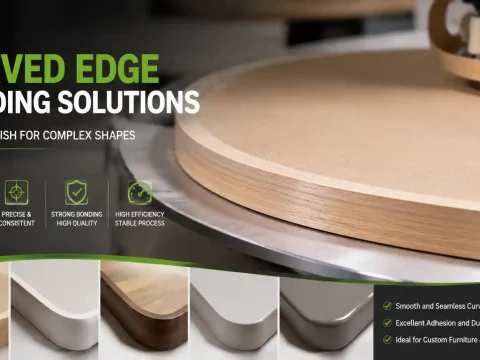
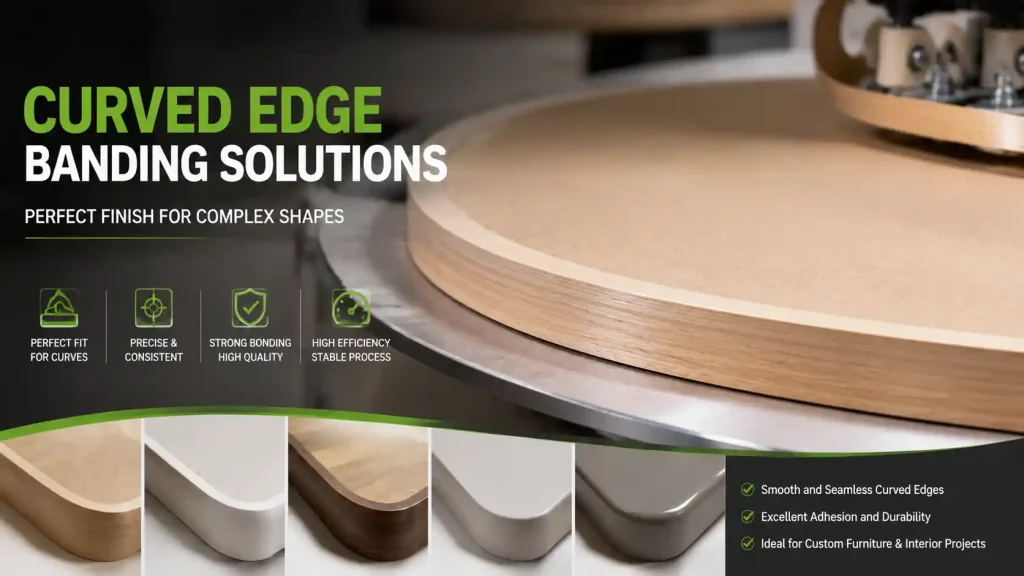
A curved edge banding machine is designed to solve this specific production problem.
Why Traditional Edge Banding Machines Struggle With Curved Panels
Straight edge banders are optimized for predictable movement.
The panel travels along a fixed path while pressure rollers, glue application systems, trimming units, and polishing stations work in sequence.
Curved panels introduce additional variables:
- Changing contact angles
- Different pressure requirements along the edge
- More complicated feeding control
- Higher risk of edge tape separation
- Greater dependence on operator skill
A small mistake that may not be visible on a straight panel can become obvious on a curved surface.
For example:
- Uneven pressure can create gaps between the edge band and panel
- Incorrect feeding speed can affect glue bonding
- Poor trimming adjustment can leave visible marks on the curve
This is why curved edge banding requires a machine designed specifically around flexible movement and stable processing.
How a Curved Edge Banding Machine Works Differently
The biggest difference is the way the machine manages the relationship between the panel and the edge banding system.
Instead of relying only on straight-line movement, a contour edge banding machine must maintain controlled contact while following the changing geometry of the workpiece.
The main processing steps typically include:
Edge preparation
The panel edge must be clean and consistent before bonding. Dust, uneven cutting, or poor substrate quality can directly affect final appearance.
Adhesive application
The glue system needs to provide stable bonding across the entire curved section. Uneven glue distribution may become more visible on rounded corners.
Pressure control
Maintaining pressure along a changing curve is one of the most important factors. Too much pressure may deform the edge material, while insufficient pressure can reduce bonding strength.
Finishing and trimming
The final trimming process determines the appearance of the finished edge. Curved sections require more attention because small dimensional errors are easier to see.
Common Production Problems When Processing Curved Panels
In real furniture factories, many curved edge problems are not caused by the machine itself. They usually come from the interaction between material preparation, tooling, and operating conditions.
Edge Tape Separation
One common problem is edge tape lifting after production.
Possible causes include:
- Insufficient glue application
- Contaminated panel edges
- Incorrect pressure adjustment
- Unsuitable edge material
A machine cannot compensate for poor preparation before the edge banding process begins.
Uneven Trimming on Curved Sections
Curved surfaces expose trimming problems more clearly than straight panels.
Operators may notice:
- Uneven edge height
- Visible cutting marks
- Different finishing quality between different curves
Proper tool condition and stable processing parameters are essential.
Operator Dependency
Traditional solutions often require experienced workers who understand how to manually control curved processing.
The challenge is that skilled operators are difficult to replace.
A well-designed curved edge banding machine reduces dependence on individual experience by making the process more repeatable.
Where Curved Edge Banding Machines Are Commonly Used
Curved edge banding is especially valuable in industries where appearance and customization matter.
Typical applications include:
- Custom kitchen cabinets
- High-end wardrobes
- Office furniture
- Hotel interior furniture
- Designer furniture
- Reception counters
- Irregular shaped panels
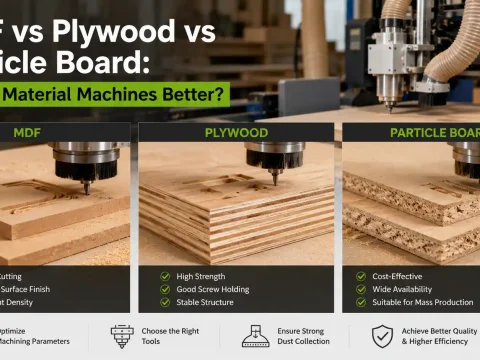
These products often use MDF, plywood, or other engineered wood panels that require smooth finishing after CNC machining.
Curved Edge Banding vs Traditional Edge Banding
| Feature | Traditional Edge Banding Machine | Curved Edge Banding Machine |
|---|---|---|
| Main Application | Straight panels | Curved and irregular panels |
| Processing Shape | Linear edges | Contour edges |
| Operator Skill Requirement | Moderate | Higher without automation |
| Suitable Products | Standard cabinets | Custom furniture and complex designs |
| Production Flexibility | Limited | Higher |
| Surface Appearance Control | Good for straight edges | Designed for complex shapes |
The Relationship Between CNC Machining and Curved Edge Banding
Curved edge banding is often the final step after CNC machining.
The quality of the previous process directly affects the edge finishing result.
A CNC router must produce:
- Accurate panel dimensions
- Smooth cutting edges
- Stable curve profiles
If the CNC cutting process creates vibration marks or inconsistent curves, the edge banding process will only follow those defects.
This is why many advanced furniture factories consider CNC machining and edge finishing as one connected production system rather than separate operations.
A well-matched workflow usually includes:
CNC routing → surface preparation → curved edge banding → final inspection → assembly
Each step influences the next.
Real Production Observation
A custom furniture manufacturer producing curved reception desks faced inconsistent finishing quality on rounded panels.
The factory initially believed the issue came from the edge banding material.
After checking the complete process, the problem was traced back to inconsistent panel preparation before edge application.
Some panels had slightly different curve dimensions after CNC machining, which caused pressure variation during edge banding.
After improving machining consistency and adjusting the curved edge banding process, the factory achieved more stable finishing quality without increasing manual labor.
The lesson was simple: curved edge processing is not only about the edge banding machine. It depends on the entire production workflow.
Frequently Asked Questions
What materials can be processed with a curved edge banding machine?
Curved edge banding machines are commonly used for engineered wood panels such as MDF, plywood, and particle board. Actual capability depends on panel thickness, edge material, and machine configuration.
Can a normal edge banding machine process curved panels?
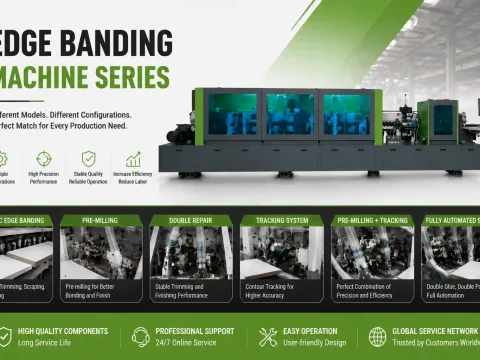
Most standard edge banding machines are designed for straight edges. Some simple curves may be processed manually, but production consistency is usually lower compared with equipment designed for contour processing.
Why is curved edge banding more difficult than straight edge banding?
Because the machine must maintain stable bonding and finishing while following changing geometry. Pressure control, feeding stability, and trimming accuracy become more critical.
Is a curved edge banding machine suitable for mass production?
It depends on the product mix. Factories producing customized furniture or complex-shaped panels can benefit significantly, especially when curved designs are frequently required.
Choosing the Right Solution for Your Furniture Production
Curved edge banding is not simply an upgraded version of traditional edge banding.
It represents a different production requirement.
For factories producing standard cabinet panels, a conventional edge banding machine may provide the best efficiency.
For manufacturers dealing with custom furniture, curved designs, and higher-end interior projects, a contour edge banding solution can reduce manual work, improve consistency, and expand production capability.
Before selecting equipment, evaluate your actual panel shapes, production volume, material types, and finishing requirements.
The best machine is not the one with the most functions—it is the one that fits your production process.
If you are planning to expand your furniture manufacturing capability or are facing challenges with curved panel finishing, review your complete workflow from CNC machining to final assembly. A stable process creates better quality than any single machine working alone.