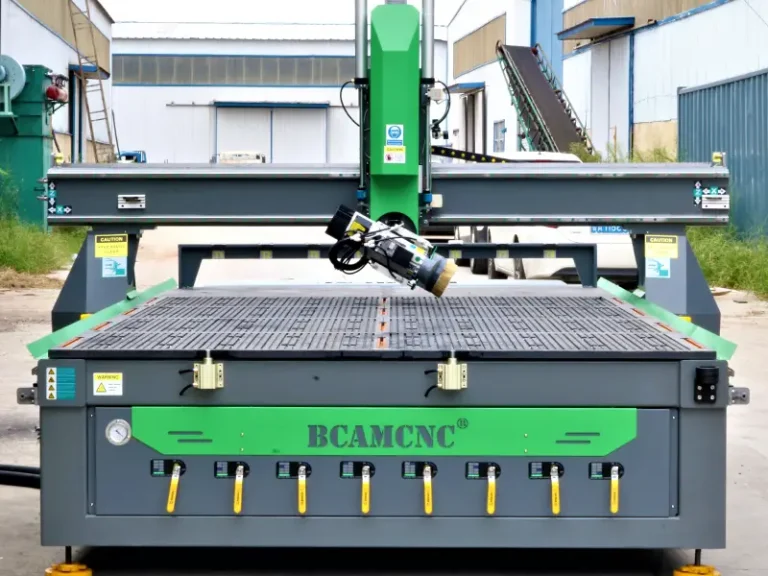

In industrial CNC production, downtime directly affects delivery schedules, labor efficiency, and overall factory output.
Whether it is a CNC router, nesting machine, ATC system, or laser cutting line, most production interruptions are not caused by major mechanical failures. They are caused by process instability, incorrect parameter settings, or operational issues.
In global manufacturing environments, waiting for on-site service is often not practical. Production must be restored quickly, and issues must be diagnosed accurately.
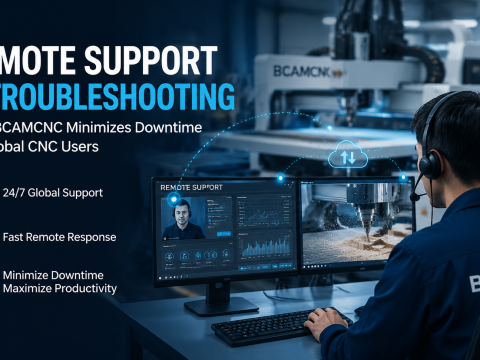
BCAMCNC remote support is designed around one principle:
Minimize downtime and restore production as fast as possible.
Why CNC Machines Stop in Real Production Environments
Most CNC machine stoppages are not hardware breakdowns. They are process-related issues that interrupt production.
Common categories include:
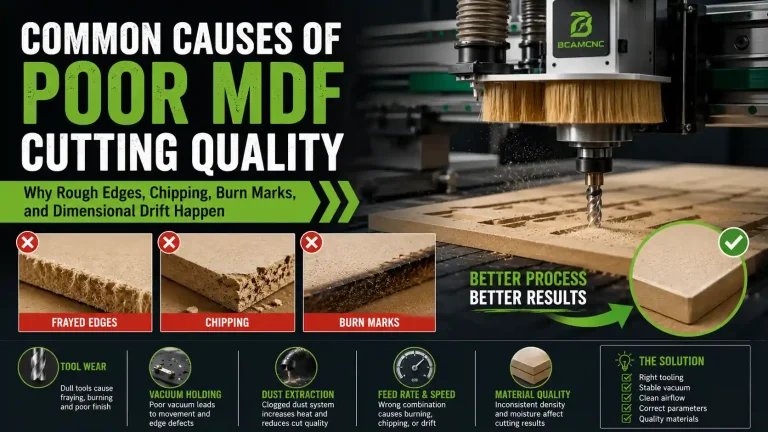
Tooling and setup issues
Incorrect tool installation, worn cutters, or improper tool selection can immediately affect cutting quality and stability.
Parameter mismatch
Feed rate, spindle speed, and cutting depth not matching material behavior (MDF, plywood, hardwood, aluminum) can cause burning, vibration, or chipping.
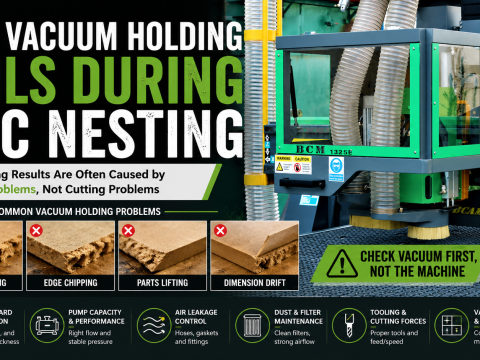
Vacuum instability in nesting systems
Insufficient vacuum pressure or poor sealing conditions may cause part movement during cutting.
Air pressure fluctuation in ATC systems
Automatic tool change systems depend on stable air pressure. Instability may cause tool change errors or incomplete clamping.
Operator or programming errors
Incorrect toolpath generation or setup mistakes are a frequent source of production interruptions.
These issues typically do not require major machine replacement, but they do require fast technical response.
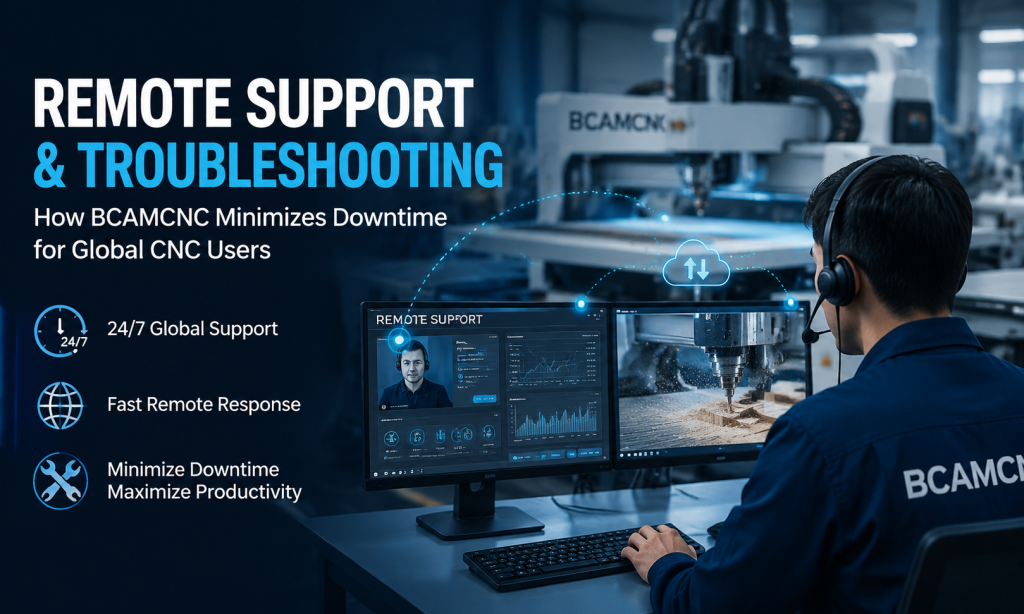
How BCAMCNC 24/7 Remote Support Works
Real-Time Diagnostic Analysis
Support begins with identifying the actual machine condition using available data.
Typical diagnostic inputs include:
- Alarm codes from CNC controllers
- Photos or short videos from the operator
- Machine behavior during failure
- Controller screen status
This helps engineers quickly narrow down the cause without physical inspection.
Step-by-Step Operator Guidance
Most production issues can be resolved through guided on-site checks.
Engineers may guide operators to inspect:
Vacuum system condition (nesting CNC machines)
Checking sealing status, vacuum zones, and spoilboard condition.
ATC tool change system
Verifying air pressure stability and tool clamping performance.
Axis movement behavior
Identifying abnormal vibration, delay, or alarm conditions.
This process often resolves operational issues without requiring spare parts.
Parameter Optimization and Production Recovery
Once the root cause is identified, the focus shifts to restoring stable production.
Typical adjustments may include:
Cutting parameter tuning
Adjusting feed rate and spindle speed based on material behavior.
Toolpath optimization
Improving cutting strategy for MDF, plywood, or other materials.
System parameter correction
Stabilizing servo behavior or resolving alarm triggers when applicable.
The goal is to restore consistent production conditions, not just remove the alarm.
The Real Cost of CNC Downtime in Manufacturing
Machine Stop Is Always a System-Level Problem
When a CNC machine stops, the impact extends beyond the machine itself:
- Idle labor waiting for resolution
- Material waste from incomplete processing
- Production delay in downstream processes
- Delivery risk for customer orders
In many factories, downtime cost is not caused by the machine itself, but by the disruption it creates in the production chain.
Why 24/7 Support Is Necessary in Global Production
Modern CNC factories operate across multiple time zones and shift schedules.
Production may run:
- Night shifts
- Weekend cycles
- Continuous batch processing
Without continuous technical coverage, even small issues can lead to long production delays.
BCAMCNC provides 24/7 remote technical support coverage to ensure production issues can be addressed regardless of time zone differences.
Real Factory Case: Nesting CNC Vacuum Instability
Small Part Movement During Cutting Process
A furniture manufacturing factory reported repeated part movement during nesting operations.
Initial assumption was a machine accuracy issue.
After remote technical review, the issue was linked to:
- Reduced vacuum efficiency due to filter contamination
- Spoilboard wear affecting sealing performance
- Nesting layout creating excessive open vacuum zones
No mechanical parts required replacement.
After cleaning the vacuum system and optimizing nesting layout, production stability was restored within the same shift.
Frequently Asked Questions
Can CNC machine problems be solved remotely?
Many CNC issues related to setup, parameters, tooling, vacuum systems, and operational conditions can be resolved remotely. Mechanical failures may still require physical repair.
What information is needed for faster support?
To improve troubleshooting speed, it is helpful to provide:
- Machine alarm code
- Short video of machine behavior
- Controller screen image
- Description of when the issue occurred
Does remote support replace on-site engineers?
No. Remote support reduces downtime and resolves most operational issues quickly. Physical service is still required for hardware-related failures.
Final Perspective: Support Is Part of Production, Not Just After-Sales
In CNC manufacturing, machine performance is not defined only by hardware capability.
It is defined by how quickly production can recover when problems occur.
A stable factory is not one without issues.
It is one that resolves issues quickly and minimizes production interruption.
That is the real value of industrial remote support in modern CNC manufacturing.