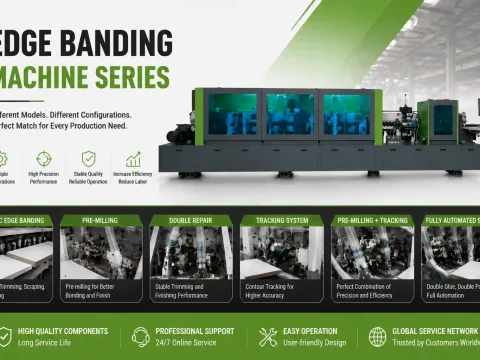

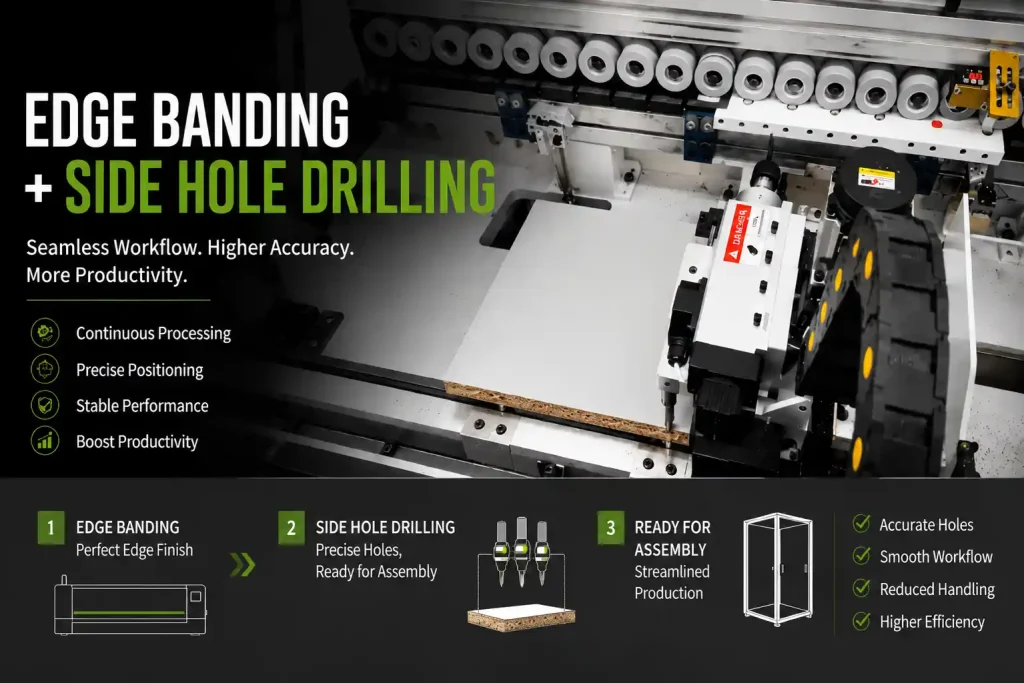
Many furniture factories invest in faster edge banders or more advanced drilling machines, expecting immediate improvements in productivity. In reality, production efficiency is often limited by what happens between these machines rather than by the machines themselves.
If edge banding and side hole drilling are disconnected, operators spend unnecessary time moving panels, checking orientation, and correcting positioning errors. Those extra minutes quickly become hours over the course of a production shift.
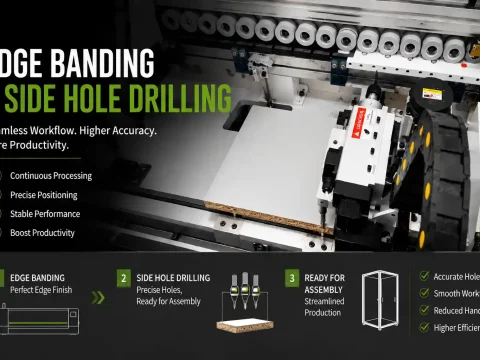
For manufacturers producing cabinets, wardrobes, office furniture, or custom panel furniture, integrating edge banding and side hole drilling into a continuous workflow can reduce handling, improve consistency, and simplify production management.
Why Side Hole Accuracy Depends on the Previous Process
Side drilling is often considered an independent operation, but its accuracy begins long before the drill touches the panel.
After edge banding, several factors influence drilling quality:
Panel positioning
If the panel is not transferred consistently, drilling references may shift.
Edge quality
Poorly bonded or uneven edge banding can affect how the panel is located during drilling.
Material flatness
Warped MDF or particleboard may introduce small positioning errors, especially on long cabinet components.
The drilling machine may be working perfectly, but inconsistent upstream processing can still reduce assembly accuracy.
Reducing Manual Handling Improves More Than Productivity
Every time a panel is manually lifted, rotated, or repositioned, there is an opportunity for mistakes.
Common problems include:
- Incorrect panel orientation
- Surface scratches
- Edge damage during handling
- Mixing similar cabinet components
- Reduced operator efficiency
Connecting edge banding directly with side hole drilling minimizes unnecessary handling while creating a smoother production rhythm.
Continuous Processing Supports Flexible Manufacturing
Modern furniture production is increasingly characterized by:
- Small batch orders
- Custom cabinet dimensions
- Frequent design changes
- Shorter delivery times
Under these conditions, production flexibility becomes more important than maximum machine speed.
Integrated processing helps factories adapt to changing production schedules while reducing setup time between operations.
Comparison: Separate Operations vs Integrated Workflow
| Production Factor | Separate Machines | Integrated Workflow |
|---|---|---|
| Panel Handling | Multiple manual transfers | Reduced handling |
| Positioning Consistency | Depends on operator | More consistent reference |
| Production Flow | Interrupted between processes | Continuous processing |
| Labor Requirement | Higher | Lower |
| Risk of Panel Damage | Higher | Reduced |
| Suitable Production | Small manual workshops | Modern furniture manufacturing |
Real Production Observation
A cabinet manufacturer producing customized kitchen furniture experienced inconsistent assembly alignment despite investing in a new side drilling machine.
After reviewing the workflow, the drilling equipment was not identified as the primary issue.
Instead, operators were manually transferring finished panels from the edge bander to the drilling station, frequently rotating panels during handling. Similar-looking components were occasionally positioned differently, resulting in inconsistent drilling references.
After reorganizing the production flow and reducing unnecessary handling between the two processes, assembly consistency improved and production became more predictable without changing the drilling parameters.
Why Process Stability Matters More Than Machine Speed
Increasing machine speed alone does not guarantee higher factory output.
Production efficiency depends on:
- Stable panel positioning
- Smooth material flow
- Consistent reference points
- Reduced operator intervention
- Reliable communication between production stages
A balanced production line often delivers better overall performance than simply purchasing the fastest individual machine.
Frequently Asked Questions
Can side hole drilling be performed before edge banding?
Depending on the production process and hardware design, some manufacturers may choose different sequences. However, many automated cabinet production lines perform side drilling after edge banding to maintain consistent references throughout the finished panel.
Does integrated production improve drilling accuracy?
Integration primarily improves workflow consistency and reduces handling. Final drilling accuracy also depends on machine calibration, material quality, positioning systems, and process control.
Which factories benefit most from integrated edge banding and side drilling?
Factories producing custom cabinets, wardrobes, office furniture, and other panel furniture with frequent order changes generally benefit most from continuous production workflows.
Final Perspective
The goal of automation is not simply to make individual machines faster.
It is to eliminate unnecessary movement, reduce production interruptions, and create a stable manufacturing process from one operation to the next.
When edge banding and side hole drilling work as one continuous system, factories spend less time handling panels and more time producing finished furniture.