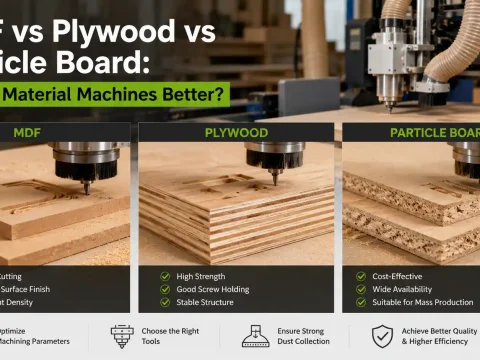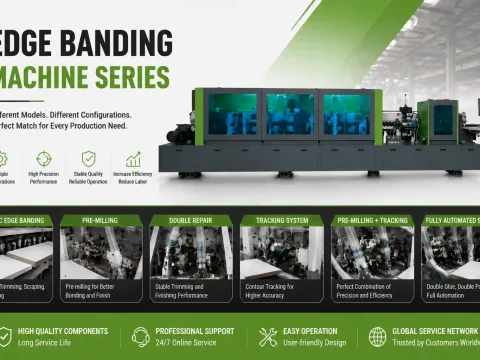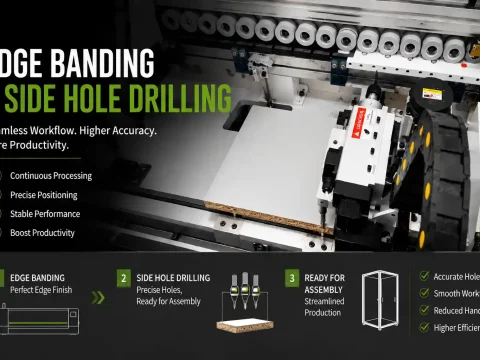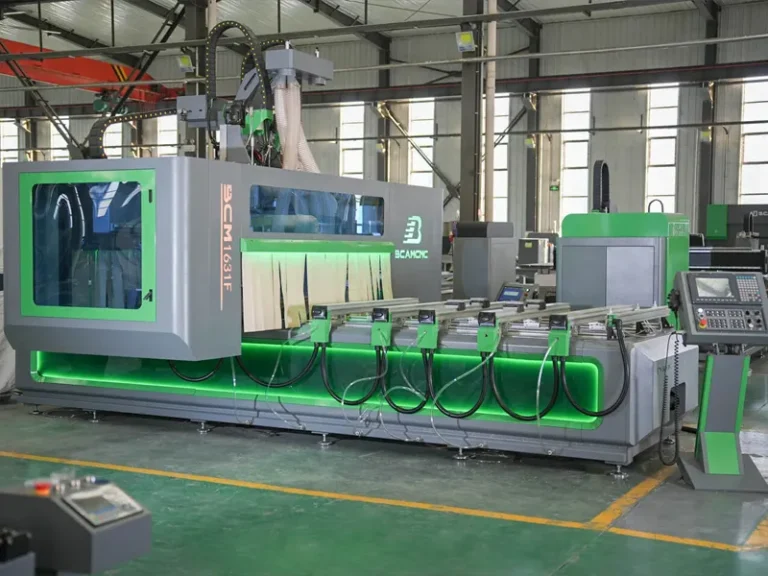

If you’re selecting MDF, plywood, or particle board based only on purchase price, you’re evaluating the smallest part of the manufacturing cost. Once the sheet reaches your CNC router, every difference in density, internal structure, moisture content, and adhesive composition begins to influence machining stability, tool life, edge banding quality, and final assembly.
Many factories blame their CNC router when edge quality suddenly deteriorates or cabinet parts stop fitting together consistently. In reality, the machine is often reacting to changes in the material rather than creating the problem.
The better machining material isn’t necessarily the strongest or the cheapest. It’s the one that allows your production line to maintain consistent quality with minimal adjustment, predictable tool life, and fewer interruptions between cutting, drilling, edge banding, and assembly.

Every Panel Behaves Differently Once the Spindle Starts Cutting
Operators sometimes expect one cutting program to perform equally well across MDF, plywood, and particle board.
That rarely happens.
Although these materials may share the same dimensions, they respond very differently to cutting forces.
Internal density, resin content, veneer structure, moisture variation, and even storage conditions all influence how the material reacts when machining begins.
The result is that identical machining parameters can produce completely different outcomes.
One sheet leaves the CNC with clean edges and accurate dimensions.
The next produces chipped corners, excessive dust, or poor edge banding adhesion—even though the machine hasn’t changed at all.
Understanding those differences is often more valuable than increasing spindle power or replacing cutting tools.
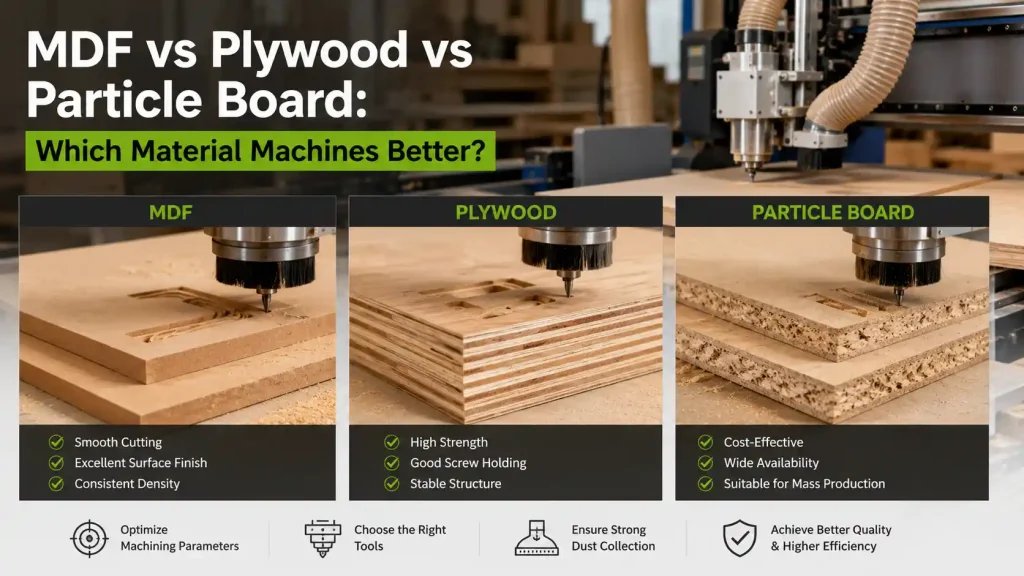
MDF: Excellent Machining Consistency, but Demanding on Dust Management
For many cabinet manufacturers, MDF remains one of the easiest engineered wood products to machine.
Its relatively uniform density allows cutting forces to remain stable throughout the sheet.
That consistency provides several practical advantages:
- Smooth profile machining
- Predictable drilling accuracy
- Stable routing performance
- High-quality painted edges
- Reliable dimensional repeatability
This is one reason why MDF is widely used for painted furniture, decorative panels, and routed cabinet doors.
However, the material introduces its own production challenges.
Fine Dust Never Stops Working Against You
MDF generates significantly more fine dust than most plywood or particle board.
That dust doesn’t simply disappear into the extraction system.
It gradually accumulates inside filters, vacuum channels, electrical cabinets, and cooling fans.
If extraction efficiency decreases, chips begin circulating around the cutting zone instead of leaving it.
The cutter starts recutting hot dust instead of clean material.
Edge quality drops.
Tool temperature rises.
Tool life becomes shorter than expected.
Many operators respond by reducing feed rate or increasing spindle speed, unintentionally creating even more heat.
The machine isn’t struggling.
The process is.
Storage Conditions Matter More Than Many Factories Expect
MDF also reacts more noticeably to moisture than many operators realize.
Boards stored directly on concrete floors or inside poorly ventilated warehouses may absorb moisture before machining begins.
Even small dimensional changes can affect:
- Groove depth
- Cabinet assembly accuracy
- Edge banding consistency
- Surface flatness during vacuum holding
The CNC router is capable of maintaining excellent positioning accuracy, but it cannot compensate for unstable raw material.
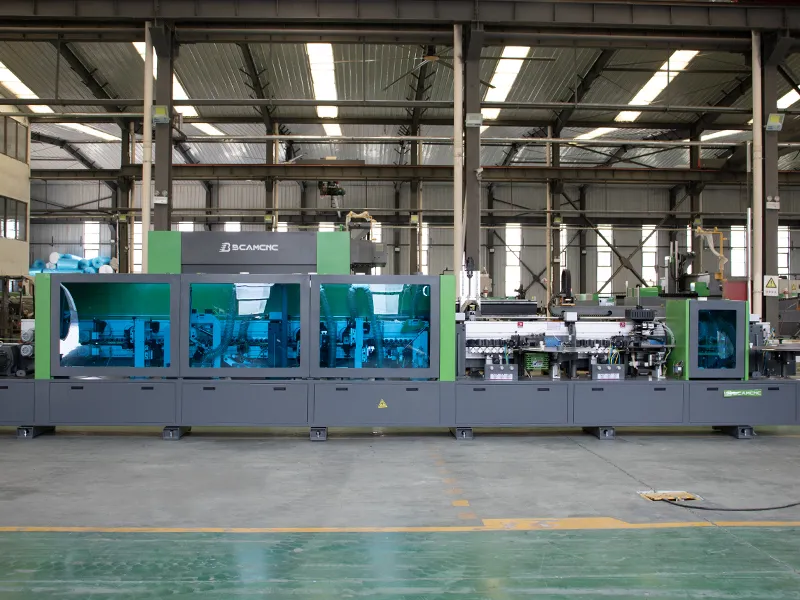
Plywood: Strong Structure, Less Predictable Machining
Plywood behaves differently because it is built from multiple veneer layers bonded together under pressure.
Its structural strength makes it popular for architectural furniture, commercial interiors, marine applications, and heavy-duty cabinetry.
Machining, however, becomes less predictable.
Every Veneer Layer Cuts Differently
Unlike MDF, plywood contains alternating grain directions.
As the cutter moves through the sheet, the cutting resistance constantly changes.
One layer may produce a perfectly smooth edge.
The next may create minor tear-out.
The next may contain harder glue lines that increase cutting resistance.
This changing material behavior explains why plywood often requires more careful tool selection than MDF.
Compression spiral bits frequently provide the most balanced edge quality because they compress both upper and lower veneer layers simultaneously.
Even then, plywood quality varies considerably between manufacturers.
Glue Lines Affect Tool Life
Many production managers focus on wood hardness.
Experienced machinists often pay more attention to the adhesive.
Some plywood adhesives are considerably more abrasive than the wood itself.
Over long production runs, those glue lines gradually increase cutter wear.
The effect isn’t always dramatic enough for operators to notice immediately.
Instead, machining quality slowly declines.
Edges become rougher.
Cutting forces increase.
Tool temperature rises.
Eventually someone decides the machine “needs adjustment,” when replacing or sharpening the cutter would have solved the issue.
Particle Board: Economical, but Less Forgiving During Production
Particle board remains one of the most widely used materials for large-scale cabinet manufacturing.
Its cost advantage makes it attractive for volume production.
Machining performance, however, depends heavily on material consistency.
Internal Structure Determines Machining Stability
Unlike MDF, particle board contains larger wood particles bonded together with resin.
The internal structure is naturally less uniform.
During routing or drilling, weaker areas may produce:
- Localized edge breakout
- Reduced screw holding
- Small corner damage
- Less consistent hole quality
These differences become more noticeable when machining narrow cabinet components or small nested parts.
Vacuum Holding Becomes More Critical
Particle board also relies more heavily on stable vacuum holding during CNC nesting.
Small parts with limited contact area are easier to shift if vacuum performance drops.
When vacuum leakage combines with aggressive feed rates or worn cutting tools, part movement becomes much more likely.
Operators often reduce feed speed to compensate.
Production continues—but productivity falls.
In many cases, improving spoilboard condition or vacuum management has a greater impact than changing machining parameters.
Material Comparison in Real CNC Production
| Factor | MDF | Plywood | Particle Board |
|---|---|---|---|
| CNC Routing Consistency | Excellent | Good (depends on veneer quality) | Moderate |
| Edge Quality | Excellent | Good to Moderate | Moderate |
| Drilling Accuracy | Excellent | Good | Good |
| Tool Wear | Moderate | Moderate to High (depends on adhesive and veneer) | Moderate |
| Dust Generation | High | Moderate | Moderate |
| Vacuum Holding Stability | Good | Good | More dependent on panel quality and part size |
| Edge Banding Performance | Excellent | Good | Good when panel quality is consistent |
| Typical Applications | Painted furniture, cabinet doors, decorative panels | Structural furniture, commercial interiors, marine furniture | Mass-produced cabinets, wardrobes, office furniture |
The table above should be viewed as a general production reference rather than an absolute ranking. Material grade, manufacturer, moisture content, tooling, and machining strategy all influence actual performance.
Hidden Costs That Don’t Appear on Material Quotations
Purchasing departments naturally compare sheet prices.
Production managers usually look at different numbers.
The difference between two materials may only be a few dollars per sheet, but the impact on the production line can be much larger.
Tool Consumption
A material that shortens cutter life increases costs in ways that are not immediately visible. More frequent tool changes interrupt production, require additional setup time, and gradually reduce spindle utilization.
Secondary Finishing
Poor edge quality means more sanding before painting or edge banding.
Even if each panel requires only an extra minute of manual finishing, the accumulated labor cost becomes significant over thousands of parts.
Production Interruptions
Inconsistent material often forces operators to reduce feed rates or perform additional quality inspections.
Machines continue running, but overall throughput decreases.
Assembly Problems
Small dimensional variations may not be noticed immediately after machining.
Instead, they appear later during cabinet assembly, where shelves no longer fit correctly or hardware alignment requires manual adjustment.
Those problems are considerably more expensive to correct than choosing a more consistent panel at the beginning of production.
One Material Change Can Affect the Entire Workflow
Many factories evaluate machining performance only at the CNC router.
In reality, the effects continue throughout the production line.
A rough machined edge influences glue application during edge banding.
Inconsistent drilling affects hardware installation.
Dimensional variation slows cabinet assembly.
A board that machines poorly rarely creates only one problem.
It creates a series of smaller inefficiencies that gradually reduce factory output.
This is why experienced production managers evaluate material performance across the complete manufacturing process rather than judging it by cutting quality alone.
Real Factory Case
A medium-sized cabinet manufacturer decided to reduce material costs by changing to a lower-priced panel supplier for a large residential project.
The new boards met the specified dimensions and appeared acceptable during incoming inspection.
Production began normally.
After several days, operators noticed that edge quality varied between batches. Some panels machined cleanly, while others produced rougher edges that required additional sanding before edge banding.
At first, attention focused on the CNC router.
Tool offsets were checked.
Spindle runout was measured.
Vacuum pressure was inspected.
No mechanical problems were found.
Further investigation showed that the panel consistency differed noticeably between production batches. Variations in internal density affected cutting behavior, particularly around narrow cabinet components.
Once the original supplier was reintroduced, machining quality returned to normal without changing machining parameters.
The lesson wasn’t that one material was universally better than another.
It was that consistency often delivers more value than the lowest purchase price.
Frequently Asked Questions
Which material produces the cleanest CNC machined edge?
For many furniture applications, MDF generally provides the most consistent edge because of its relatively uniform internal structure. Actual performance still depends on tooling, machine condition, and machining parameters.
Does plywood always reduce cutter life?
Not necessarily.
Plywood quality varies considerably. Veneer species, adhesive composition, and manufacturing quality all influence cutter wear.
Premium plywood often machines much more consistently than lower-grade panels.
Is particle board suitable for CNC nesting?
Yes.
Particle board is widely used in cabinet manufacturing.
Stable vacuum holding, sharp cutting tools, and appropriate machining parameters become especially important when producing small nested components.
Can one machining program be used for all three materials?
Usually not.
Feed rate, spindle speed, depth of cut, and cutter geometry should be adjusted according to the material being processed.
Using identical parameters across different materials often reduces both machining quality and tool life.
Should material selection be based only on machining performance?
No.
Material choice should consider the complete production process, including machining, drilling, edge banding, assembly, product requirements, and overall manufacturing cost.
Final Thoughts
There is no universally “best” board for CNC machining.
MDF offers excellent consistency and surface quality.
Plywood provides structural strength and durability while requiring greater attention to tooling and material quality.
Particle board remains an economical choice for many cabinet manufacturers when production processes are properly optimized.
The most efficient factories rarely achieve their results by purchasing the most expensive machine or the cheapest material.
They succeed because every stage of production—from material storage and CNC machining to edge banding and final assembly—is designed to work together.
If your production line is experiencing inconsistent edge quality, excessive tool wear, or unexpected assembly problems, don’t begin by adjusting the machine.
Start by evaluating the material entering the factory.
A consistent panel, matched with the right tooling and machining strategy, often delivers greater improvements than changing machine settings alone.