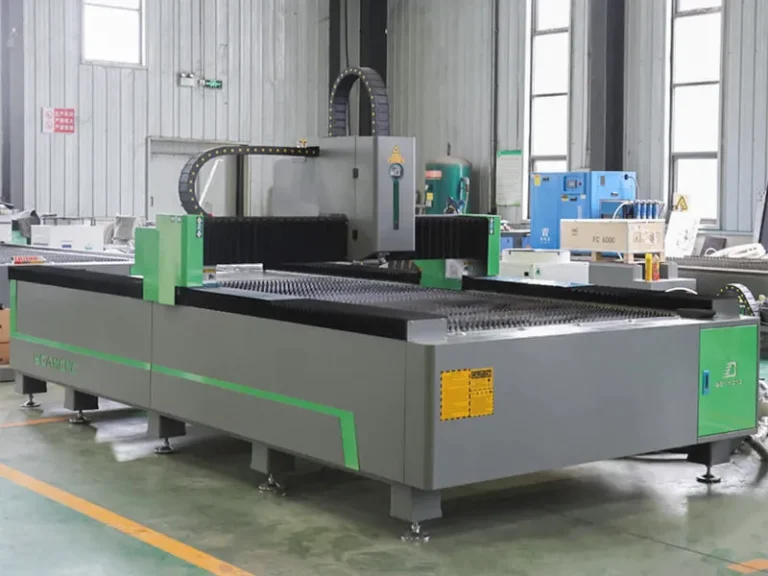

Selecting the proper focal length is one of the most important decisions when configuring a fiber laser cutting machine. The focal lens directly influences cutting precision, penetration depth, edge quality, and overall processing efficiency. Different lenses serve different applications, and choosing the correct one ensures stable performance across various materials and thicknesses.
Below is a practical guide to help you understand the characteristics of common fiber laser focal lengths and how to select the best option for your production needs.
What Is Focal Length in Fiber Laser Cutting?
The focal length refers to the distance from the lens to the point where the laser beam converges into its smallest spot.
A shorter focal length produces a smaller, sharper laser spot suitable for fine, shallow cuts.
A longer focal length allows the beam to stay narrower over a longer distance, making it better for cutting thicker materials.
Common Focal Length Options and Their Applications
1. 1.5-inch Focal Lens – Ultra-Fine Precision
Produces an extremely small spot size, ideal for micro-cutting and detailed designs.
Best for thin sheet metal, intricate contours, and high-precision applications.
Not recommended for thick materials, as the short focal length limits penetration depth.
Recommended for:
Electronics parts, decorative patterns, thin stainless steel, fine contour cutting.
2.0-inch Focal Lens – General Purpose & High Accuracy
One of the most widely used lenses in fiber laser cutting.
Offers an excellent balance between spot size and cutting capability.
Maintains high precision while providing slightly deeper penetration than 1.5-inch lenses.
Recommended for:
General sheet metal fabrication, stainless steel, carbon steel, and aluminum within thin–medium thickness.
2.5-inch Focal Lens – Versatile for Multiple Materials
A flexible choice that combines precision with better depth of focus.
Capable of cutting thicker plates while keeping stable performance and good edge quality.
Suitable for workshops handling a mix of thin and medium-thick materials.
Recommended for:
Metal fabrication factories handling 3–12 mm stainless steel, carbon steel, and mixed metal jobs.
5-inch Focal Lens – Designed for Thick Material Cutting
Provides a long depth of focus for heavy-duty cutting tasks.
Supports cutting thick plates with consistent penetration and stable beam quality.
Larger spot size but handles deep or bulky material sections very efficiently.
Recommended for:
Heavy steel structure fabrication, machinery manufacturing, thick carbon steel, and high-power cutting systems.
How to Choose the Right Focal Length?
When deciding which focal length lens to use, consider these key factors:
✔ Material Thickness
Thin sheets → 1.5” or 2.0”
Mixed thickness → 2.5”
Thick plates → 5.0”
✔ Cutting Accuracy Required
High-precision jobs → shorter focal lengths
General cutting → medium-length lenses
Rough and deep cuts → long lenses
✔ Laser Power
Higher wattage machines (6–12 kW and above) often pair better with longer focal lengths to ensure stable cutting quality on thick materials.
Conclusion
Choosing the correct focal length lens is essential for maximizing the performance of your fiber laser cutting machine. Whether you need ultra-fine accuracy, balanced versatility, or high-penetration power for thick materials, selecting the right lens ensures smoother edges, faster cutting speed, and better efficiency.
If you need help matching the best focal length with your metal types and production requirements, BCAMCNC technical team can provide tailored recommendations for your cutting applications.