
For many small woodworking and fabrication businesses, choosing the right CNC router is not easy. One of the most common questions is whether an ATC CNC router is really worth the investment, or if a simpler machine can do the job just fine.
The answer depends on your production needs, budget, and long-term plans.
What Is an ATC CNC Router?
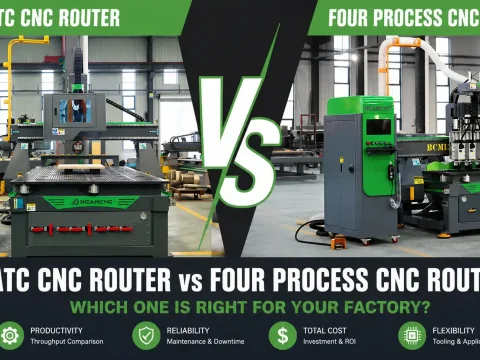
ATC stands for Automatic Tool Changer. An ATC CNC router can automatically switch tools during machining without stopping the machine or manual intervention.
This feature is especially useful when one job requires multiple tools, such as:
- Cutting
- Drilling
- Grooving
- Engraving
Instead of stopping the machine to change tools by hand, the router completes the process automatically.
Benefits of an ATC CNC Router for Small Businesses
For small businesses that handle growing or repeat orders, an ATC CNC router offers several clear advantages.
Higher efficiency
Automatic tool changing saves time on every job. Over a full workday, this can significantly increase output.
More consistent quality
Since tool changes are automated, there is less chance of setup errors. This helps maintain consistent machining accuracy.
Better for complex jobs
If your products require several tools in one program, ATC machines make the workflow much smoother.
Lower labor dependency
Operators do not need to stay near the machine for tool changes, which reduces manual workload.
When an ATC CNC Router May Not Be Necessary
Despite its advantages, an ATC CNC router is not always the best choice for every small shop.
If your business mainly handles:
- Simple cutting jobs
- Small batches
- Limited tool types
- Tight startup budgets
Then a standard CNC router or a multi-process CNC router may be more cost-effective in the early stage.
For many small workshops, production speed is important, but cash flow and return on investment matter more.
Cost vs. Long-Term Value
An ATC CNC router costs more than a basic CNC router, but the real question is not the price—it is the value over time.
If your shop:
- Has repeat orders
- Plans to expand production
- Wants to reduce manual operation
Then the time saved and productivity gained can justify the higher initial cost.
In many cases, small businesses start without ATC and upgrade later. However, choosing an entry-level ATC model early can avoid future replacement costs.
A Practical Option: Economic ATC CNC Routers
For small businesses that want the benefits of automatic tool changing without a high investment, economic ATC CNC routers are a smart middle ground.
The CA Series ATC CNC Router is designed for this purpose. It offers:
- Automatic tool changer
- Stable structure
- Reliable machining accuracy
- Practical configuration for woodworking and panel processing
Compared with high-end industrial ATC machines, the CA series focuses on essential features, making it suitable for small and medium workshops that want efficiency without overpaying.
Final Thoughts
So, is an ATC CNC router worth it for small businesses?
If you are aiming for higher efficiency, cleaner workflow, and future growth, the answer is often yes. The key is choosing the right level of automation for your actual needs.
For many small businesses, starting with an economic ATC CNC router like the CA series can be a balanced and practical decision.