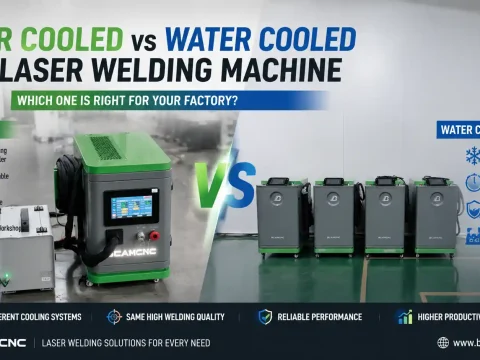

When selecting a laser welding machine, many buyers focus first on laser power, welding speed, and price. However, the cooling system is also an important factor that directly affects machine stability, operating conditions, and long-term production performance.
Air cooled and water cooled laser welding machines are designed for different working environments. Neither solution is suitable for every application.
For small workshops, repair operations, and flexible welding tasks, an air cooled laser welding machine may provide a simpler solution. For factories requiring longer operating hours and more stable continuous production, a water cooled system may offer better temperature control.
The right choice depends on your materials, production volume, working environment, and expected usage frequency.
Why Cooling System Matters in Laser Welding
A fiber laser welding machine generates heat during operation. The cooling system helps maintain stable working temperatures for key components, including the laser source and internal optical systems.
Stable temperature control is important because excessive heat can affect:
- Welding consistency
- Equipment stability
- Long-term component performance
- Production reliability
In real production environments, the best cooling solution is not always the most powerful one. It is the one that matches the actual workload of the factory.
How Air Cooled Laser Welding Machines Work
An air cooled laser welding machine uses air circulation and built-in cooling components to remove heat generated during operation.
This design eliminates the need for an external water chiller system, making the machine more compact and easier to install.
Advantages of Air Cooled Laser Welding Machines
Simpler Installation
Air cooled systems usually require fewer auxiliary devices. This can reduce installation preparation and makes them suitable for locations where space is limited.
Lower Maintenance Requirements
Without a separate cooling water system, operators do not need to manage water circulation, coolant replacement, or chiller maintenance.
Better Mobility
The compact structure makes air cooled laser welding machines suitable for flexible working environments, including workshops where equipment needs to be moved between different production areas.
Suitable Applications
Air cooled laser welding machines are commonly suitable for:
- Small and medium workshops
- Maintenance and repair operations
- Light metal fabrication
- Flexible welding applications
However, the final suitability depends on welding workload, material type, and operating conditions.
How Water Cooled Laser Welding Machines Work
A water cooled laser welding machine uses a cooling circulation system to control operating temperature.
The system transfers heat away from important components through coolant circulation, helping maintain stable temperature control during longer production periods.
Advantages of Water Cooled Laser Welding Machines
Better Temperature Stability
Water cooling generally provides more effective heat management, especially during extended operation.
This can be beneficial for factories where welding machines operate for longer periods.
Suitable for Continuous Production
For production environments with frequent welding tasks, stable cooling performance can help maintain consistent equipment operation.
Better for Higher Workloads
When welding requirements involve longer working cycles or higher production intensity, water cooled systems may provide advantages in maintaining stable performance.
Suitable Applications
Water cooled laser welding machines are often considered for:
- Industrial production
- Metal fabrication factories
- Longer working cycles
- Higher welding workloads
Air Cooled vs Water Cooled Laser Welding Machine Comparison
| Factor | Air Cooled Laser Welding Machine | Water Cooled Laser Welding Machine |
|---|---|---|
| Installation | Simple installation with fewer auxiliary systems | Requires cooling system setup |
| Maintenance | Lower maintenance requirements | Requires cooling system management |
| Machine Mobility | More flexible for different locations | Usually less mobile |
| Space Requirement | Compact design | Requires additional cooling equipment |
| Continuous Operation | Suitable for lighter workloads | Suitable for longer production cycles |
| Temperature Control | Suitable for normal operating conditions | Better control for demanding applications |
How to Choose the Right Laser Welding Machine Cooling System
The correct cooling system depends on how the machine will be used.
Choose an Air Cooled Laser Welding Machine If:
Your production requires:
- Occasional welding work
- Flexible operation
- Limited installation space
- Lower maintenance requirements
For many small fabrication shops and repair applications, air cooled systems provide a practical solution.
Choose a Water Cooled Laser Welding Machine If:
Your factory requires:
- Long operating hours
- Continuous production
- Higher workload capability
- More stable temperature control
For industrial production environments, water cooled systems may provide better support for demanding applications.
Common Mistakes When Selecting a Laser Welding Machine
Many buyers select equipment only by comparing laser power and purchase price.
However, several other factors influence the actual production result.
Ignoring Working Conditions
A machine used for occasional repair work and a machine running daily production have completely different requirements.
The cooling system should match the expected workload.
Choosing the Lowest Price Option
The initial equipment cost is only one part of the investment.
Factories should also consider:
- Operating stability
- Maintenance requirements
- Production efficiency
- Long-term reliability
Not Considering Material Requirements
Different materials may require different welding parameters.
Common materials include:
- Stainless steel
- Carbon steel
- Aluminum
- Galvanized sheets
The welding process should be evaluated together with material thickness, joint design, and production requirements.
Factors to Consider Before Buying a Fiber Laser Welding Machine
Cooling type is only one part of selecting a suitable laser welding solution.
Manufacturers should also evaluate:
Laser Power
The required laser power depends on material type, thickness, and welding requirements.
Welding Applications
Consider whether the machine will be used for:
- Sheet metal welding
- Equipment manufacturing
- Metal structure fabrication
- Repair work
Machine Configuration
Important factors include:
- Laser source
- Welding head
- Control system
- Cooling method
- Technical support
A suitable configuration should be selected according to the complete production process.
Frequently Asked Questions
Is an air cooled laser welding machine suitable for factory production?
Yes, depending on the production requirements. Air cooled systems can be suitable for many applications, especially when welding frequency and working hours are moderate.
Does a water cooled laser welding machine require more maintenance?
Water cooled systems require additional attention to the cooling system, including coolant management and regular inspection. However, they can provide stable temperature control for longer operating cycles.
Which cooling system has a longer service life?
Service life depends on overall machine quality, operating conditions, maintenance practices, and usage frequency. Proper operation and maintenance are important for both cooling types.
Can both air cooled and water cooled laser welding machines weld stainless steel and aluminum?
The ability to weld different materials depends on laser power, material thickness, welding parameters, and machine configuration.
Choosing the Right Laser Welding Solution for Your Production
Air cooled and water cooled laser welding machines both have their own advantages.
The better choice is not determined only by cooling technology. It depends on your production environment, working hours, material requirements, and future manufacturing plans.
For workshops requiring flexibility and simple operation, an air cooled laser welding machine may be a practical choice.
For factories requiring longer production cycles and stable industrial performance, a water cooled laser welding machine may be more suitable.
At BCAMCNC, we help customers evaluate laser welding solutions based on their actual applications, including material requirements, production conditions, and equipment configuration.
If you are planning to invest in a fiber laser welding machine and are unsure which cooling system fits your production needs, contact BCAMCNC for a professional recommendation.