
CNC Router + Edge Bander + Drilling Machine Integration Solution
In today’s competitive woodworking industry, a complete cabinet production line is no longer optional—it is essential for scale, speed, and consistent quality.
For panel furniture manufacturers, integrating a CNC Router + Automatic Edge Bander + CNC Side Drilling Machine creates a fully automated cabinet production system. This integrated workflow reduces labor, improves precision, and increases daily output dramatically.
At BCAMCNC, we provide a turnkey cabinet manufacturing solution designed for modern furniture factories worldwide.
Phase 1: Precision Panel Processing with CNC Router
The foundation of any cabinet production line is high-precision panel cutting.
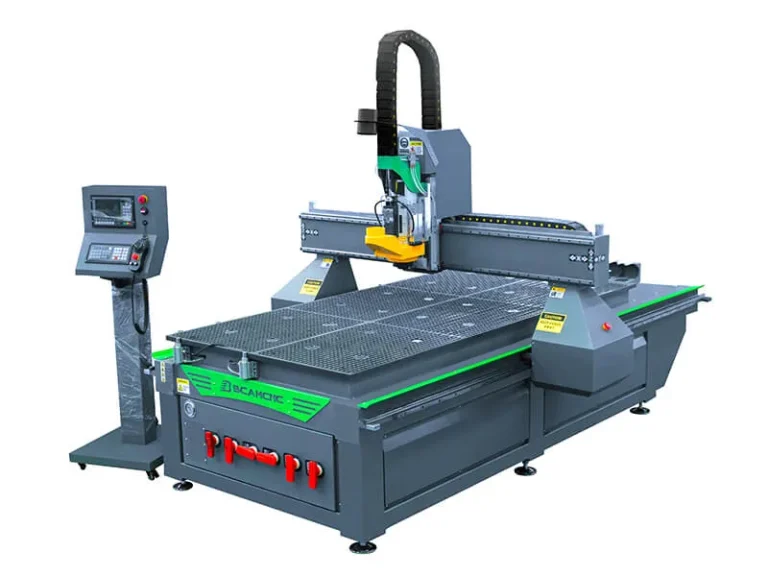
A nesting CNC router acts as the “central processing unit” of your factory.
Key Technical Advantages
-
ATC Spindle Power: 9kW–18.5kW optional
-
Repeat Positioning Accuracy: ±0.05 mm
-
Servo Motor Drive System for stable high-speed motion
-
Auto Tool Changer (ATC) for uninterrupted processing
-
Intelligent Nesting Software for maximum board utilization
Production Benefits
-
Material waste reduced by up to 25–30%
-
High-speed cutting of MDF, plywood, particle board, and solid wood
-
Automatic label printing for barcode production management
Phase 2: Premium Finishing with Automatic Edge Banding Machine
After cutting, panels move directly to the edge banding section—where product quality becomes visible.
A BCAMCNC automatic edge bander ensures structural integrity and a seamless appearance.
Integrated Processing Units
- Pre-milling
- Glue application (EVA / PUR optional)
- Edge pressing
- End trimming
- Fine trimming
- Scraping
- Polishing
Performance Parameters
- Feeding speed: 15–25 m/min
- Glue line precision: near invisible
- Suitable for frameless cabinet production
This stage transforms raw panels into high-end retail-ready components.
Phase 3: High-Speed Assembly with CNC Side Drilling Machine
The final bottleneck in many factories is manual hole alignment.
A CNC side drilling machine (horizontal boring machine) eliminates measurement errors and accelerates RTA furniture production.
Technical Highlights
- Infrared hole detection
- PLC intelligent control system
- Automatic panel width recognition
- Horizontal drilling for cam-and-bolt connectors
Efficiency Upgrade
While one panel is edge-banded, another is being drilled.
This creates a continuous cabinet production loop.
Why an Integrated Cabinet Production Line Outperforms Standalone Machines
| Feature | Manual Production | BCAMCNC Automated Line |
|---|---|---|
| Labor Requirement | 5–8 workers | 1–2 operators |
| Accuracy | Human dependent | ±0.05 mm |
| Daily Output | 10–15 cabinets | 50–80+ cabinets |
| Material Waste | High | Software-optimized low waste |
| Production Stability | Inconsistent | PLC controlled |
An integrated cabinet production line ensures synchronization between cutting, edge banding, and drilling—maximizing throughput.
ROI Analysis: How Fast Can a Cabinet Production Line Pay for Itself?
Let’s calculate a simplified scenario:
- Daily output increase: +40 cabinets
- Average profit per cabinet: $80
- Extra daily gross profit: $3,200
- Estimated working days per month: 26
Monthly additional profit: $83,200
Most mid-size furniture factories recover investment within 8–14 months, depending on production scale.
Automation is not an expense—it is a capacity multiplier.
Global Application: Cabinet Production Line Around the World
BCAMCNC supports furniture manufacturers in:
-
Vietnam and Thailand – growing export furniture hubs
-
Mexico – expanding North American cabinet supply chain
-
Saudi Arabia and UAE – large-scale residential projects
-
Australia – customized kitchen cabinet production
-
Poland and Germany – precision panel furniture markets
We provide installation guidance, layout planning, and technical support to ensure compliance with CE and international safety standards.
Whether you are setting up a cabinet production line in Southeast Asia or upgrading a panel furniture factory in North America, our integrated solution adapts to your local market demands.
Factory Layout Planning & Customization
Every workshop is different.
We provide:
-
Production capacity analysis
-
Workshop layout design
-
Electrical requirement planning
-
ROI simulation report
-
One-to-one engineer consultation
Our goal is not to sell a machine—but to deliver a scalable manufacturing system.
FAQ – Cabinet Production Line
What machines are required for a cabinet production line?
A standard automated cabinet production line includes a CNC router, automatic edge banding machine, and CNC side drilling machine. Optional additions include label printers and automatic loading systems.
How many workers are needed for an automated cabinet factory?
Typically 1–2 operators can manage a fully integrated line.
What is the cost of a cabinet production line?
The price depends on configuration and automation level. Entry-level systems start lower, while high-speed industrial lines require higher investment.
How much space is required?
A standard cabinet production line typically requires 300–800 square meters, depending on workflow layout.
Is this suitable for RTA furniture production?
Yes. The CNC side drilling machine is specifically designed for cam-and-bolt connectors used in ready-to-assemble furniture.
Conclusion: Upgrade from Machines to a Manufacturing System
A complete cabinet production line (CNC Router + Edge Bander + Drilling Machine) transforms a traditional workshop into a high-efficiency manufacturing facility.
It reduces labor cost.
It improves precision.
It increases daily production capacity.
It strengthens your competitive advantage.
If you are planning to expand your furniture factory or launch a new cabinet manufacturing project, BCAMCNC can provide a fully customized solution.
Contact BCAMCNC today to receive your factory layout design and ROI analysis report.