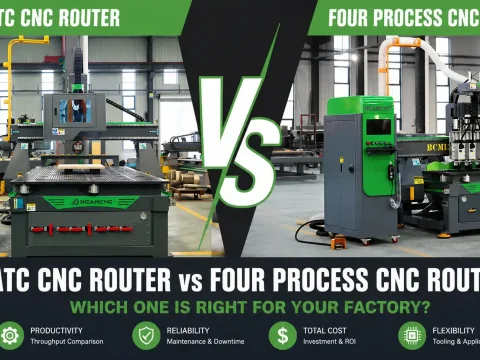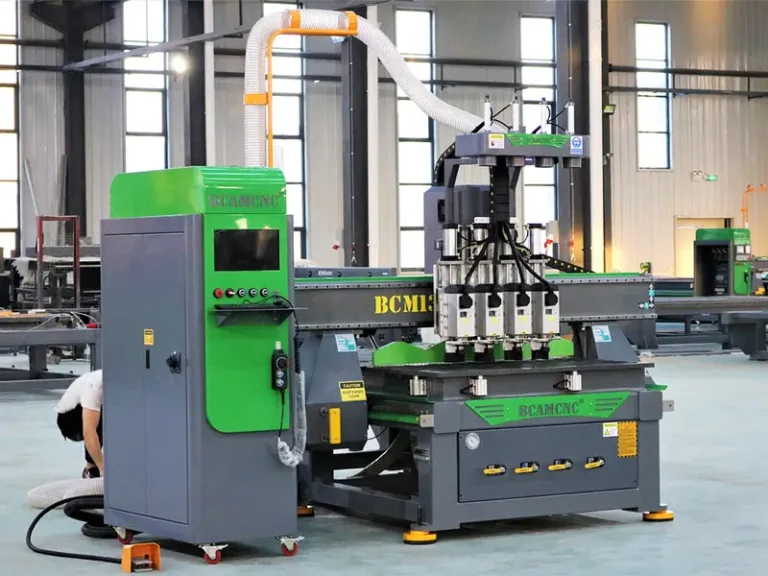

Choosing the right automatic tool changer (ATC) is a key decision when buying a CNC router for cabinet production. One of the most common questions from cabinet manufacturers is simple but important: how many tool positions are really needed for cabinet work?
The short answer is: most cabinet workshops work best with 6–12 tool positions, but the ideal number depends on your production scale, cabinet design, and workflow. This article explains how to choose the right ATC capacity and avoid overpaying—or under-configuring—your machine.
Why Tool Positions Matter in Cabinet Manufacturing
In cabinet production, multiple machining steps are usually completed in one program. These may include:
- Panel cutting
- Pocketing and grooving
- Drilling hinge holes
- Slotting for back panels
- Edge profiling or chamfering
Each operation requires a different tool. With an automatic tool changer, the CNC router switches tools automatically, saving time, reducing errors, and improving consistency.
Too few tool positions can slow production. Too many can increase cost without real benefits.
Typical Tools Used in Cabinet CNC Work
Before choosing an ATC capacity, it helps to understand the common tools used in cabinet making:
1.Straight cutting tools (6–12 mm)
2.Compression bits for laminated boards
3.Drill bits for hinges and dowels
4.Grooving tools for back panels
5.Chamfer or round-over tools
6.Optional engraving or labeling tools
Most standard cabinet jobs use 6 to 8 tools regularly.
Recommended Tool Positions by Workshop Type
1. Small Cabinet Workshops (6–8 Tool Positions)
For small or growing workshops focusing on custom cabinets:
- Handles most cabinet door and carcass jobs
- Lower machine cost
- Simple maintenance
- Ideal for MDF, plywood, and particle board
Best choice: 6 or 8-position linear or carousel ATC
2. Medium-Scale Production (8–12 Tool Positions)
For workshops running daily production with varied cabinet designs:
- Supports complex machining in one program
- Reduces manual tool changes to near zero
- Better efficiency for batch production
Best choice: 8–12 position carousel ATC CNC router
3. Large Factories & Automated Lines (12–16+ Tool Positions)
For large cabinet factories with nesting lines and flexible designs:
- Supports specialized tools
- Ideal for integrated drilling blocks
- Higher upfront cost
- Not necessary for most standard cabinet shops
Best choice: Only if you run high-volume, multi-style production
Is More Always Better? Not for Cabinet Work
Many buyers assume that more tool positions mean higher productivity. In reality:
- Extra tool holders increase cost
- Unused tools waste space
- Longer tool change cycles may occur
For cabinet manufacturing, efficiency comes from smart configuration, not maximum capacity.
ATC Type Also Matters
Besides tool quantity, the ATC structure affects performance:
- Linear ATC: cost-effective, simple, good for 6–8 tools
- Carousel ATC: faster tool change, ideal for 8–12 tools
- Drum ATC: used in advanced production lines
Choosing the right type ensures smooth cabinet production.
Final Recommendation: What Should You Choose?
For most cabinet manufacturers worldwide:
- 6–8 tool positions → small to mid-size workshops
- 8–12 tool positions → professional cabinet production
- 12+ tool positions → large automated factories only
If your CNC router is mainly used for panel furniture, kitchen cabinets, wardrobes, and office cabinets, an 8-tool or 10-tool ATC is usually the best balance of cost and performance.
Conclusion
So, how many tool positions should an automatic tool changer have for cabinet work?
For the majority of cabinet workshops, 8–12 tool positions are more than enough to handle daily production efficiently.
The key is matching the ATC configuration to your real machining needs—not chasing unnecessary specifications. A well-configured ATC CNC router will deliver faster cycles, stable quality, and long-term value for cabinet manufacturing.